Union Budget Aligns Education Ecosystem with Skill Development
Source:Indian Express ↗
Why It Matters
The analysis is relevant for UPSC aspirants as it connects macro-budgetary allocations with qualitative shifts in the education sector (GS Paper 2). It provides critical talking points on how policy alignment between education, skill development, and industry needs is necessary to overcome the employability crisis and leverage the demographic dividend.
Summary
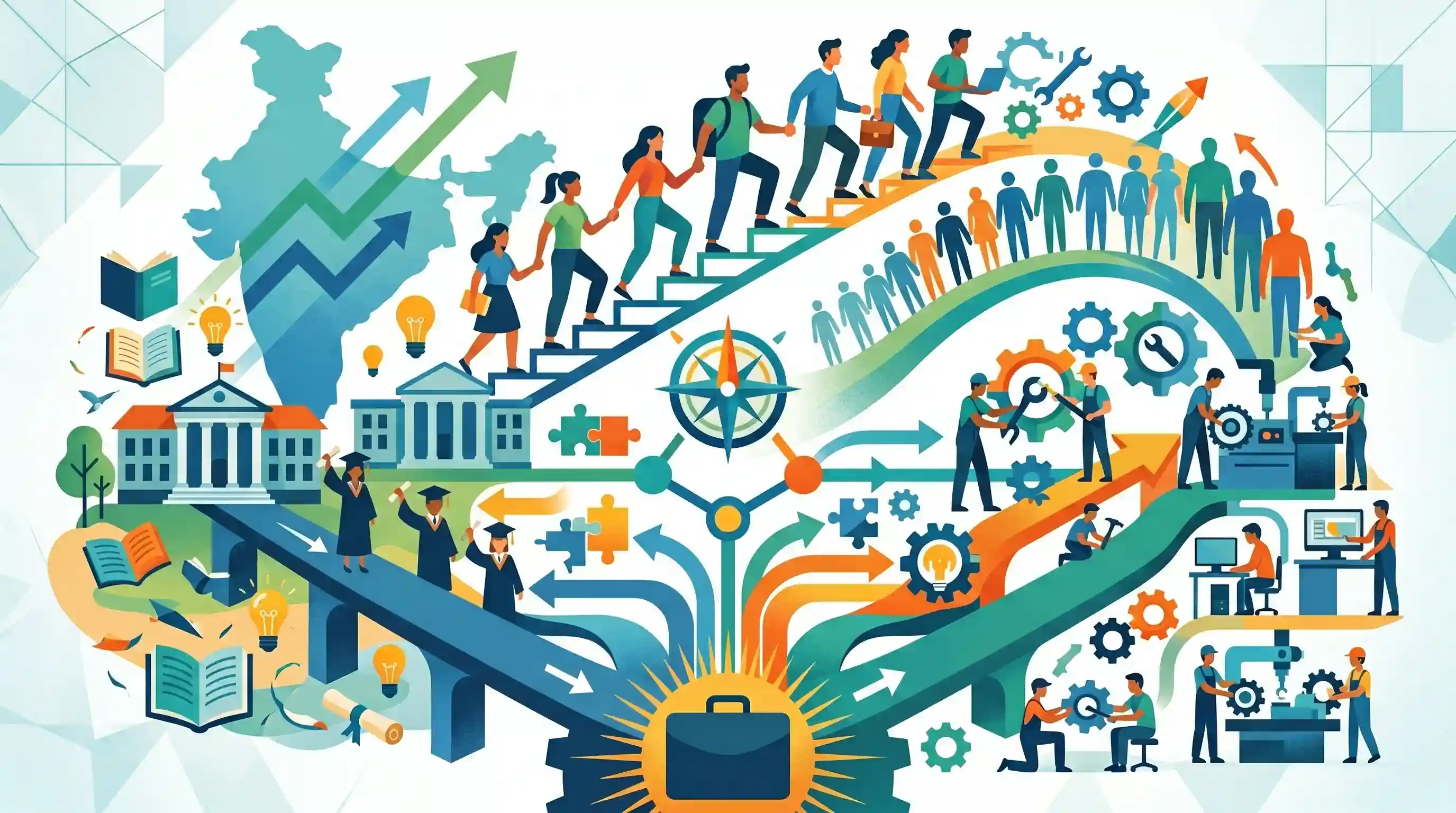
The article examines the Union Budget's approach to the education sector, arguing that the future of education is inherently interconnected. It applauds the budgetary focus on linking traditional higher education with skill development and employability, moving away from academic silos. This strategy aligns with the vision of the National Education Policy (NEP) 2020, aiming to create a holistic learning ecosystem. By emphasizing human capital formation and practical skills, the Budget attempts to address structural unemployability and maximize India's demographic dividend.
Key Points
- The article highlights the Union Budget's recognition of education as an interconnected ecosystem, linking academic learning with skill development and employment.
- It stresses that breaking academic silos and promoting multidisciplinary education is in alignment with the broader goals of the National Education Policy (NEP) 2020.
- Budgetary allocations and policies are reflecting a shift towards practical employability and human capital formation.
- Bridging the gap between traditional education and industry requirements is essential for India to harness its demographic dividend effectively.
Important Terms
National Education Policy (NEP) 2020

India's 21st-century pedagogical framework aiming for universal access, multidisciplinary learning, and vocational integration to transform the country into a global knowledge superpower.
UPSC context
GS Paper II (Social Justice/Education). Tests understanding of structural reforms, 5+3+3+4 structure, and vocational-academic convergence.
Union Budget
The constitutional annual financial statement (Article 112) detailing the government's estimated receipts and expenditure, serving as the primary tool for fiscal policy and sector-wise resource allocation.
UPSC context
GS Paper III (Economy). Tests fiscal policy, sectoral allocations, and government schemes for human resource development.
Ministry of Education (MoE)
The nodal agency for formulating and implementing national education policies, overseeing school education, literacy, and higher education to enhance India's intellectual capital.
UPSC context
GS Paper II (Governance). Relevant for institutional framework and the implementation of educational mandates like Samagra Shiksha.
Ministry of Skill Development and Entrepreneurship (MSDE)
A dedicated ministry formed to coordinate skilling efforts, bridge the demand-supply gap in the labor market, and oversee vocational training through ITIs and apprenticeship schemes.
UPSC context
GS Paper II & III. Tests convergence between education and employability, and flagship schemes like PMKVY.
Human Capital Formation
The process of increasing the stock of skilled, educated, and healthy individuals in a nation to enhance productive capacity and economic growth.
UPSC context
GS Paper III (Economy). Fundamental concept regarding the link between education, health, and national productivity.
Demographic Dividend
The economic growth potential resulting from a shift in a population's age structure, where the working-age population (15-64) is larger than the non-working-age group.
UPSC context
GS Paper I (Population) & III (Economy). Tests the ability to link education and skilling to economic advantages.
Prelims Trap
"NEP 2020 mandates the introduction of vocational education exclusively at the higher education level."
Under NEP 2020, vocational exposure actually begins much earlier, starting at the Middle Stage (from Grade 6 onwards) including bagless days and internships, not just in higher education.
Static Concepts Connected
How does Human Capital Formation differ from Human Development?
- Human Capital: Views education and health as strategic investments to increase labor productivity and economic output; humans are treated as a means to an economic end.
- Human Development: Considers human well-being as an end in itself. Education and health are valuable fundamental rights, regardless of their immediate impact on economic productivity.
What defines structural unemployment in the Indian context?
- Skills Mismatch: Occurs when the workforce lacks the specific practical skills required by emerging industries, a core issue addressed by linking higher education to vocational training.
- Chronic Nature: Unlike cyclical unemployment tied to temporary business cycles, it is long-term and requires foundational, structural shifts in a nation's educational and skilling ecosystem.
Cross-Topic Patterns
Demographic Dividend + SDG 4
Reaping India's demographic dividend depends entirely on achieving SDG 4 (Quality Education). Without bridging the industry skill gap, the youth bulge risks becoming a demographic burden.
Make in India + Skilling Ecosystem
The success of PLI schemes and advanced manufacturing relies heavily on an interconnected education system supplying shop-floor-ready workers, seamlessly bridging academic theory with industrial demands.

Expect a 2026 Mains essay or GS3 question linking NEP 2020's vocational integration directly to structural unemployability and PLI success.
Linked PYQs · 5
Linked PYQs · 5
- 2023MainsGS2
Skill development programmes have succeeded in increasing human resources supply to various sectors. In the context of the statement analyse the linkages between education, skill and employment.
- 2020MainsGS2
National Education Policy 2020 is in conformity with the Sustainable Development Goal-4 (2030). It intends to restructure and reorient education system in India. Critically examine the statement.
- 2021MainsGS2
“Earn while you learn' scheme needs to be strengthened to make vocational education and skill training meaningful.” Comment.
- 2023MainsGS2
The crucial aspect of development process has been the inadequate attention paid to Human Resource Development in India. Suggest measures that can address this inadequacy.
- 2014MainsGS3
While we flaunt India's demographic dividend, we ignore the dropping rates of employability. What are we missing while doing so? Where will the jobs that India desperately needs come from? Explain.
