Fiscal Sustainability and Economic Costs of Cash Transfer Schemes
Source:The Hindu ↗
Why It Matters
Crucial for GS-3 (Economy, Budgeting, and Fiscal Policy) as it highlights the recurring policy dilemma between funding populism/welfare cash transfers and maintaining fiscal prudence, capital expenditure, and debt sustainability.
Summary
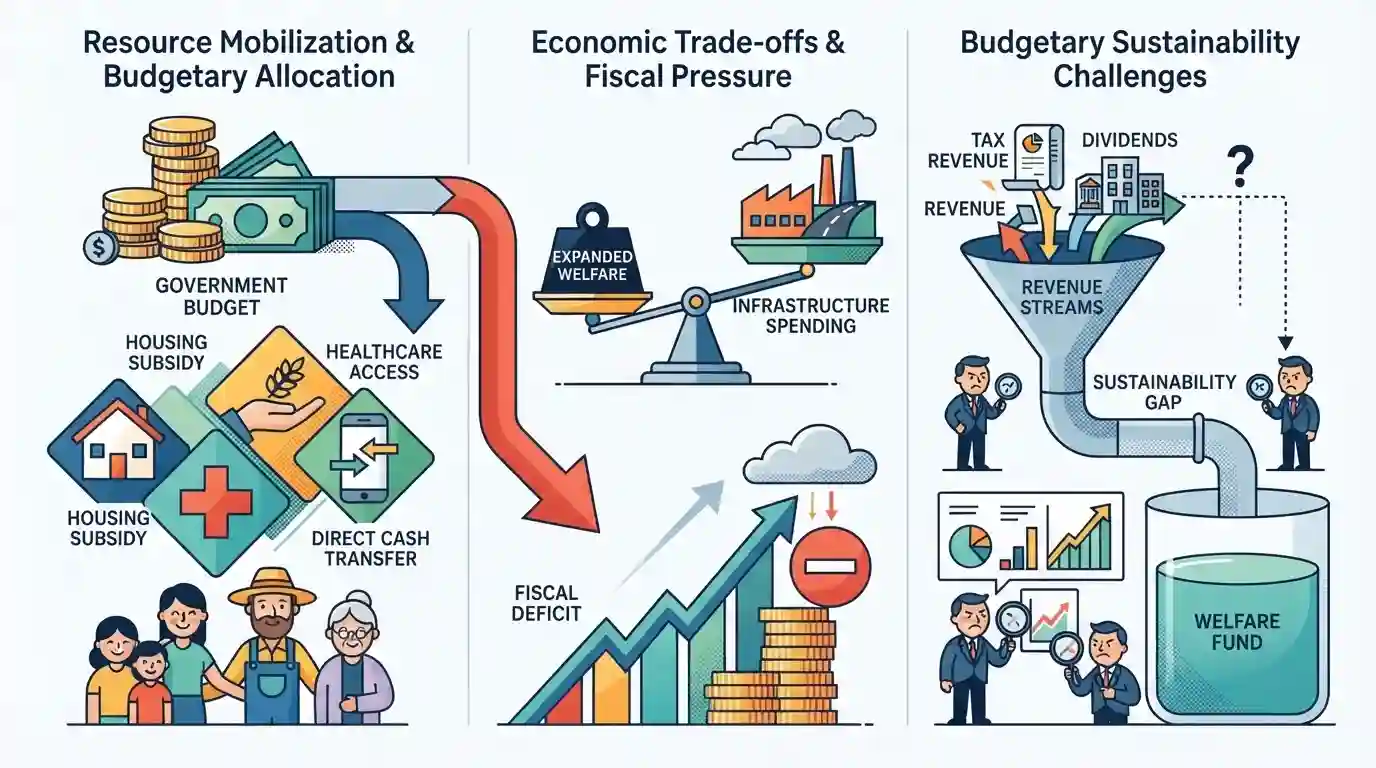
The article explores the fiscal implications, economic trade-offs, and budgetary sustainability challenges associated with expanding cash-transfer schemes and welfare programs in India.
Key Points
- Cash transfer schemes and targeted welfare programs impose significant burdens on state and national fiscal balances.
- Unfunded welfare promises can crowd out critical capital expenditure on infrastructure and long-term developmental projects.
- Balancing social welfare mandates with fiscal prudence is critical for maintaining macroeconomic stability and sustainable debt levels.
- Re-evaluating targeting mechanisms helps optimize resource allocation and prevent structural fiscal deficits.
Prelims Trap
Cash-transfer schemes and direct benefit transfers are categorized under Capital Expenditure as they inject liquidity directly into the economy.
Aspirants often assume cash-transfer schemes are classified under Capital Expenditure because they involve financial outflows, whereas they are strictly classified as Revenue Expenditure since they create no tangible or intangible assets.
Static Concepts Connected
What is the difference between Revenue Expenditure and Capital Expenditure in the Union Budget?
- Revenue Expenditure:: Expenses that neither create assets nor reduce liabilities (e.g., salaries, interest payments, subsidies, and cash transfers).
- Capital Expenditure:: Expenses that create physical/financial assets or reduce financial liabilities (e.g., infrastructure, machinery, loans repaid).
- Fiscal Impact:: High revenue deficit indicates borrowing for consumption rather than asset creation, eroding long-term fiscal health.
What are the core mandates and thresholds under the FRBM Act, 2003?
- Objective:: Enacted to institutionalize financial discipline, reduce fiscal deficit, and macroeconomic stability.
- Deficit Targets:: Targeted eliminating revenue deficit and capping fiscal deficit at 3% of GDP (though amended periodically based on economic shocks).
- Debt Management:: Mandates debt consolidation and transparency through medium-term fiscal policy statements.
Cross-Topic Patterns
Welfare Schemes vs. Capital Expenditure Trade-offs
Unfunded populist cash-transfers directly compete with capital expenditure allocations, testing the FRBM Act targets and states' fiscal deficit limits (Fiscal Responsibility and Budget Management).
Revenue Expenditure Compression of Developmental CapEx
Excessive revenue expenditure on subsidies and doles crowds out states' investments in human capital (health and education) and physical infrastructure.

FRBM targets + fiscal deficit + revenue vs. capital expenditure trade-off likely to feature in GS-3 Mains or a conceptual Prelims Q.
Linked PYQs · 2
Linked PYQs · 2
- 2015MainsGS3
In what way could replacement of price subsidy with Direct Benefit Transfer (DBT) change the scenario of subsidies in India ? Discuss.
- 2025MainsGS3
Explain how the Fiscal Health Index (FHI) can be used as a tool for assessing the fiscal performance of states in India. In what way would it encourage the states to adopt prudent and sustainable fiscal policies?
