State Genocide Conviction and International Law Implications
Source:The Hindu ↗
Why It Matters
This topic is crucial for UPSC Civil Services Examination GS Paper 2 under International Relations and International Law, specifically regarding the functioning of UN bodies, ICJ rulings, state accountability, and global human rights enforcement.
Summary
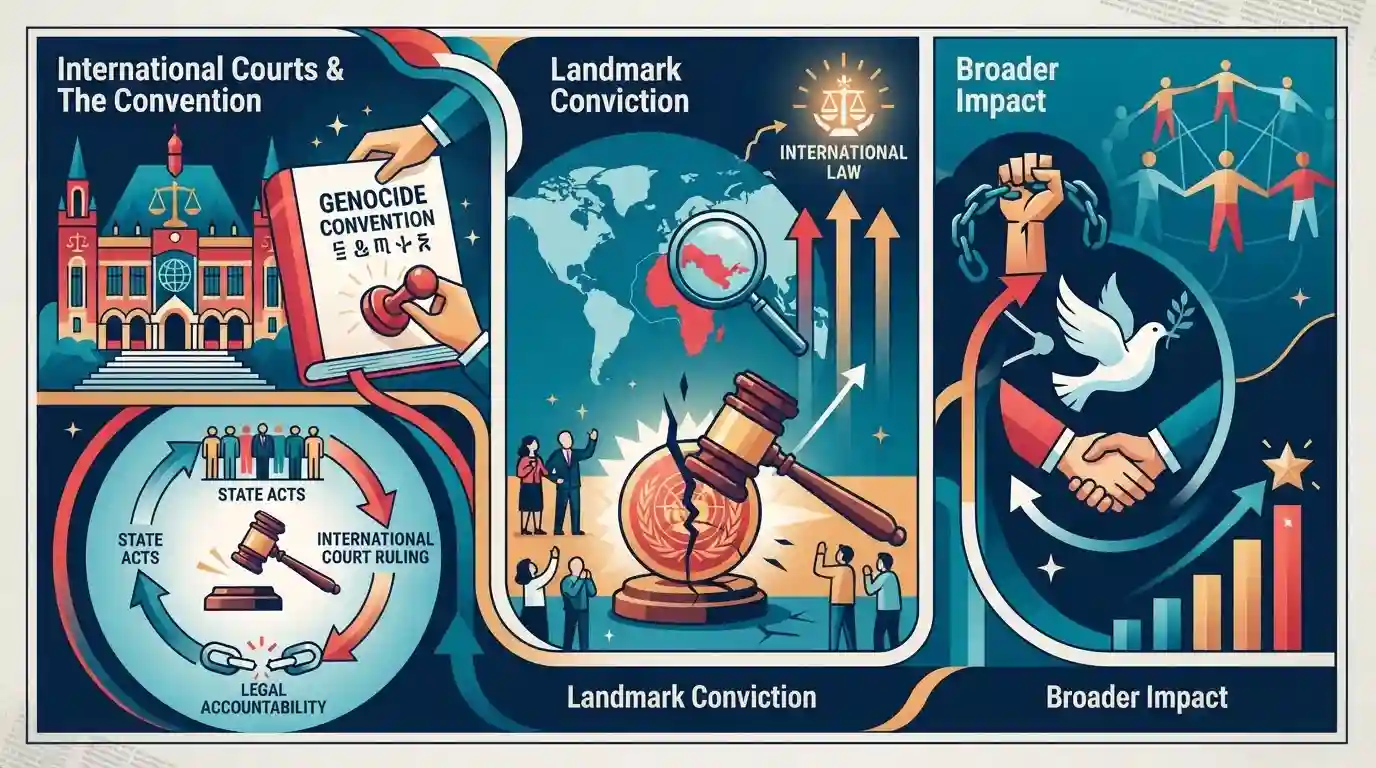
The article examines the landmark implications of the first-ever genocide conviction of a state under international law. It analyzes the role of international courts like the ICJ, the mechanics of holding sovereign nations accountable under the Genocide Convention, and the broader impact of such rulings on global human rights enforcement and international diplomacy.
Key Points
- The article discusses the historical significance of the first genocide conviction of a state under international law.
- Examines the jurisdiction, role, and limitations of international judicial bodies like the International Court of Justice (ICJ) in holding sovereign states accountable for state-sponsored atrocities.
- Highlights the challenges in enforcing international humanitarian law and the Genocide Convention against powerful states.
- Analyzes the implications of state responsibility for human rights violations on global governance and international relations.
Important Terms
Genocide Convention

A 1948 landmark international treaty adopted by the UN General Assembly that codifies genocide as a crime under international law and obligates state parties to prevent and punish it.
UPSC context
Important for GS Paper II (International Relations / International Conventions) and understanding global human rights accountability mechanisms.
International Court of Justice (ICJ)
The principal judicial organ of the United Nations, located in The Hague, which settles legal disputes between sovereign states and issues advisory opinions.
UPSC context
Important for GS Paper II under International Institutions, bodies and fora, their structure and mandate.
United Nations (UN)
An international organization founded in 1945 to maintain international peace and security, develop friendly relations, and promote international cooperation.
UPSC context
Important for GS Paper II covering important international institutions, multilateral bodies, and global governance frameworks.
Prelims Trap
The International Court of Justice convicted individual political leaders for war crimes under the Genocide Convention.
Aspirants often confuse the ICJ with the ICC. The ICJ tries sovereign *states* for state responsibility under treaties, whereas the ICC tries *individuals* for criminal accountability.
Static Concepts Connected
What is the difference in jurisdiction and mandate between the ICJ and the ICC?
- Primary Mandate: ICJ jurisdiction covers disputes between sovereign states and gives advisory opinions to UN organs; ICC tries individuals for war crimes, crimes against humanity, and genocide.
- Legal Basis: ICJ derives authority from the UN Charter and Statute of the Court; ICC is an independent treaty-based body governed by the Rome Statute.
- Enforcement: ICJ issues binding judgments on states backed by the UN Security Council; ICC issues arrest warrants and tries individual perpetrators.
What does the legal doctrine of erga omnes partes mean in international law?
- Core Meaning: Obligations owed by a state party to all other parties in a multilateral treaty, protecting common values and collective interests.
- Standing to Sue: Allows any state party to invoke responsibility for breaches even if it has not suffered direct material injury, as seen in The Gambia v. Myanmar.
Cross-Topic Patterns
Erga Omnes Partes & Universal Jurisdiction
The ICJ's reliance on erga omnes partes obligations allows non-injured states like The Gambia to sue perpetrators, paralleling universal jurisdiction principles in international criminal law.
ICJ vs ICC: State vs Individual Liability
State accountability at the ICJ operates alongside individual criminal liability at the ICC, showing how international tribunals tackle dual layers of atrocity crimes.

ICJ state liability vs ICC individual accountability + erga omnes partes principle likely to be tested in a multi-statement prelims Q.
Linked PYQs · 2
Linked PYQs · 2
- 2024MainsGS2
‘Terrorism has become a significant threat to global peace and security.’ Evaluate the effectiveness of the United Nations Security Council's Counter Terrorism Committee (CTC) and its associated bodies in addressing and mitigating this threat at the international level.
- 2025MainsGS2
"The reform process in the United Nations remains unresolved, because of the delicate imbalance of East and West and entanglement of the USA vs. Russo-Chinese alliance.” Examine and critically evaluate the East-West policy confrontations in this regard.
