Neonatal Resuscitation Program and Child Mortality Reduction
Source:The Hindu ↗
Why It Matters
Neonatal mortality constitutes a major chunk of India's overall Infant Mortality Rate (IMR). Understanding the structural interventions (like the NRP, INAP, and NSSK) and capacity-building of primary healthcare workers is essential for GS Paper 2 questions on social sector schemes, public health infrastructure, and human development.
Summary
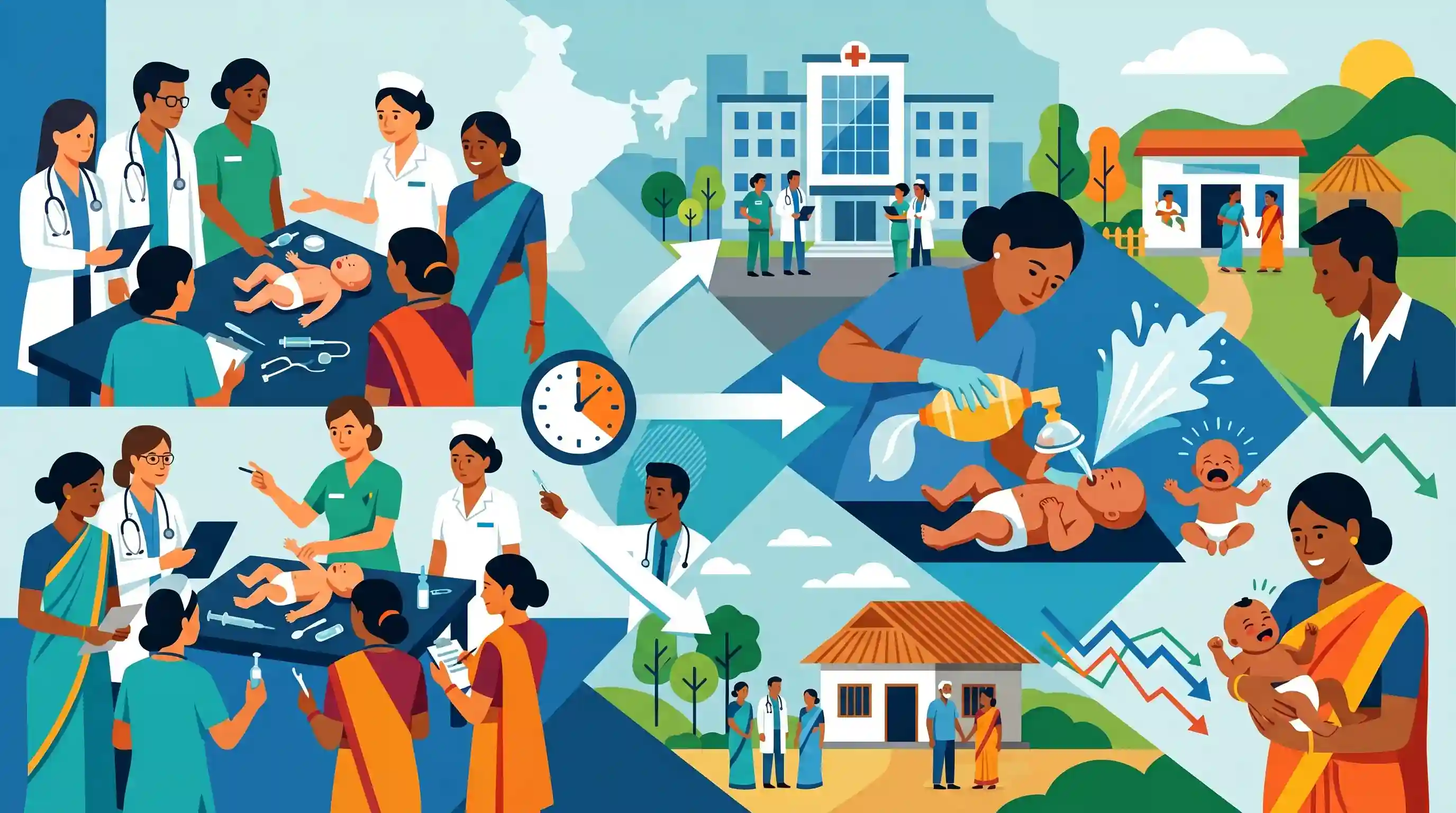
The article highlights the significance of the Nationwide Neonatal Resuscitation Program (NRP) Day 2026, focusing on the urgent need to scale up resuscitation training for healthcare professionals across India. Birth asphyxia remains a leading cause of neonatal mortality. By training doctors, nurses, and frontline health workers in primary and rural health centres to assist newborns in taking their 'first breath', India can dramatically reduce its Neonatal Mortality Rate (NMR). This initiative is a vital component of maternal and child public healthcare, aligning with broader goals like the India Newborn Action Plan and the SDGs to ensure child survival.
Key Points
- The nationwide Neonatal Resuscitation Program (NRP) Day 2026 aims to scale up specialized training for healthcare workers to ensure safe newborn deliveries and reduce birth asphyxia.
- Capacity building of nurses, midwives, and primary healthcare staff is a core pillar, equipping them to help newborns take their 'first breath' immediately after delivery.
- Addressing neonatal mortality (deaths within the first 28 days) is the most critical hurdle in further reducing India's Infant Mortality Rate (IMR), as neonatal deaths account for the majority of infant mortality.
- Scaling resuscitation skills at the grassroots level ties into broader public health goals, including Sustainable Development Goal (SDG) targets for child survival and maternal healthcare integration.
Important Terms
India Newborn Action Plan (INAP)

A strategic framework launched in 2014 aiming to achieve 'Single Digit Neonatal Mortality' and 'Single Digit Stillbirth Rate' (fewer than 10 per 1,000) by 2030 through integrated life-cycle interventions.
UPSC context
GS Paper II: Government policies and health; tests knowledge of national targets for child survival and SDG 3 alignment.
Navjaat Shishu Suraksha Karyakram (NSSK)
A Ministry of Health initiative launched in 2009 to train healthcare providers (doctors, nurses, ANMs) in basic newborn care and resuscitation to reduce mortality at the time of birth.
UPSC context
GS Paper II: Issues relating to Health and Human Resources; tests awareness of frontline health capacity-building schemes.
Neonatal Resuscitation Program (NRP)
A global training curriculum, implemented in India by the NNF and IAP, designed to teach birth attendants clinical skills for newborn resuscitation, specifically during the 'golden minute.'
UPSC context
GS Paper II: Social Justice/Health; tests understanding of public-private partnerships and specialized clinical training in public health.
Neonatal Mortality Rate (NMR)
The probability of a child dying during the first 28 completed days of life per 1,000 live births; it is a critical indicator of maternal and newborn care quality.
UPSC context
GS Paper II: Health Indicators; essential for analyzing demographic trends and progress toward Sustainable Development Goal 3.2.
Birth Asphyxia
A medical condition resulting from oxygen deprivation to a newborn during birth; it is one of the leading preventable causes of neonatal death in India.
UPSC context
GS Paper II: Health; tests understanding of specific clinical challenges that impact large-scale public health outcomes and mortality targets.
Indian Academy of Pediatrics (IAP)
The largest association of pediatricians in India, serving as a key technical and implementation partner for national health programs targeting infant and child mortality.
UPSC context
GS Paper II: Role of civil society and professional bodies in governance and health service delivery.
Prelims Trap
Neonatal mortality accounts for infant deaths occurring within the first year of birth.
Neonatal mortality strictly counts deaths within the first 28 days of life. Infant mortality covers the full first year. UPSC frequently swaps these in statements.
Static Concepts Connected
How are standard child mortality indicators defined in Indian public health?
- Neonatal Mortality (NMR): Number of deaths within the first 28 days of life per 1,000 live births.
- Infant Mortality (IMR): Number of deaths occurring before the age of one year per 1,000 live births.
- Under-5 Mortality (U5MR): Probability of a child dying between birth and exactly 5 years of age per 1,000 live births.
What are the core targets of the India Newborn Action Plan (INAP)?
- Single Digit Targets: Aims to achieve a single-digit Neonatal Mortality Rate (NMR under 10) and single-digit Stillbirth Rate by 2030.
- SDG 3.2 Alignment: INAP's national target is more ambitious than the global SDG 3.2 target (12 or fewer per 1,000).
- Targeted Causes: Prematurity, low birth weight, and birth asphyxia, tackled through programs like Navjaat Shishu Suraksha Karyakram.
Cross-Topic Patterns
Frontline health worker capacity
NRP's reliance on training primary care staff highlights the crucial GS2 theme of empowering ASHA and ANM workers to bridge systemic rural healthcare gaps.
Domestic targets vs Global SDGs
India's INAP targets an NMR under 10, compared to the SDG target of 12. UPSC often tests frameworks where domestic Indian goals outpace global targets.

Expect a 2026 Prelims question contrasting INAP's single-digit NMR targets with SDG 3.2, alongside exact definitions of NMR vs IMR.
Linked PYQs · 5
Linked PYQs · 5
- 2009PrelimsGS1
Consider the following statements: 1. Infant mortality rate takes into account the death of infants within a month after birth. 2. Infant mortality rate is the number of infant deaths in a particular year per 100 live births during that year. Which of the above statements is/are correct?
- 2023PrelimsGS1
Consider the following statements in relation to Janani Suraksha Yojana: 1. It is a safe motherhood intervention of the State Health Departments. 2. Its objective is to reduce maternal and neonatal mortality among poor pregnant women. 3. It aims to promote institutional delivery among poor pregnant women. 4. Its objective includes providing public health facilities to sick infants up to one year of age. How many of the statements given above are correct?
- 2020MainsGS2
In order to enhance the prospects of social development, sound and adequate health care policies are needed particularly in the fields of geriatric and maternal health care. Discuss.
- 2021MainsGS2
“Besides being a moral imperative of a Welfare State, primary health structure is a necessary precondition for sustainable development.” Analyze.
- 2024MainsGS2
In a crucial domain like the public healthcare system the Indian State should play a vital role to contain the adverse impact of marketisation of the system. Suggest some measures through which the State can enhance the reach of public healthcare at the grassroots level.
