Global Trade Shifts from Neoliberal Washington Consensus to State Aid
Source:The Hindu ↗
Why It Matters
Understanding the shift from the Washington Consensus to a state-interventionist model is crucial for UPSC aspirants, as it directly impacts global macroeconomic stability, international trade architectures (WTO), and India's own industrial and foreign policies in an era of deglobalization.
Summary
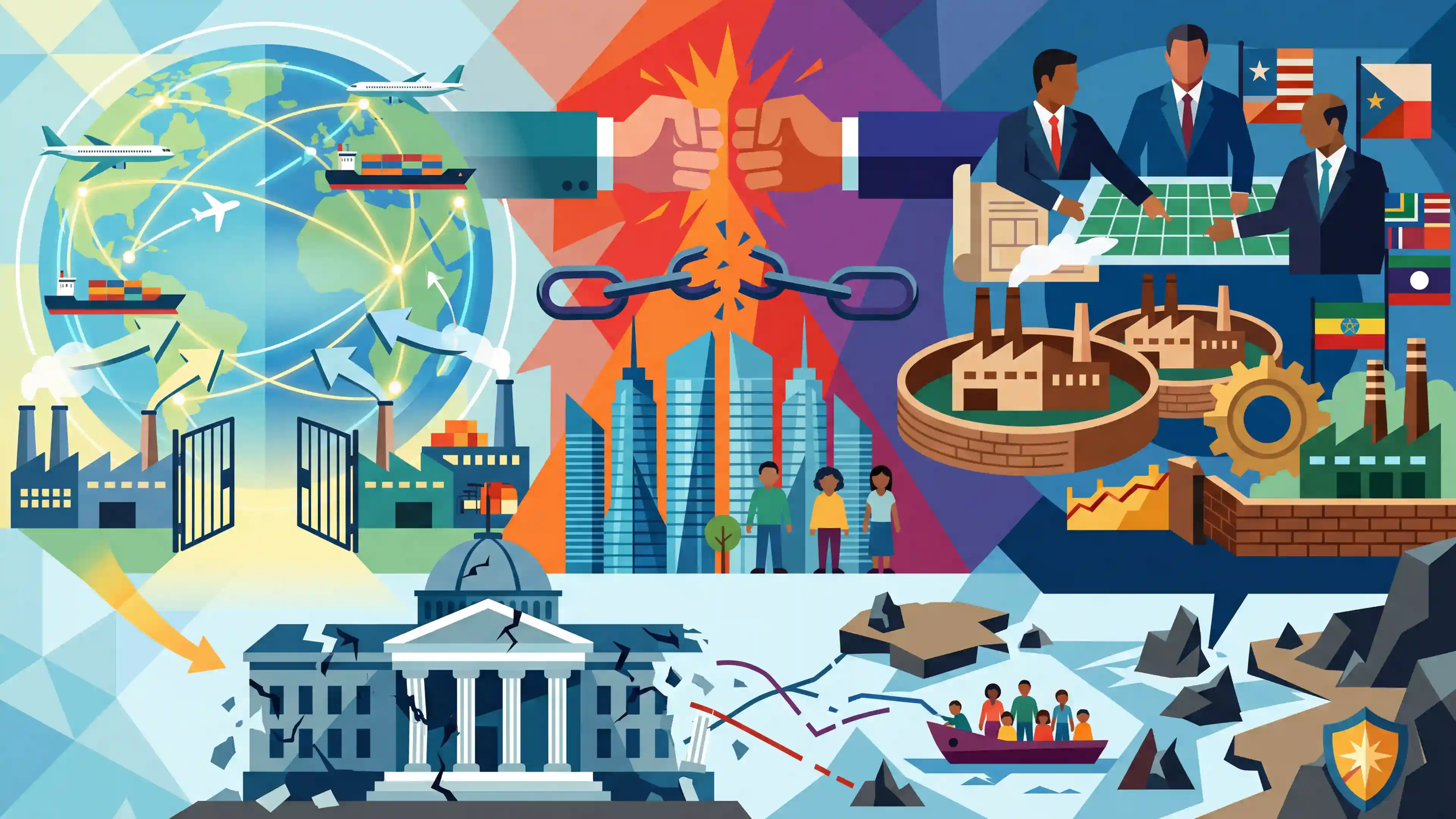
The article examines the decline of the 'Washington Consensus'—a longstanding neoliberal economic paradigm characterized by free markets, deregulation, and fiscal discipline. It highlights how growing geopolitical tensions, supply chain vulnerabilities, and domestic inequalities have led to the emergence of a 'New Washington Consensus'. This new approach heavily favors state intervention, industrial policy, and protectionism over unfettered globalization. Consequently, the multilateral trading system, underpinned by institutions like the WTO, is under immense strain, forcing developing economies to navigate a more fragmented and inward-looking global economic landscape.
Key Points
- The 'Washington Consensus', which championed free markets, deregulation, and trade liberalization, is increasingly being replaced by a 'New Washington Consensus' focused on state intervention.
- Geopolitical fragmentation, particularly the US-China rivalry, has driven a shift away from economic efficiency towards supply chain security and national self-reliance.
- Major economies are increasingly adopting industrial policies and protectionist measures, such as subsidies and tariffs, challenging the rules-based multilateral trading system.
- The World Trade Organization (WTO) faces an existential crisis as nations bypass multilateral agreements in favor of national security exemptions and bilateral deals.
- Developing nations face new challenges in this protectionist environment, requiring them to recalibrate their economic strategies to navigate deglobalization and secure foreign investment.
Important Terms
Washington Consensus

A set of 10 neoliberal policy prescriptions (e.g., privatization, deregulation, fiscal discipline) advocated by the IMF and World Bank for crisis-hit developing nations since 1989.
UPSC context
GS Paper 3: Effects of liberalization; tests understanding of global economic paradigms and India's 1991 reforms.
New Washington Consensus
A modern economic framework prioritizing industrial policy, state intervention, and supply-chain resilience over unfettered free trade to address inequality, climate change, and geopolitical competition.
UPSC context
GS Paper 2/3: International relations and industrial policy; tests impact of developed nation policies on India's interests.
World Trade Organization (WTO)
A global body of 164 members that regulates international trade, aims to lower barriers, and provides a legal framework for resolving trade disputes.
UPSC context
GS Paper 3: Important international institutions; tests knowledge of multilateral trade governance and contemporary challenges like protectionism.
International Monetary Fund (IMF)
An international organization that promotes global monetary cooperation, financial stability, and provides temporary financial assistance to countries facing balance-of-payments crises.
UPSC context
GS Paper 2: International institutions; tests understanding of global financial governance and economic stability mechanisms.
World Bank
An international financial institution providing long-term loans and grants to low- and middle-income countries for development projects aimed at poverty reduction and infrastructure.
UPSC context
GS Paper 2: International institutions; focuses on development assistance and global economic governance structures.
Prelims Trap
The 'New Washington Consensus' aims to strengthen the WTO and expand multilateral free trade agreements.
The 'New' consensus actually advocates for state intervention, industrial policy, and protectionism (like friend-shoring), marking a clear departure from unfettered multilateral free trade.
Static Concepts Connected
What were the core pillars of the original Washington Consensus (1989)?
- Fiscal discipline: Strict limits on government borrowing and deficit spending to maintain macroeconomic stability.
- Market deregulation: Removing barriers to entry and exit, and privatizing state-owned enterprises to boost market efficiency.
- Trade liberalization: Slashing import tariffs, eliminating quotas, and removing restrictions on Foreign Direct Investment (FDI).
What are the key exemptions to the WTO's Most-Favored-Nation (MFN) principle?
- Regional Trade Agreements: Members in FTAs or Customs Unions can grant each other preferential, lower tariffs under Article XXIV.
- GSP Allowances: Developed countries can offer non-reciprocal preferential tariff treatment to developing and least-developed nations.
- Security Exceptions: Article XXI permits members to breach WTO obligations if necessary to protect essential national security interests.
Cross-Topic Patterns
Atmanirbhar Bharat & Global Industrial Policy
The global shift away from pure free markets conceptually legitimizes India's Production Linked Incentive (PLI) schemes, framing them as part of a wider global 'de-risking' and supply chain resilience trend.
WTO Appellate Body Paralysis
The U.S. block on WTO judges ties directly into this 'New Consensus', as major powers increasingly prefer unilateral tariffs and national security exemptions over multilateral dispute resolution.

Expect a Mains GS3 question contrasting the 1991 LPG reforms (old consensus) with India's current Atmanirbhar Bharat (new consensus).
Linked PYQs · 4
Linked PYQs · 4
- 2025MainsGS2
"With the waning of globalization, post-Cold War world is becoming a site of sovereign nationalism.” Elucidate.
- 2018MainsGS2
What are the key areas of reform if the WTO has to survive in the present context of "Trade War', especially keeping in mind the interest of India?
- 2016MainsGS2
The broader aims and objectives of WTO are to manage and promote international trade in the era of globalization. But the Doha round of negotiations seem doomed due to differences between the developed and the developing countries." Discuss in the Indian perspective.
- 2023PrelimsGS1
Consider the following statements: Statement-I: Recently, the United States of America (USA) and the European Union (EU) have launched the 'Trade and Technology Council'. Statement-II: The USA and the EU claim that through this they are trying to bring technological progress and physical productivity under their control. Which one of the following is correct in respect of the above statements?
