Evolution and Current Status of Environmental Jurisprudence
Source:The Hindu ↗
Why It Matters
The evolution of environmental jurisprudence is a key theme in both GS2 (Judiciary, Governance) and GS3 (Conservation, Environmental Pollution). Aspirants must understand the balance between development and environmental protection, the role of statutory bodies like NGT, and the implications of diluting environmental laws.
Summary
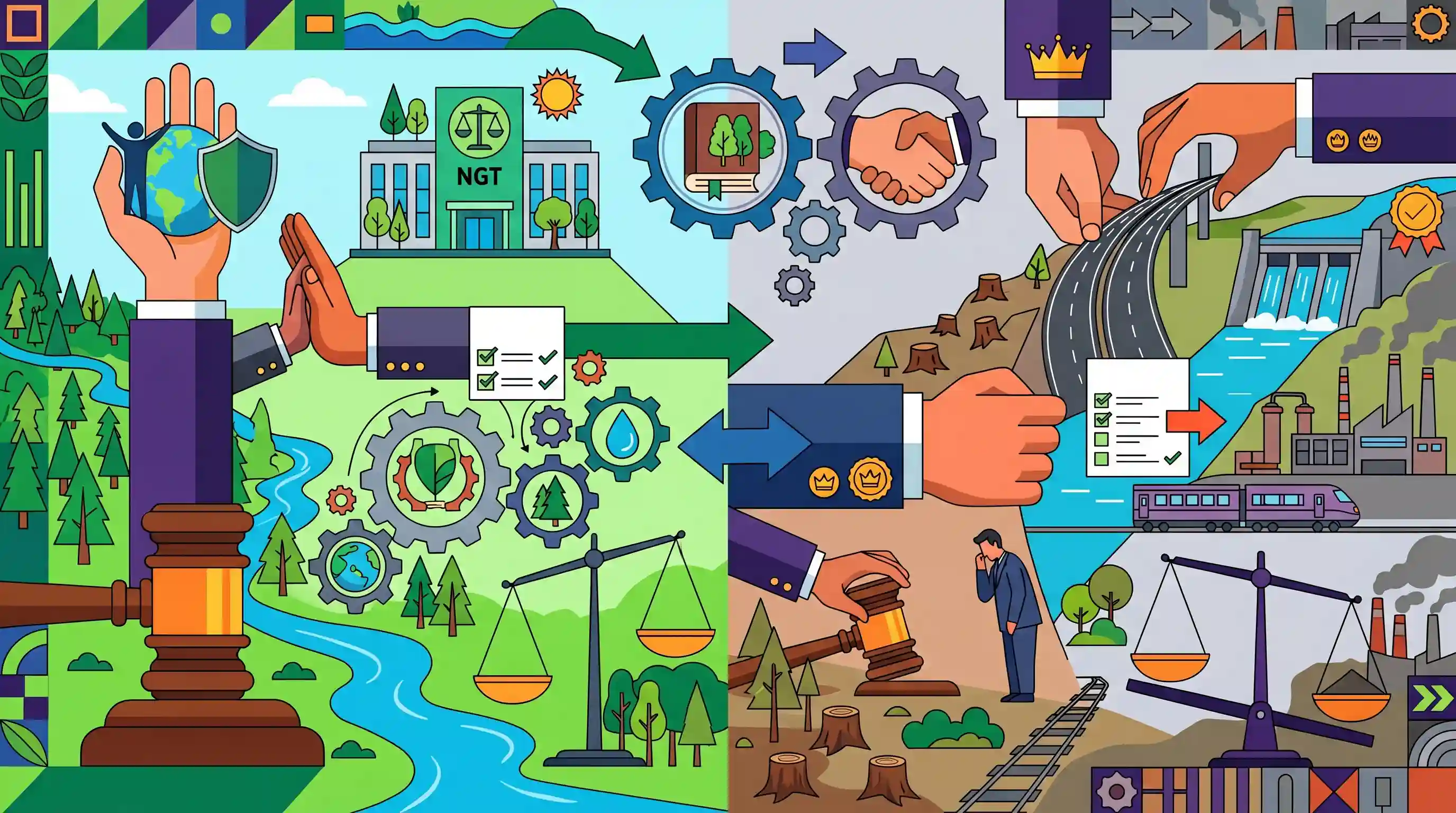
The article critically examines the fading legacy of India's environmental jurisprudence, once globally renowned for its proactive judicial interventions. Historically, the Supreme Court and the National Green Tribunal (NGT) championed ecological rights by interpreting the right to a healthy environment under Article 21 of the Constitution. However, recent trends indicate a systemic dilution of this legacy. Through legislative changes like the Forest (Conservation) Amendment Act and the easing of Environmental Impact Assessment (EIA) norms, the executive has centralized power to fast-track development and infrastructure projects. Concurrently, the judiciary has displayed increased deference to the executive, pulling back from its previously robust activist approach. This shift threatens the institutional frameworks designed to balance economic growth with environmental sustainability.
Key Points
- India's environmental jurisprudence, historically defined by proactive Supreme Court interventions and the expansion of Article 21 to include the right to a healthy environment, is experiencing a decline.
- Recent legislative amendments, such as the Forest (Conservation) Amendment Act and the Biological Diversity (Amendment) Act, have systematically diluted environmental safeguards to facilitate easier project clearances.
- The Environmental Impact Assessment (EIA) framework has been progressively weakened, reducing the scope of public participation and critical ecological scrutiny for infrastructure and industrial projects.
- The judiciary, including the National Green Tribunal (NGT), has demonstrated increased restraint and deference to the executive branch on developmental projects, shifting away from its earlier activist stance on environmental protection.
Important Terms
National Green Tribunal (NGT)

A specialized statutory body established under the NGT Act 2010 for the effective and expeditious disposal of cases related to environmental protection and forest conservation.
UPSC context
GS Paper II (Statutory Bodies) & III (Environment). Tests quasi-judicial mechanisms and environmental justice.
Forest (Conservation) Amendment Act, 2023
A legislative update to the 1980 Act that exempts strategic national security projects within 100km of borders and limits the Act's applicability to land recorded as forest.
UPSC context
GS Paper III (Forestry/Environment). Tests critical analysis of development versus conservation trade-offs.
Environmental Impact Assessment (EIA) Notification
A statutory process evaluating a project's potential environmental impact. Recent 2020 draft updates sparked controversy over post-facto clearances and reduced public consultation periods.
UPSC context
GS Paper III (Environment). Core for questions on sustainable development and the Precautionary Principle.
Environment (Protection) Act, 1986
India's 'umbrella' environmental law passed in 1986 (post-Bhopal tragedy). It empowers the Central Government to coordinate environmental protection and set national pollution standards.
UPSC context
GS Paper III (Environment). Fundamental legal framework for air, water, and waste regulation.
Biological Diversity (Amendment) Act, 2023
A 2023 law amending the 2002 Act to facilitate the AYUSH industry and decriminalize offenses, aiming to simplify access to biological resources and traditional knowledge.
UPSC context
GS Paper III (Biodiversity). Tests knowledge of the Nagoya Protocol and commercial-ecological balance.
Supreme Court of India (Environmental Jurisprudence)
The Court has proactively shaped environmental jurisprudence by interpreting Article 21 (Right to Life) to include the right to a clean and healthy environment.
UPSC context
GS Paper II (Polity). Tests judicial activism and the expansion of fundamental rights.
Prelims Trap
"The Right to a Healthy Environment is explicitly codified as a Fundamental Right under Article 21."
It is a trap because the judiciary read the environment into Article 21. Only DPSP (Art 48A) and Fundamental Duties (Art 51A) explicitly mention environmental protection in the original constitutional text.
Static Concepts Connected
What is the statutory basis and jurisdiction of the National Green Tribunal (NGT)?
- Statutory Body: Established under the NGT Act 2010 for effective and expeditious disposal of cases relating to environmental protection and conservation of forests.
- Natural Justice: It is not bound by the procedural rules of the Code of Civil Procedure, 1908, but is guided by the principles of natural justice.
- Suo Motu Powers: The Supreme Court has affirmed that the NGT holds suo motu powers to initiate proceedings on critical environmental issues, contrary to typical tribunals.
What is the legal framework for Environmental Impact Assessment (EIA) in India?
- Statutory Backing: EIA derives its statutory backing from the Environment (Protection) Act, 1986, which allows the Central Government to restrict industries on ecological grounds.
- Public Consultation: A mandatory stage allowing local affected persons and plausible stakeholders to express concerns regarding project impacts, often the target of recent dilutions.
Cross-Topic Patterns
Judicial Restraint vs Separation of Powers
The NGT's shift from activism to deference highlights the evolving separation of powers, where courts increasingly yield to the executive on complex socio-economic and developmental policies.
Border Infrastructure vs Forest Clearances
Exempting land within 100km of borders under the Forest Conservation Amendment Act ties environmental governance directly to internal security mandates and LAC infrastructure building.

Expect a multi-statement Prelims question evaluating the 2023 Forest and Biodiversity Act exemptions alongside NGT's statutory limits.
Linked PYQs · 5
Linked PYQs · 5
- 2022MainsGS2
“The most significant achievement of modern law in India is the constitutionalization of environmental problems by the Supreme Court.” Discuss this statement with the help of relevant case laws.
- 2020MainsGS3
How does the draft Environment Impact Assessment (EIA) Notification, 2020 differ from the existing EIA Notification, 2006?
- 2024MainsGS3
What role do environmental NGOs and activists play in influencing Environmental Impact Assessment (EIA) outcomes for major projects in India? Cite four examples with all important details.
- 2018PrelimsGS1
How is the National Green Tribunal (NGT) different from the Central Pollution Control Board (CPCB)? 1. The NGT has been established by an Act whereas the CPCB has been created by an executive order of the Government. 2. The NGT provides environmental justice and helps reduce the burden of litigation in the higher courts whereas the CPCB promotes cleanliness of streams and wells, and aims to improve the quality of air in the country. Which of the statements given above is/are correct?
- 2019PrelimsGS1
Consider the following statements : The Environment Protection Act, 1986 empowers the Government of India to 1. state the requirement of public participation in the process of environmental protection, and the procedure and manner in which it is sought 2. lay down the standards for emission or discharge of environmental pollutants from various sources Which of the statements given above is/are correct?
