Evolution of Free Trade Agreements and Non-Tariff Regulatory Barriers
Source:The Hindu ↗
Why It Matters
With India actively negotiating FTAs with major trading blocs like the EU and the UK, understanding the transition from traditional tariff-based agreements to those including labor, environment, and digital trade is highly crucial for Mains GS2 (International Relations) and GS3 (Economy) answers.
Summary
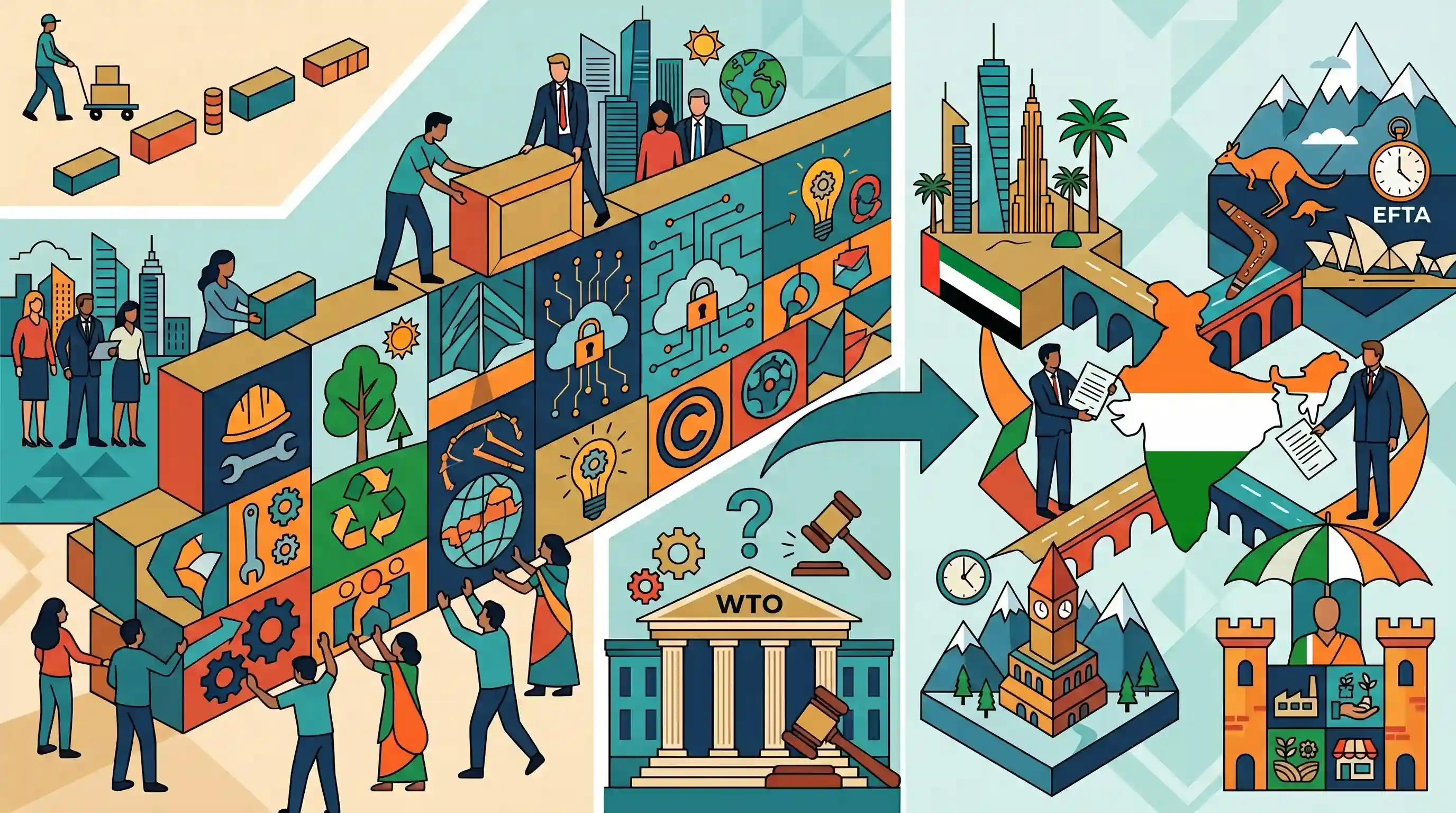
The landscape of international trade has shifted significantly from simple tariff-reduction pacts to deep integration models like Comprehensive Economic Partnership Agreements. Modern Free Trade Agreements (FTAs) increasingly incorporate non-trade issues (NTIs) such as labor standards, environmental compliance, digital trade, and intellectual property rights, often driven by the Global North to ensure a 'level playing field.' Developing countries argue these stringent standards act as non-tariff barriers that undermine their comparative advantages. In response to the stalling of the WTO's multilateral mechanisms, India has pivoted to aggressively negotiate bilateral and regional FTAs (e.g., with UAE, Australia, and EFTA) while cautiously navigating these evolving regulatory frameworks to protect its domestic interests.
Key Points
- Modern trade agreements have evolved beyond traditional tariff reductions on goods, increasingly focusing on deep integration and comprehensive economic partnerships.
- Developed countries in the Global North are actively pushing for the inclusion of non-trade issues (NTIs) such as labor standards, environmental protection, gender rights, and digital trade into 'WTO-plus' and 'WTO-extra' frameworks.
- Developing nations (the Global South) often view these strict environmental and labor clauses as non-tariff barriers and disguised protectionism that erode their comparative advantage in lower production costs.
- India's recent strategic shift involves negotiating modern FTAs (like the CEPA with the UAE, ECTA with Australia, and TEPA with EFTA) that attempt to balance domestic regulatory autonomy with these evolving global trade standards.
- The stalling of the WTO's multilateral negotiations (such as the Doha Round) has accelerated the proliferation of bilateral, plurilateral, and mega-regional trade agreements.
Important Terms
Free Trade Agreements (FTAs)

A treaty between two or more countries to reduce or eliminate tariffs and non-tariff barriers on goods and services, while retaining independent trade policies toward non-members.
UPSC context
GS II & III; tests trade policy, comparative advantage, and India's shift toward bilateralism amid stalled WTO multilateralism.
World Trade Organization (WTO)
A global multilateral organization (est. 1995) that regulates international trade rules, settles disputes, and facilitates negotiations among its 164 member nations.
UPSC context
GS II (Important International Institutions); tests multilateralism, dispute settlement mechanisms, and India's stance on subsidies.
Comprehensive Economic Partnership Agreement (CEPA)
A deep-integration trade agreement covering not only goods and services but also investment, intellectual property rights (IPR), and regulatory cooperation (e.g., India-UAE deal).
UPSC context
GS II/III; tests advanced economic engagement models beyond traditional tariff-reduction pacts.
Trade and Economic Partnership Agreement (TEPA)
A comprehensive trade framework; notably the 2024 India-EFTA agreement featuring an unprecedented $100 billion investment and job creation commitment over 15 years.
UPSC context
GS II/III; tests recent trade milestones and India’s unique investment-linked market access strategies.
Economic Cooperation and Trade Agreement (ECTA)
A bilateral trade pact focused on immediate tariff reduction and market access (e.g., India-Australia 2022), often acting as a precursor to more comprehensive agreements.
UPSC context
GS II/III; tests "early harvest" strategies and India’s economic pivot within the Indo-Pacific region.
Regional Comprehensive Economic Partnership (RCEP)
The world’s largest free trade bloc (15 members) which India exited in 2019 due to concerns over trade deficits, dairy protection, and Chinese dumping.
UPSC context
GS II; tests India's strategic autonomy and policy concerns regarding regional trade imbalances and China.
European Free Trade Association (EFTA)
An intergovernmental organization of four non-EU nations (Iceland, Liechtenstein, Norway, Switzerland) that focuses on free trade and economic cooperation with global partners.
UPSC context
GS II; tests India’s bilateral relations with non-EU European powers and technology-driven partnerships.
Prelims Trap
"WTO-plus agreements are multilateral frameworks negotiated under the WTO."
'WTO-plus' refers to provisions in bilateral/regional FTAs that go beyond WTO commitments (like stricter IPR). It does NOT mean they are negotiated at the WTO.
Static Concepts Connected
What is the difference between an FTA, CECA, and CEPA?
- Free Trade Agreement (FTA): Focuses primarily on reducing or eliminating tariffs on trade in goods between partner countries.
- Comprehensive Economic Cooperation Agreement (CECA): A stepping stone to a CEPA; usually covers trade in goods and a gradual opening of services.
- Comprehensive Economic Partnership Agreement (CEPA): The most extensive form of integration; covers goods, services, investments, IPR, and regulatory harmonization.
What are 'WTO-plus' and 'WTO-extra' provisions?
- WTO-plus: Obligations in FTAs that go further than existing WTO agreements (e.g., stricter IPR enforcement than TRIPS).
- WTO-extra: Issues covered in FTAs that fall entirely outside the current WTO mandate (e.g., labor standards, environmental protection, gender).
Cross-Topic Patterns
Carbon taxes as Non-Tariff Barriers
The Global North's push for environmental NTIs in FTAs mirrors unilateral measures like the EU's Carbon Border Adjustment Mechanism (CBAM), challenging the UNFCCC principle of Common But Differentiated Responsibilities (CBDR).
FDI commitments in modern Trade Pacts
India's EFTA TEPA introduces a novel linkage by securing a legally binding $100 billion FDI commitment in exchange for market access, setting a new template for integrating investment into trade pacts.

Expect a 2026 Prelims question on 'WTO-plus' vs 'WTO-extra' provisions, or matching recent FTAs (TEPA, ECTA) to their unique features.
Linked PYQs · 3
Linked PYQs · 3
- 2016PrelimsGS1
The term 'Regional Comprehensive Economic Partnership' often appears in the news in the context of the affairs of a group of countries known as
- 2016MainsGS2
The broader aims and objectives of WTO are to manage and promote international trade in the era of globalization. But the Doha round of negotiations seem doomed due to differences between the developed and the developing countries." Discuss in the Indian perspective.
- 2018PrelimsGS1
Consider the following countries: 1. Australia 2. Canada 3. China 4. India 5. Japan 6. USA Which of the above are among the 'free-trade partners' of ASEAN?
