Advancements in Molecular Diagnostics for Tuberculosis Elimination
Source:The Hindu ↗
Why It Matters
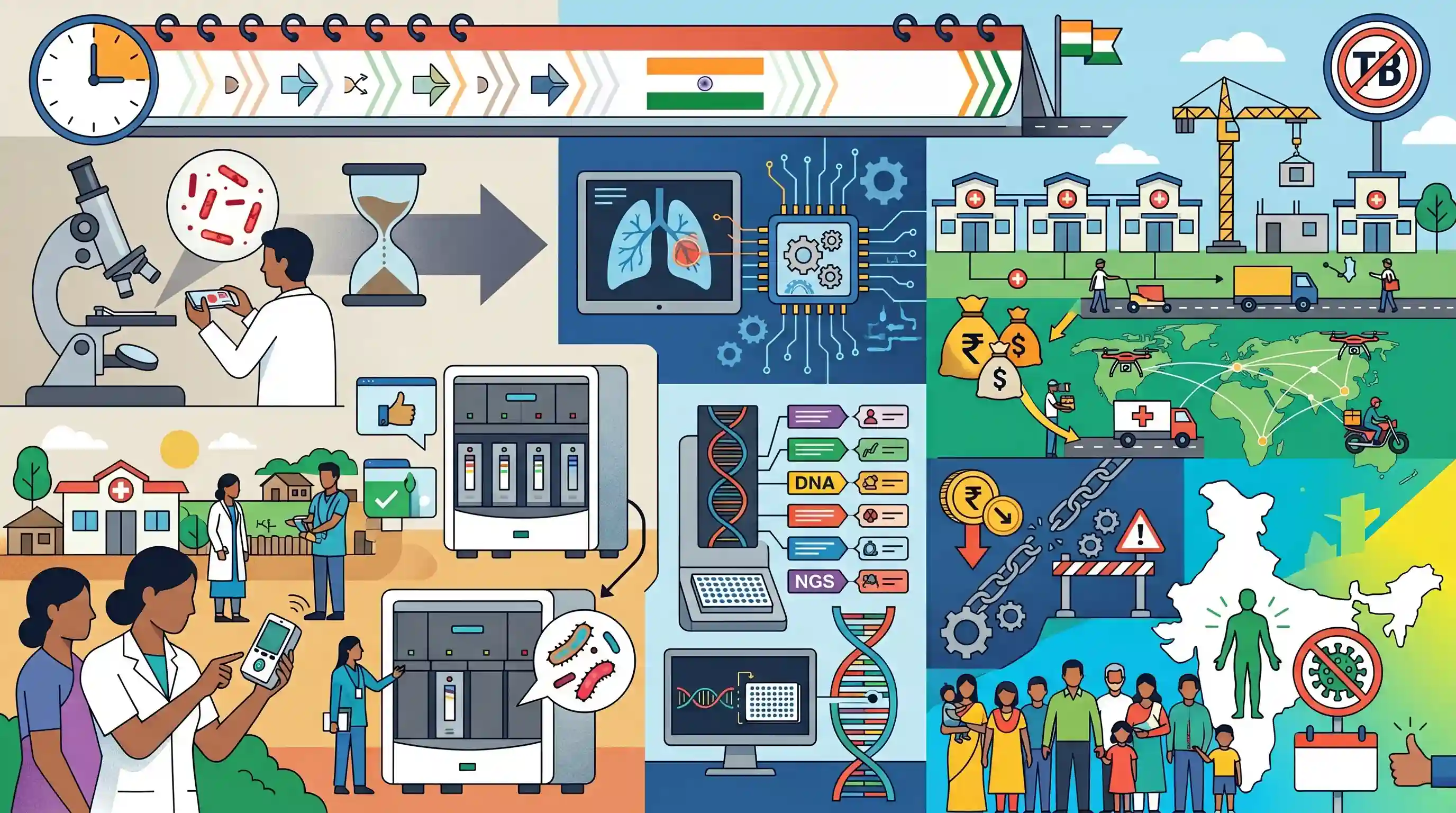
Tuberculosis remains a severe public health burden in India. Understanding the evolution of TB diagnostics—from microscopy to molecular and AI-driven methods—is essential for answering questions on health infrastructure (GS2) and the application of indigenous biotechnology in clinical diagnosis (GS3). It also highlights the role of the State in effectively implementing these technologies to curb anti-microbial resistance and achieve elimination targets.
Summary
The article explores the significant transformation in the diagnostic landscape for Tuberculosis (TB), highlighting the shift from conventional sputum smear microscopy to advanced molecular testing. Innovations such as CBNAAT and the indigenous, portable TrueNat system have revolutionized rapid detection, importantly identifying multi-drug-resistant TB (MDR-TB) at decentralized primary healthcare levels. The integration of artificial intelligence in radiology and Next-Generation Sequencing (NGS) offers enhanced diagnostic precision and comprehensive drug-resistance profiling. Scaling these advanced diagnostic technologies at the grassroots level is framed as a critical prerequisite for India to achieve its National Strategic Plan goal of eliminating TB by 2025, despite persistent challenges related to cost, infrastructure, and accessibility.
Key Points
- The transition from traditional sputum smear microscopy, which suffers from low sensitivity and an inability to detect drug resistance, to advanced molecular diagnostic testing.
- Widespread adoption of molecular diagnostic tools such as CBNAAT (GeneXpert) and the indigenously developed TrueNat, which allow for rapid, decentralized detection of TB and Rifampicin resistance.
- TrueNat's battery-operated, rugged design makes it particularly suitable for expanding diagnostic access to grassroots primary healthcare centers (PHCs).
- Integration of emerging technologies like Artificial Intelligence (AI-driven portable X-rays) and Next-Generation Sequencing (NGS) to improve early case detection and comprehensively map drug-resistant profiles (MDR/XDR-TB).
- Upgrading the primary health infrastructure with these modern diagnostic tools is imperative for India to achieve its ambitious target of eliminating Tuberculosis by 2025.
Important Terms
National Strategic Plan (NSP) for TB Elimination

The government roadmap (2017-2025) aiming to eliminate TB in India by 2025, five years ahead of global targets, using four pillars: Detect, Treat, Prevent, and Build.
UPSC context
GS Paper 2 (Social Justice/Health); tests knowledge of national health missions and target-based policy interventions.
Ni-kshay Poshan Yojana
A centrally sponsored Direct Benefit Transfer (DBT) scheme providing monthly financial support (increased to ₹1,000 in 2024) to all notified TB patients for their nutritional needs during treatment.
UPSC context
GS Paper 2 (Welfare Schemes); examines social security nets and the link between nutrition and public health outcomes.
National TB Elimination Program (NTEP)
India's flagship public health initiative (formerly RNTCP) managed by the MoHFW to provide free diagnostic and treatment services, aiming for a "TB Mukt Bharat" by 2025.
UPSC context
GS Paper 2 (Health Governance); focuses on institutional frameworks for managing infectious diseases and public health policy.
TrueNat
An indigenous, portable, and battery-operated molecular diagnostic test that allows rapid detection of TB and resistance to drugs like Rifampicin at the decentralized primary healthcare level.
UPSC context
GS Paper 3 (S&T/Indigenization); highlights domestic innovation in medical diagnostics and its role in improving healthcare accessibility.
Multi-Drug-Resistant TB (MDR-TB)
A strain of tuberculosis that does not respond to at least isoniazid and rifampicin, the two most powerful first-line anti-TB drugs, requiring longer and more complex treatment.
UPSC context
GS Paper 3 (Science/Health); relevant for understanding antimicrobial resistance (AMR) and the challenges in disease eradication.
Ni-kshay Portal
The unified web-based IT platform used by the Government of India for monitoring TB patients, tracking treatment adherence, and facilitating Direct Benefit Transfers.
UPSC context
GS Paper 2 (e-Governance); tests the role of digital technology and data-driven monitoring in health service delivery.
Prelims Trap
"Multi-Drug Resistant TB (MDR-TB) is characterized by the bacteria's resistance to all first-line anti-tuberculosis drugs."
MDR-TB specifically denotes resistance to at least Isoniazid and Rifampicin, the two most potent first-line drugs. Resistance to all first-line drugs is not required.
Static Concepts Connected
What distinguishes Multi-Drug Resistant TB (MDR-TB) from Extensively Drug-Resistant TB (XDR-TB)?
- MDR-TB: Defined by resistance to at least Isoniazid and Rifampicin, which are the two most potent first-line anti-TB drugs.
- XDR-TB: Resistant to Isoniazid and Rifampicin, PLUS any fluoroquinolone and at least one additional Group A core second-line drug.
- Primary drivers: Resistance is largely driven by premature treatment interruption, lack of treatment adherence, and antimicrobial misuse.
What are the key technical features of the TrueNat diagnostic tool?
- Indigenous Technology: It is an indigenously developed, microchip-based, battery-operated RT-PCR testing system.
- Dual detection: Detects both the Mycobacterium tuberculosis bacteria and its resistance to the drug Rifampicin in a matter of hours.
- Decentralized deployment: Its rugged, portable design allows usage at decentralized Primary Health Centres (PHCs) without needing advanced laboratory infrastructure or stable electricity.
Cross-Topic Patterns
TB Diagnostics + Antimicrobial Resistance (AMR)
The shift to molecular diagnostics like TrueNat ties directly to India's National Action Plan on AMR by preventing blind antibiotic prescriptions through rapid resistance profiling.
AI Diagnostics + Rural Health Infrastructure
Integrating AI-driven portable X-rays for TB at primary healthcare centers overlaps with the Ayushman Bharat Digital Mission (ABDM) for real-time, rural epidemiological mapping.

Expect a Prelims question comparing the indigenous, portable TrueNat technology with CBNAAT, explicitly linked to India's 2025 target.
Linked PYQs · 4
Linked PYQs · 4
- 2019PrelimsGS1
Which of the following are the reasons for the occurrence of multi-drug resistance in microbial pathogens in India? 1. Genetic predisposition of some people 2. Taking incorrect doses of antibiotics to cure diseases 3. Using antibiotics in livestock farming 4. Multiple chronic diseases in some people Select the correct answer using the code given below.
- 2024MainsGS2
In a crucial domain like the public healthcare system the Indian State should play a vital role to contain the adverse impact of marketisation of the system. Suggest some measures through which the State can enhance the reach of public healthcare at the grassroots level.
- 2021MainsGS2
“Besides being a moral imperative of a Welfare State, primary health structure is a necessary precondition for sustainable development.” Analyze.
- 2023MainsGS3
Introduce the concept of Artificial Intelligence (AI). How does Al help clinical diagnosis? Do you perceive any threat to privacy of the individual in the use of Al in healthcare?
