West Asia conflict environmental damage and energy security impacts
Source:The Hindu ↗
Why It Matters
Connects the direct environmental and climate costs of modern warfare with global energy security and the ongoing transition to renewable energy, providing a nuanced perspective for GS3 and GS2 answers.
Summary
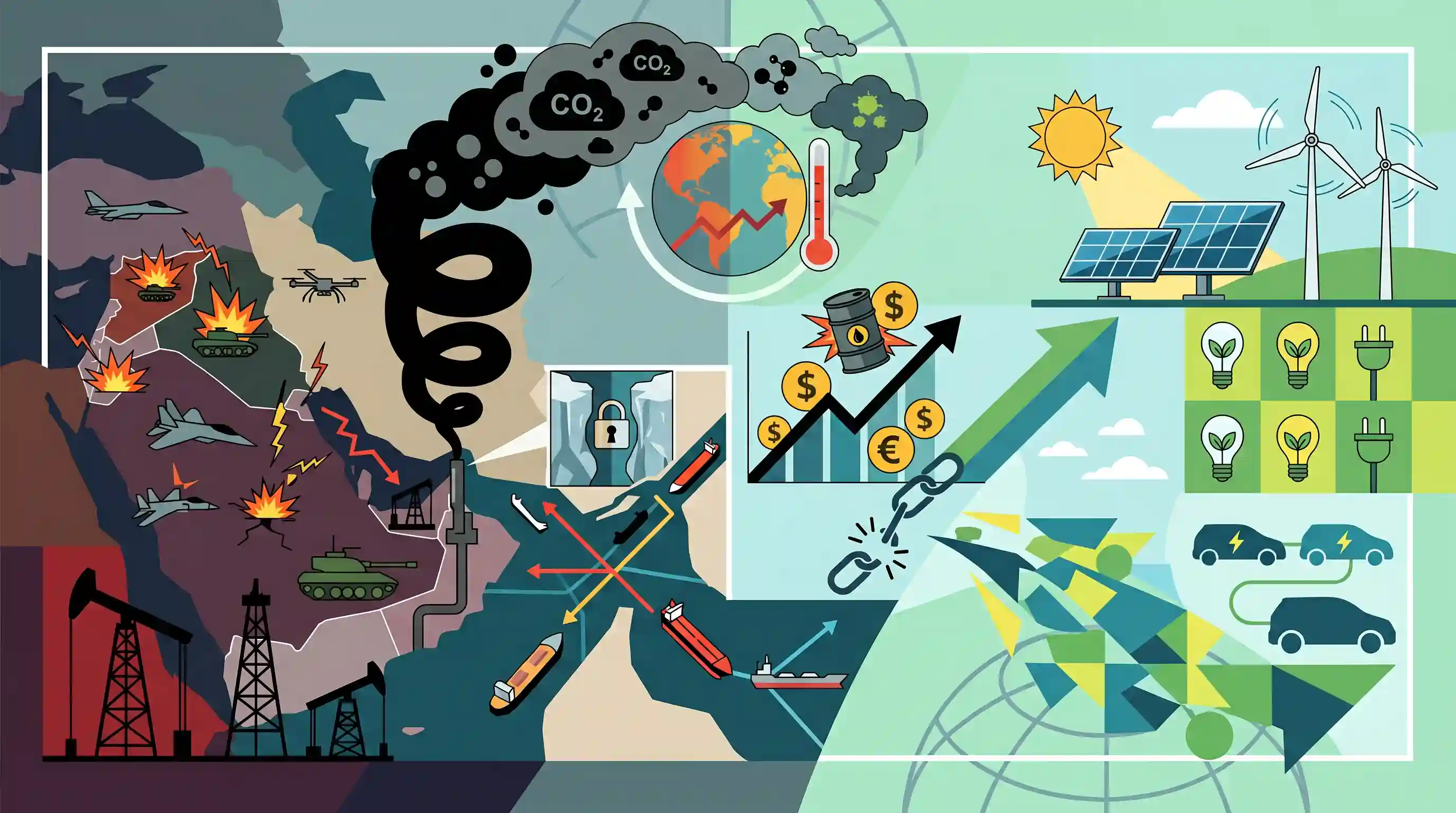
The escalating conflict in West Asia is exacting a severe toll on the environment, with extensive military operations and targeted strikes on oil infrastructure releasing massive amounts of greenhouse gases and toxic pollutants. As the war threatens critical energy chokepoints like the Strait of Hormuz, the resulting surge in fossil fuel prices highlights the vulnerability of global energy markets. However, experts note that this economic pressure could inadvertently accelerate the global transition toward cleaner, renewable energy solutions.
Key Points
- Military operations, including extensive jet fuel usage and the deployment of naval fleets, significantly increase global greenhouse gas emissions.
- Targeted strikes on oil refineries and storage facilities in West Asia are causing toxic air and water pollution, exacting a severe environmental cost.
- The conflict threatens the Strait of Hormuz, a critical artery for global oil and gas supplies, causing fossil fuel prices to soar.
- Rising fossil fuel prices driven by geopolitical instability may inadvertently accelerate the global transition towards decarbonization and electrification solutions.
Important Terms
Strait of Hormuz

A strategic maritime narrow passage connecting the Persian Gulf with the Gulf of Oman, through which approximately 20% of global oil and LNG supplies pass.
UPSC context
GS Paper I (Geography), GS Paper II (International Relations), and GS Paper III (Energy Security). Tests knowledge of maritime chokepoints and geopolitical volatility.
Military Emissions Gap
The absence of mandatory reporting requirements for military greenhouse gas emissions under international frameworks like the UNFCCC, leading to underestimated global carbon footprints.
UPSC context
GS Paper III (Environment & Ecology). Relevant to climate change negotiations, accountability, and the 1.5°C target of the Paris Agreement.
Initiative on GHG Accounting of War
A collaborative project that developed a methodology to quantify greenhouse gas emissions specifically resulting from active warfare, infrastructure destruction, and post-conflict reconstruction.
UPSC context
GS Paper III (Environment). Highlights emerging standards for carbon accounting in conflict zones and holding aggressors accountable for climate damage.
Institute for Sustainable Development and International Relations (IDDRI)
An independent Paris-based think tank that provides policy research and a dialogue platform for sustainable development and international climate negotiations.
UPSC context
GS Paper II (IR) and GS Paper III (Environment). Important for understanding European and global climate policy influence and sustainable transition pathways.
Energy Chokepoints
Narrow channels along widely used global sea routes whose closure could cause major disruptions in energy markets and international trade.
UPSC context
GS Paper III (Energy Security & Economy). Relevant to global supply chain resilience and strategic vulnerability of energy-importing nations like India.
Queen Mary University of London (QMUL)
A premier UK academic institution whose researchers lead global studies quantifying the environmental and carbon costs of military operations in West Asia and Ukraine.
UPSC context
GS Paper III (Environment). Noted for its pioneering role in quantifying 'conflict-related emissions,' a new dimension in climate impact assessment.
Prelims Trap
"Military greenhouse gas emissions are subject to mandatory reporting under the UNFCCC and the Paris Agreement."
Global military operations are largely exempt from mandatory reporting under both the UNFCCC framework and the Paris Agreement, creating a massive undocumented "military emissions gap."
Static Concepts Connected
Where are India's Strategic Petroleum Reserves (SPRs) located?
- Phase I locations: Visakhapatnam (Andhra Pradesh), Mangaluru (Karnataka), and Padur (Karnataka), managed by ISPRL with a combined capacity of 5.33 MMT.
- Phase II planned: Chandikhol (Odisha) and further expansion at Padur (Karnataka), operating on a public-private partnership (PPP) model.
- Strategic buffer: These reserves act as a buffer against maritime supply shocks (e.g., Strait of Hormuz disruptions), covering roughly 10-18 days of India's domestic demand.
What are the geographical linkages of the Strait of Hormuz?
- Connecting water bodies: It connects the oil-rich Persian Gulf in the west to the Gulf of Oman and the Arabian Sea in the southeast.
- Bordering nations: It is bounded by Iran to the north, and by Oman (the Musandam Peninsula enclave) and the UAE to the south.
- Trade significance: A critical maritime chokepoint through which approximately 40-50% of India's crude oil and 60% of its LNG imports transit.
Cross-Topic Patterns
Energy shocks as climate catalysts
Similar to the 1970s oil crisis, prolonged fossil fuel volatility in West Asia acts as an economic catalyst, accelerating the viability and adoption of EVs and global grid decarbonization.
Conflict pollution & transboundary impact
Strikes on refineries release massive sulfur oxides, directly linking geopolitical warfare to static environmental concepts like acid rain, soil contamination, and regional transboundary pollution.

Expect a multi-statement Prelims question linking UNFCCC military emission exemptions with the geography of West Asian chokepoints.
Linked PYQs · 3
Linked PYQs · 3
- 2017MainsGS2
The question of India's Energy Security constitutes the most important part of India's economic progress. Analyze India's energy policy cooperation with West Asian countries.
- 2025MainsGS2
"Energy security constitutes the dominant kingpin of India's foreign policy, and is linked with India's overarching influence in Middle Eastern countries.” How would you integrate energy security with India's foreign policy trajectories in the coming years?
- 2022MainsGS3
Discuss global warming and mention its effects on the global climate. Explain the control measures to bring down the level of greenhouse gases which cause global warming, in the light of the Kyoto Protocol, 1997.
