West Asia conflict carbon footprint and ecological degradation
Source:The Hindu ↗
Why It Matters
It integrates international relations with environmental ecology, highlighting the often-overlooked massive ecological costs of war. It provides excellent fodder for mains answers discussing energy security, the economic push toward decarbonization during geopolitical crises, and the environmental hazards of oil pollution.
Summary
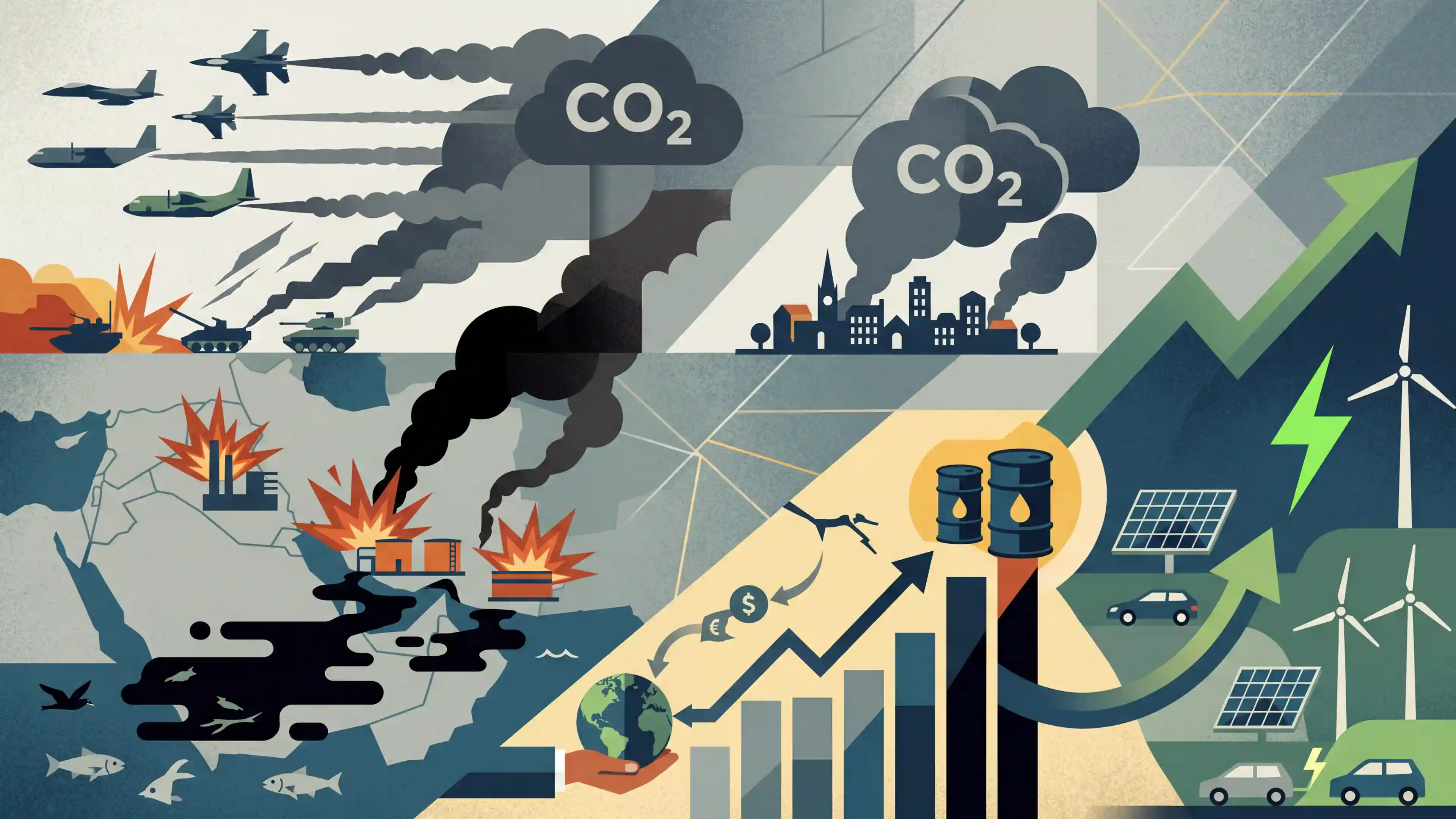
The military conflict in West Asia involving the U.S., Israel, and Iran is causing significant environmental and climate damage. Modern military operations, including continuous jet sorties and remote deployments, generate massive carbon footprints comparable to the annual emissions of small nations. Furthermore, the targeted destruction of oil refineries, fuel depots, and tankers along the critical Strait of Hormuz leads to devastating toxic pollution of local air and marine ecosystems. Geopolitically, the resulting spike in crude oil prices severely impacts global energy security. However, this crisis could also serve as a catalyst for the global clean energy transition, as the high cost of fossil fuels makes decarbonization and electrification technologies increasingly viable.
Key Points
- The ongoing military conflict in West Asia is causing severe environmental damage, with military operations, including fighter jets and aircraft carriers, generating immense carbon footprints.
- Attacks on energy infrastructure, such as oil refineries and tankers near the critical Strait of Hormuz, are releasing highly toxic chemicals into the air and water.
- Experts estimate the carbon emissions from such modern conflicts to be comparable to the annual emissions of entire countries, as seen previously in Gaza and Ukraine.
- While soaring oil prices due to the war create economic pressure, they may paradoxically accelerate global decarbonization efforts and the transition to renewable energy.
Important Terms
Initiative on GHG Accounting of War

A collaborative group of experts and scientists dedicated to documenting the greenhouse gas emissions resulting from armed conflicts, addressing the 'hidden' climate costs often excluded from international reporting frameworks.
UPSC context
GS Paper III (Environment); relevant for topics on climate change governance and the environmental impact of modern warfare.
US Navy
A major institution with a massive carbon footprint due to its global fleet and remote operations; if considered a nation, it would be among the world's top polluters.
UPSC context
GS Paper III (Environment) and GS Paper II (Security); tests awareness of institutional carbon footprints and military energy security.
Strait of Hormuz
A narrow maritime chokepoint between Iran and Oman through which approximately 20% of the world's oil and a significant portion of LNG transit, making it vital for global energy security.
UPSC context
GS Paper I (Geography) and GS Paper II (International Relations); critical for India's energy security and West Asian geopolitics.
Queen Mary University of London
A leading UK research institution whose recent studies have quantified the massive carbon emissions of modern conflicts, such as the Israel-Gaza and Russia-Ukraine wars.
UPSC context
GS Paper III (Environment); provides empirical evidence for mains answers regarding the environmental degradation and climate impacts of war.
Institute for Sustainable Development and International Relations (IDDRI)
An independent French think tank that researches and proposes policy tools to integrate sustainable development into international relations and global governance.
UPSC context
GS Paper II (International Institutions) and GS Paper III (Sustainable Development); relevant for global climate policy discussions.
Prelims Trap
Military GHG emissions are mandatorily reported and capped under the UNFCCC Paris Agreement.
Military emissions are largely exempt or strictly voluntary in UNFCCC reporting due to national security concerns, a historical concession dating back to the Kyoto Protocol.
Static Concepts Connected
What are the key maritime chokepoints in West Asia?
- Strait of Hormuz: Connects the Persian Gulf to the Gulf of Oman and Arabian Sea. It handles approximately 20% of global petroleum liquids.
- Bab el-Mandeb: Connects the Red Sea to the Gulf of Aden and Arabian Sea. It is a critical gateway for maritime trade moving through the Suez Canal.
How are marine oil spills managed ecologically?
- Ecological Impact: Spills block sunlight for phytoplankton, coat marine bird feathers (causing hypothermia), and introduce highly toxic polycyclic aromatic hydrocarbons (PAHs) into food webs.
- Bioremediation: Uses naturally occurring or engineered microbes (like 'Oilzapper' or Alcanivorax) to biologically degrade crude oil hydrocarbons into non-toxic substances.
- MARPOL Convention: The International Convention for the Prevention of Pollution from Ships (MARPOL) remains the primary global treaty addressing marine environment pollution.
Cross-Topic Patterns
Crude Oil Shocks & Twin Deficits
Geopolitical supply disruptions at Hormuz directly widen India's Current Account Deficit and trigger imported inflation, forcing the RBI into a tightrope walk regarding interest rate adjustments.
Warfare's Climate Diplomacy Loophole
The tension between national security and climate commitments highlights a major 'blind spot' in global GHG accounting, driving demands for mandating military emission disclosures at future COPs.

Expect a multi-statement question linking West Asian maritime chokepoints (Hormuz/Bab el-Mandeb) with UNFCCC military emission exemptions.
Linked PYQs · 4
Linked PYQs · 4
- 2017MainsGS2
The question of India's Energy Security constitutes the most important part of India's economic progress. Analyze India's energy policy cooperation with West Asian countries.
- 2025MainsGS2
"Energy security constitutes the dominant kingpin of India's foreign policy, and is linked with India's overarching influence in Middle Eastern countries.” How would you integrate energy security with India's foreign policy trajectories in the coming years?
- 2023MainsGS3
What is oil pollution? What are its impacts on the marine ecosystem? In what way is oil pollution particularly harmful for a country like India?
- 2022MainsGS3
Do you think India will meet 50 percent of its energy needs from renewable energy by 2030 ? Justify your answer. How will the shift of subsidies from fossil fuels to renewables help achieve the above objective ? Explain.
