Artificial intelligence impact on employment and work culture
Source:Indian Express ↗
Why It Matters
This article provides a multi-dimensional perspective (economic, ethical, and societal) on the future of work in the era of Artificial Intelligence. It is highly relevant for GS-3 (impact of AI on employment and economy), GS-2 (need for employment generation schemes like MNREGA), and GS-4 (human values, ethics of work, and finding purpose beyond productivity), making it an excellent resource for essay writing and holistic mains answers.
Summary
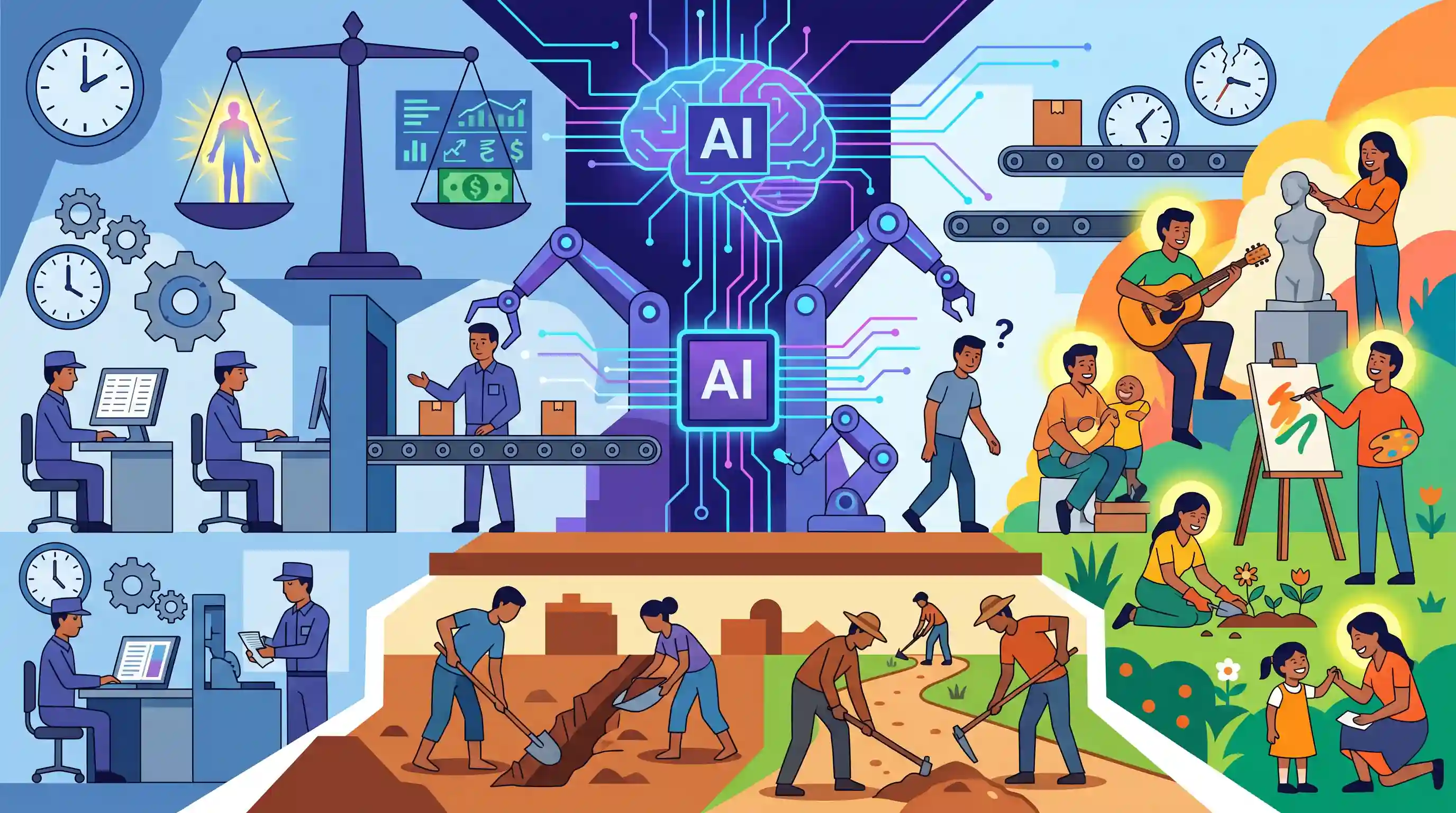
An opinion piece exploring the philosophical and practical implications of Artificial Intelligence (AI) on the traditional 'nine-to-five' work structure. It highlights how society's deeply ingrained belief that human worth is tied to economic productivity will be tested as AI displaces jobs across various sectors. The article touches upon the necessity of government employment schemes like MNREGA for social stability and survival, while suggesting that the end of monotonous work could ultimately free humanity to pursue joy, hobbies, and community service.
Key Points
- Artificial Intelligence (AI) is significantly altering the future of work, diminishing opportunities across entry-level roles, investment banking, and law, raising existential questions about human utility in an automated world.
- The societal norm linking individual self-worth and moral standing exclusively to economic productivity and stable 'nine-to-five' careers is being fundamentally challenged.
- Government employment guarantee initiatives like India's MNREGA serve a dual purpose: providing income for survival and keeping large populations occupied to maintain social order.
- While the AI-driven technological age introduces stressful uncertainty for the youth, it may eventually liberate people from monotonous jobs, allowing them to pursue community service, volunteering, and activities that bring genuine joy.
Important Terms
Mahatma Gandhi National Rural Employment Guarantee Act (MGNREGA)

A 2005 Indian law providing a legal guarantee of 100 days of unskilled manual wage employment annually to rural households to enhance livelihood security.
UPSC context
GS Paper 2 (Welfare Schemes) and GS Paper 3 (Employment); tests understanding of social safety nets.
Artificial Intelligence (AI)
The simulation of human intelligence by computer systems, including learning and reasoning, which is increasingly automating both routine and high-skill cognitive tasks.
UPSC context
GS Paper 3 (S&T and Economy); tests impact of technology on the future of work.
Gig Economy
A labor market characterized by short-term contracts, freelance work, and digital platform-mediated tasks (e.g., Uber, Swiggy) instead of traditional 'nine-to-five' full-time employment.
UPSC context
GS Paper 3 (Employment/Indian Economy); tests knowledge of shifting employment patterns and worker rights.
Structural Unemployment
Long-term unemployment arising from a mismatch between a worker's skills and the requirements of new jobs created by technological shifts or economic reorganization.
UPSC context
GS Paper 3 (Economy/Growth); tests analysis of AI-induced job displacement versus traditional unemployment.
Social Security Code, 2020
A comprehensive legal framework in India that consolidates labor laws and extends social security benefits to unorganized, gig, and platform workers for the first time.
UPSC context
GS Paper 2 (Governance/Social Justice); tests understanding of legal protections in a changing labor market.
Work Ethics
The set of values centered on the importance of work; currently being redefined as technology decouples human economic productivity from personal worth.
UPSC context
GS Paper 4 (Human Values/Ethics); tests philosophical perspectives on work, leisure, and dignity in the AI era.
Prelims Trap
The Constitution guarantees the Right to Work as a Fundamental Right to counter technological unemployment.
The Right to Work is a Directive Principle of State Policy (Article 41), not a fundamental right. MGNREGA provides a statutory right, not a constitutional fundamental right.
Static Concepts Connected
How does the Indian Constitution address the 'Right to Work'?
- Article 41 (DPSP): Directs the State to make effective provisions for securing the right to work and public assistance in cases of unemployment, within its economic capacity.
- Non-justiciable nature: Like all Directive Principles, it is fundamental in the governance of the country but not legally enforceable in a court of law.
- Statutory backing: The MGNREGA scheme translates this constitutional directive into a legal, statutory right for rural households to demand 100 days of wage employment.
What are the key types of unemployment relevant to AI disruption?
- Technological unemployment: Job loss occurring because automation and machinery replace human labor. AI is accelerating this across both blue-collar and white-collar sectors.
- Structural unemployment: A mismatch between the skills workers possess and the skills the economy demands as AI transforms industry requirements.
- Disguised unemployment: When workers unable to find jobs in AI-disrupted sectors fall back into agriculture, exacerbating the problem of more people working than required.
Cross-Topic Patterns
AI automation reviving the UBI debate
As AI displaces white-collar jobs, the Economic Survey 2016-17 proposal of Universal Basic Income (UBI) gains fresh relevance as a necessary evolution from manual wage-guarantee schemes like MGNREGA.
Changing human values in an AI economy
The shift from deriving moral worth via economic productivity (traditional work ethic) to finding purpose in community service maps directly to GS4 topics on human values and the meaning of life.

Expect a GS3 Mains question linking AI-induced structural unemployment with the necessity of UBI or expanding MGNREGA to urban areas.
Linked PYQs · 5
Linked PYQs · 5
- 2023MainsGS3
Introduce the concept of Artificial Intelligence (AI). How does Al help clinical diagnosis? Do you perceive any threat to privacy of the individual in the use of Al in healthcare?
- 2022MainsGS3
Economic growth in the recent past has been led by increase in labour productivity." Explain this statement. Suggest the growth pattern that will lead to creation of more jobs without compromising labour productivity.
- 2015MainsGS3
What are the areas of prohibitive labour that can be sustainably managed by robots ? Discuss the initiatives that can propel research in premier research institutes for substantive and gainful innovation.
- 2016MainsGS4
Explain how ethics contributes to social and human well-being.
- 2022MainsGS2
Besides the welfare schemes, India needs deft management of inflation and unemployment to serve the poor and the underprivileged sections of the society. Discuss.
