Constitutional Vacancy of Deputy Speaker and Parliamentary Norms
Source:Indian Express ↗
Why It Matters
Understanding the roles, election, and removal of the Speaker and Deputy Speaker is highly relevant for both UPSC Prelims and Mains (GS-II), as these are foundational aspects of parliamentary democracy and frequently tested in exams.
Summary
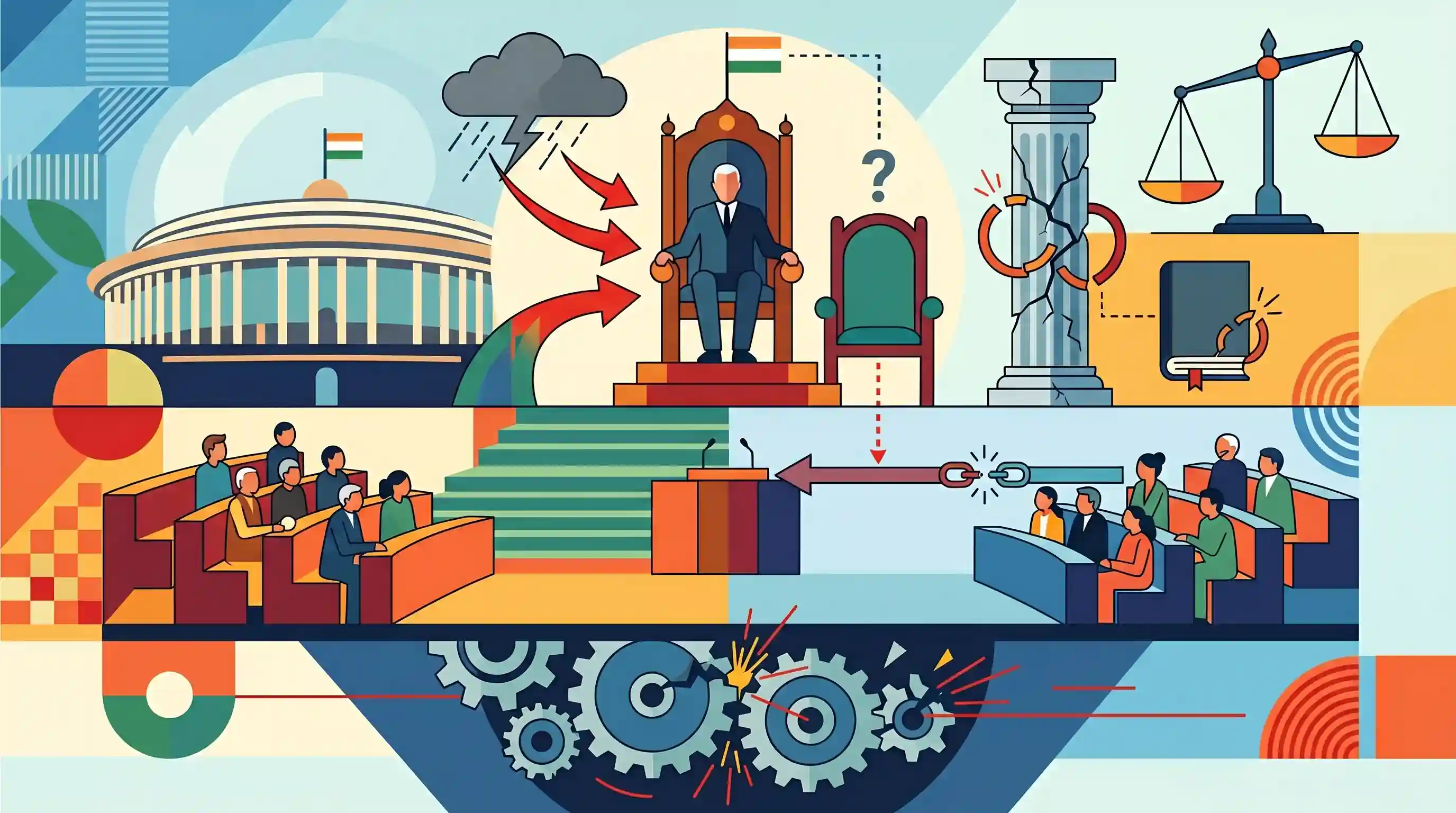
The article analyzes the political and constitutional crisis highlighted by the unprecedented no-confidence motion against Lok Sabha Speaker Om Birla and the persistent vacancy of the Deputy Speaker post. It argues that the "empty chair" of the Deputy Speaker violates constitutional mandates (Article 93) and breaks long-standing parliamentary conventions that usually grant this position to the opposition. This situation, coupled with concerns over the Speaker's impartiality, exposes deeper systemic flaws in the functioning of the legislature and the erosion of democratic checks and balances within the Indian Parliament.
Key Points
- A rare no-confidence motion was initiated against Lok Sabha Speaker Om Birla, reflecting deep-seated issues regarding the perceived impartiality of the presiding officer.
- The prolonged vacancy of the Deputy Speaker post is highlighted as a significant constitutional anomaly, violating the mandate of Article 93.
- Historically, parliamentary convention has allotted the Deputy Speaker position to the principal opposition party to ensure balanced legislative functioning.
- The combined issues of the Speaker's role and the missing Deputy Speaker expose systemic challenges to parliamentary conventions and democratic checks and balances in India.
Important Terms
Article 93

A constitutional mandate requiring the Lok Sabha to choose two members as Speaker and Deputy Speaker "as soon as may be" after its formation or upon a vacancy.
UPSC context
GS Paper II (Polity). Tests understanding of constitutional requirements for parliamentary leadership and the mandatory nature of house elections.
Article 94
Outlines the procedure for the vacation, resignation, and removal of the Speaker and Deputy Speaker; removal requires 14 days' notice and a majority of all "then members."
UPSC context
GS Paper II (Polity). Critical for questions on legislative accountability and the specific majority required for removing constitutional officers.
Deputy Speaker of Lok Sabha
The second-highest presiding officer of the House, responsible for performing the Speaker's duties during their absence or when the Speaker's office is vacant.
UPSC context
GS Paper II (Parliament). Tests knowledge of the role's independence and its significance in maintaining legislative continuity.
Parliamentary Convention
An unwritten but established practice, such as the tradition since 1956 of electing the Deputy Speaker from the opposition to ensure impartial legislative conduct.
UPSC context
GS Paper II (Polity). Evaluates the ability to distinguish between legally mandated provisions and conventions that ensure democratic balance.
Article 96
Specifies that neither the Speaker nor the Deputy Speaker shall preside over the House while a resolution for their own removal is under consideration.
UPSC context
GS Paper II (Polity). Tests understanding of 'principles of natural justice' within parliamentary procedure to prevent bias.
Lok Sabha
The "House of the People" or Lower House of India’s bicameral Parliament, composed of directly elected representatives serving a five-year term.
UPSC context
GS Paper II (Parliament). Fundamental concept regarding the structure of the legislature and its role in India's representative democracy.
Prelims Trap
"The Speaker cannot vote in the Lok Sabha when a resolution for their removal is under consideration."
Under Article 96, the Speaker retains the right to speak and vote in the *first instance* during removal proceedings. They only lose their casting vote (voting in case of a tie).
Static Concepts Connected
What are the constitutional rules governing the Deputy Speaker?
- Article 93: Mandates the Lok Sabha to choose a Deputy Speaker "as soon as may be," though no specific constitutional timeframe is defined.
- Election Date: Fixed by the Speaker. The tradition of allocating the post to the principal opposition is purely a parliamentary convention, not legally binding.
- Independence: The Deputy Speaker is not subordinate to the Speaker; they are directly responsible to the House and have identical powers when presiding.
How is the Lok Sabha Speaker removed from office?
- Article 94(c): Removed by a resolution passed by a majority of all the *then* members (an effective majority), requiring a strictly mandated 14-day prior notice.
- Presiding Rules: The Speaker cannot preside while the removal resolution is under consideration, but they can still participate in proceedings and vote in the first instance.
Cross-Topic Patterns
Conventions vs. Constitutional Law
GS2 Mains often tests the enforceability of parliamentary conventions. The breakdown of the Deputy Speaker opposition-allocation mirrors ongoing debates on non-binding conventions in Governor appointments.
Judicial Review of Legislature
Connects to Article 122. The Supreme Court's jurisdiction to issue a writ of mandamus compelling Parliament to elect a Deputy Speaker forms a major constitutional debate on separation of powers.

Expect a 2026 Prelims question testing the exact 'effective majority' needed to remove a Speaker alongside their Article 96 voting rights.
Linked PYQs · 5
Linked PYQs · 5
- 2024PrelimsGS1
With reference to the Speaker of the Lok Sabha, consider the following statements : While any resolution for the removal of the Speaker of the Lok Sabha is under consideration 1. He/She shall not preside. 2. He/She shall not have the right to speak. 3. He/She shall not be entitled to vote on the resolution in the first instance. Which of the statements given above is/are correct?
- 2022PrelimsGS1
With reference to Deputy Speaker of Lok Sabha, consider the following statements: 1. As per the Rules of Procedure and Conduct of Business in Lok Sabha, the election of Deputy Speaker shall be held on such date as the Speaker may fix. 2. There is a mandatory provision that the election of a candidate as Deputy Speaker of Lok Sabha shall be from either the principal opposition party or the ruling party. 3. The Deputy Speaker has the same power as of the Speaker when presiding over the sitting of the House and no appeal lies against his rulings. 4. The well established parliamentary practice regarding the appointment of Deputy Speaker is that the motion is moved by the Speaker and duly seconded by the Prime Minister. Which of the statements given above are correct?
- 2025PrelimsGS1
Consider the following statements : I. On the dissolution of the House of the People, the Speaker shall not vacate his/her office until immediately before the first meeting of the House of the People after the dissolution. II. According to the provisions of the Constitution of India, a Member of the House of the People on being elected as Speaker shall resign from his/her political party immediately. III. The Speaker of the House of the People may be removed from his/her office by a resolution of the House of the People passed by a majority of all the then Members of the House, provided that no resolution shall be moved unless at least fourteen days' notice has been given of the intention to move the resolution. Which of the statements given above are correct?
- 2020MainsGS2
Once a Speaker, Always a Speaker' ! Do you think this practice should be adopted to impart objectivity to the office of the Speaker of Lok Sabha ? What could be its implications for the robust functioning of parliamentary business in India?
- 2017PrelimsGS1
Consider the following statements: 1. In the election for Lok Sabha or State Assembly, the winning candidate must get at least 50 percent of the votes polled, to be declared elected. 2. According to the provisions laid down in the Constitution of India, in Lok Sabha, the Speaker's post goes to the majority. party and the Deputy Speaker's to the Opposition. Which of the statements given above is/are correct?
