Allahabad High Court 1975 Verdict on Electoral Malpractices
Source:Indian Express ↗
Why It Matters
The 1975 Allahabad High Court verdict is one of the most consequential judicial decisions in Indian history. It directly relates to GS2 topics such as disqualification of MPs under the RPA, corrupt electoral practices, judicial review, and the separation of powers. Additionally, the subsequent Emergency is a core topic in GS1 Post-Independence History.
Summary
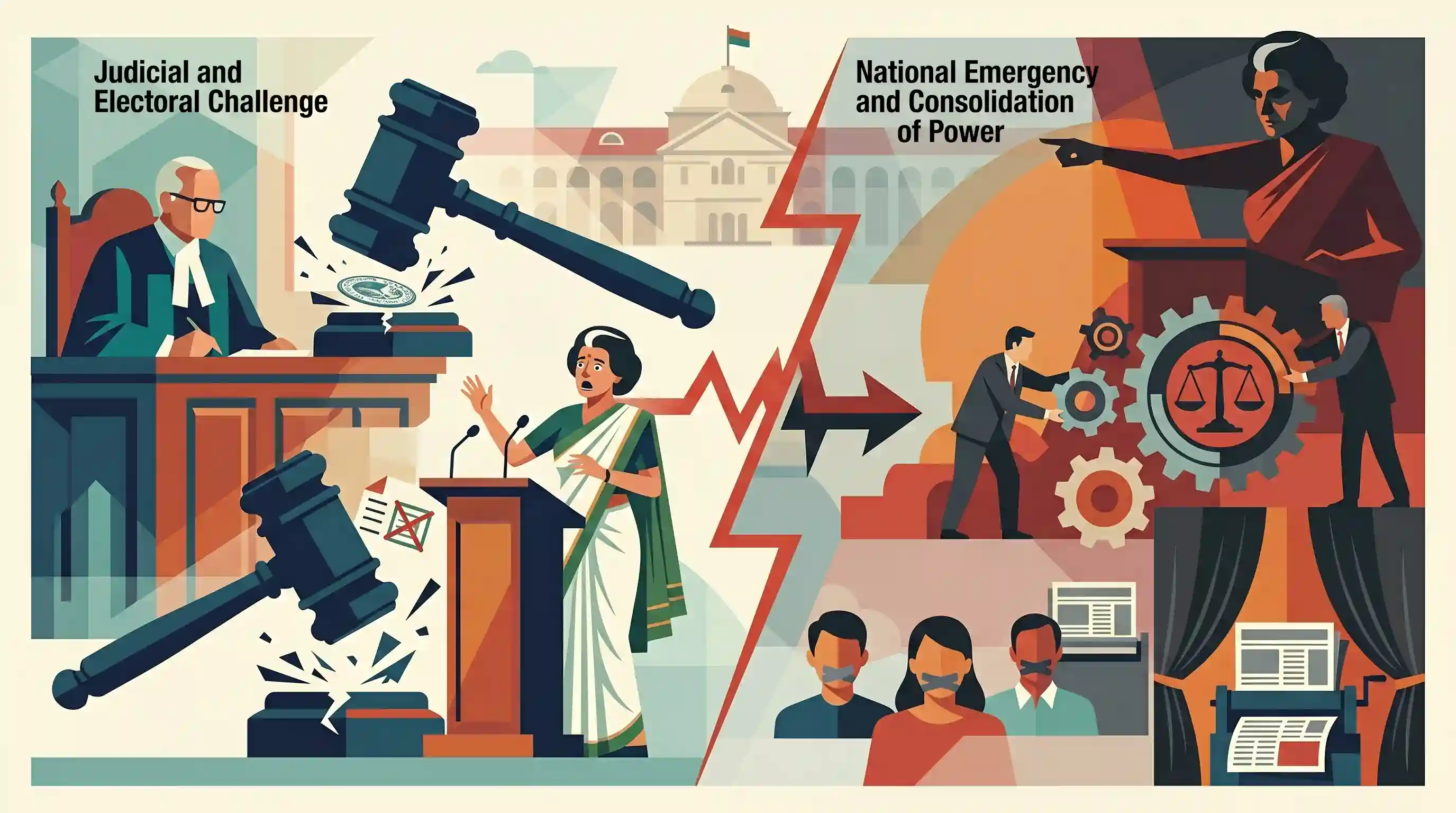
The article reflects on the 50th anniversary of the historic June 12, 1975 Allahabad High Court judgment that unseated Prime Minister Indira Gandhi. Delivered by Justice Jagmohan Lal Sinha in the State of UP vs Raj Narain case, the verdict convicted the sitting PM of corrupt electoral practices under the Representation of the People Act, 1951, and disqualified her for six years. This unprecedented judicial intervention sparked a grave constitutional crisis. In retaliation, Indira Gandhi imposed a National Emergency on June 25, 1975, suspending civil liberties and fundamentally altering India's democratic trajectory. The event remains a cornerstone in studying executive-judiciary friction, election laws, and constitutional amendments in post-independence India.
Key Points
- On June 12, 1975, Justice J.M.L. Sinha of the Allahabad High Court delivered a landmark verdict in the State of UP vs Raj Narain case, declaring PM Indira Gandhi's election to the Lok Sabha from Rae Bareli null and void.
- Indira Gandhi was found guilty of electoral malpractices under the Representation of the People Act, 1951, specifically for utilizing government machinery and officials (like Yashpal Kapoor) for her election campaign.
- The judgment disqualified her from holding elected office for six years, precipitating a massive political and constitutional crisis.
- Rather than resigning, Indira Gandhi responded by advising President Fakhruddin Ali Ahmed to declare a National Emergency on June 25, 1975, citing 'internal disturbance' under Article 352.
- The crisis led to severe executive overreach, including the controversial 39th Amendment (which attempted to place the PM's election beyond judicial scrutiny) and the 42nd Amendment, ultimately shaping the basic structure doctrine's enforcement and the subsequent democratic restoration via the 44th Amendment.
Important Terms
Representation of the People Act, 1951

The primary legislation governing election conduct in India, detailing qualifications, disqualifications of MPs/MLAs, corrupt practices, and procedures for resolving electoral disputes.
UPSC context
GS Paper II (Elections); essential for understanding disqualification criteria and the legal framework for democratic integrity.
Article 352
Constitutional provision allowing the President to declare a National Emergency if India's security is threatened by war, external aggression, or "armed rebellion."
UPSC context
GS Paper II (Polity); critical for studying executive powers and the federal-unitary shift during crises.
39th Constitutional Amendment Act, 1975
Enacted during the Emergency to place election disputes of the President, Vice-President, PM, and Speaker beyond judicial review; largely struck down later.
UPSC context
GS Paper II (Judiciary); significant for the evolution of the "Basic Structure" doctrine and judicial review.
42nd Constitutional Amendment Act, 1976
Known as the "Mini-Constitution," it centralized power, restricted judicial review, added "Socialist, Secular, Integrity" to the Preamble, and introduced Fundamental Duties.
UPSC context
GS Paper II (Polity); tests knowledge of the most extensive constitutional overhaul and executive overreach.
44th Constitutional Amendment Act, 1978
A corrective amendment that restored democratic safeguards, changed "internal disturbance" to "armed rebellion" for emergencies, and reinstated judicial review powers.
UPSC context
GS Paper II (Polity); essential for studying the restoration of civil liberties and legislative checks on the executive.
Corrupt Practices (Electoral)
Specific malpractices under the RPA 1951, such as bribery or misuse of government machinery, that can lead to an election being declared void.
UPSC context
GS Paper II (Elections); tests the legal standards for free and fair elections and judicial oversight.
Prelims Trap
The 1975 National Emergency was proclaimed by the President after receiving a written recommendation from the Union Cabinet.
The 1975 Emergency was declared on the PM's sole advice. The strict requirement for a 'written recommendation' from the Union Cabinet was introduced later by the 44th Amendment Act (1978).
Static Concepts Connected
What constitutes a 'corrupt practice' regarding government officials under the RPA, 1951?
- Section 123(7): Obtaining assistance from gazetted officers, police, or revenue officers to further the prospects of a candidate's election is expressly forbidden.
- Penalties: If proven, the High Court can declare the election void and the Election Commission can disqualify the candidate for up to six years.
- Exception: Regular administrative duties or security arrangements provided to a Minister are generally distinct from active election campaigning assistance.
How did the 44th Amendment Act (1978) reform National Emergency (Article 352) provisions?
- Grounds altered: The vague phrase 'internal disturbance' was replaced with 'armed rebellion' to prevent subjective executive abuse.
- Written Cabinet advice: The President can only proclaim a National Emergency after receiving a written recommendation from the Union Cabinet, not just the PM.
- Parliamentary approval: Parliamentary approval time was reduced from two months to one month, requiring a special majority rather than a simple majority.
- Fundamental Rights: Fundamental Rights guaranteed by Articles 20 and 21 cannot be suspended even during a National Emergency.
Cross-Topic Patterns
Basic Structure & 39th Amendment
The Indira Gandhi v Raj Narain case (1975) applied the Kesavananda doctrine, striking down the 39th Amendment by declaring 'free and fair elections' and 'judicial review' as parts of the Basic Structure.
GS1 Post-Independence & GS2 Polity
The Emergency era bridges GS1 Post-Independence history (JP movement, authoritarian drift) and GS2 technicalities (RPA corrupt practices, Constitutional Amendments), often tested as a combined thematic question.

The 50th anniversary of the Emergency makes multi-statement Prelims questions contrasting the 39th, 42nd, and 44th Amendments highly probable.
Linked PYQs · 4
Linked PYQs · 4
- 2022MainsGS2
Discuss the procedures to decide the disputes arising out of the election of a Member of the Parliament or State Legislature under The Representation of the People Act, 1951. What are the grounds on which the election of any returned candidate may be declared void ? What remedy is available to the aggrieved party against the decision ? Refer to the case laws.
- 2019MainsGS2
On what grounds a people's representative can be disqualified under the Representation of Peoples Act, 1951? Also mention the remedies available to such person against his disqualification.
- 2025MainsGS2
Discuss the 'corrupt practices' for the purpose of the Representation of the People Act, 1951. Analyze whether the increase in the assets of the legislators and/or their associates, disproportionate to their known sources of income, would constitute 'undue influence' and consequently a corrupt practice.
- 2024PrelimsGS1
Which of the following statements are correct about the Constitution of India? 1. Powers of the Municipalities are given in Part IX A of the Constitution. 2. Emergency provisions are given in Part XVIII of the Constitution. 3. Provisions related to the amendment of the Constitution are given in Part XX of the Constitution. Select the answer using the code given below :
