Global Leaders Warning on Gaza Humanitarian Crisis and Famine
Source:The Hindu ↗
Why It Matters
Highlights the role of global civil society and moral leadership in shaping the narrative on international law violations, human rights crises, and major geopolitical conflicts. Understanding the geography and dynamics of the Israel-Palestine conflict is crucial for Prelims and Mains IR.
Summary
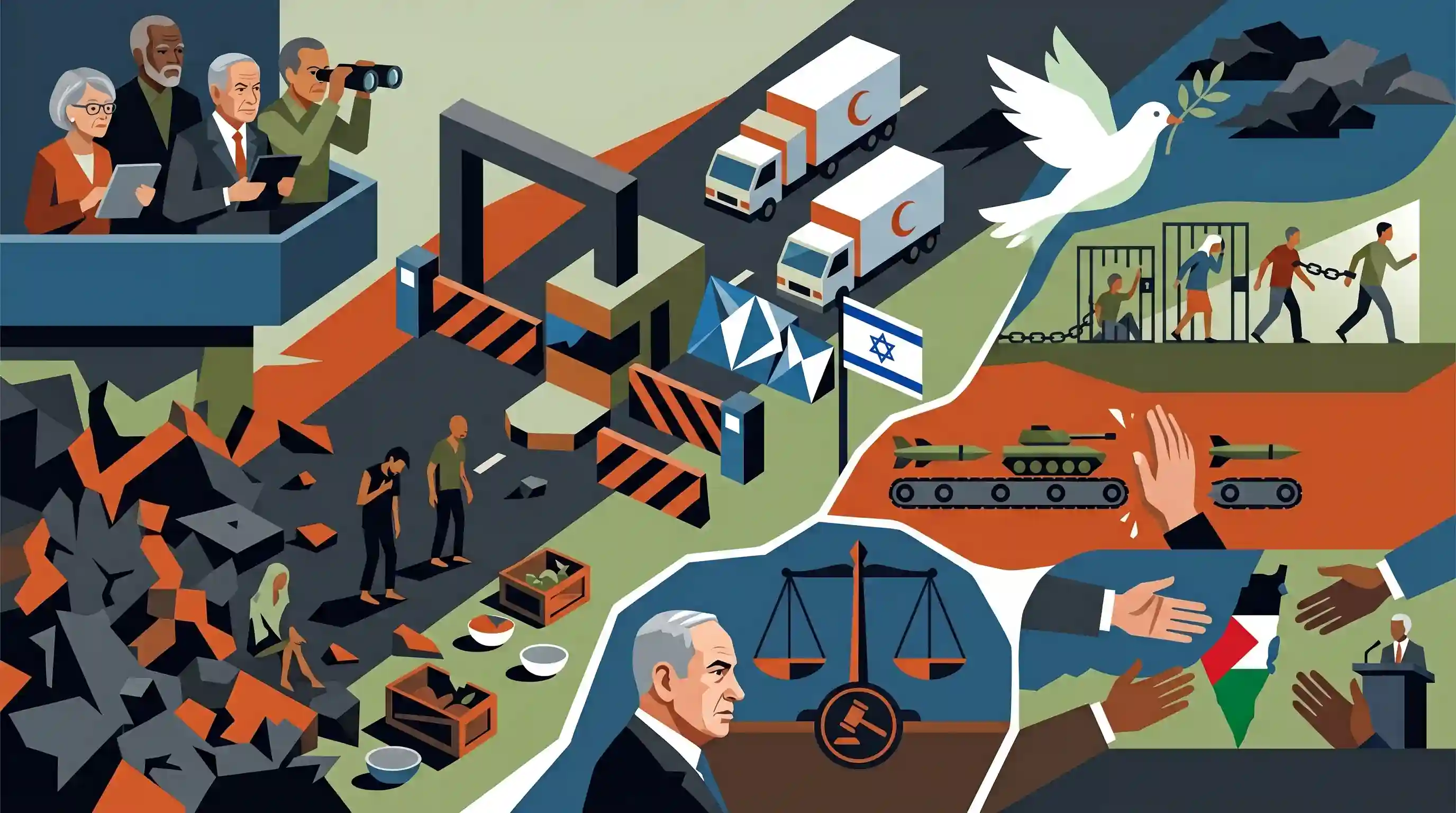
The Elders, an independent group of global leaders established by Nelson Mandela, has issued a stark warning regarding the situation in Gaza, describing it as an 'unfolding genocide'. Following a visit to the Rafah border crossing by delegation members Helen Clark and Mary Robinson, the group accused Israel of deliberately obstructing food and medical aid, leading to widespread famine. They urgently called for a ceasefire, the release of hostages by Hamas, a halt to arms transfers to Israel, and the international recognition of a Palestinian state, while supporting accountability measures against Israeli Prime Minister Benjamin Netanyahu.
Key Points
- The Elders, a prominent group of global leaders founded by Nelson Mandela, characterized the ongoing crisis in Gaza as an unfolding genocide.
- A delegation visiting the Rafah border crossing between Egypt and Gaza reported that the obstruction of humanitarian aid by Israel is actively causing famine.
- The group called for an immediate ceasefire, the release of hostages held by Hamas, and urged international allies to suspend arms transfers to Israel.
- They advocated for the formal recognition of the State of Palestine and supported punitive actions or sanctions against Israeli leadership for alleged war crimes.
Important Terms
The Elders

An independent group of global leaders, founded by Nelson Mandela in 2007, working for peace, justice, and human rights through public advocacy and private diplomacy.
UPSC context
GS Paper 2: International Relations; role of non-state actors and civil society in global conflict resolution and humanitarian advocacy.
Hamas
A Palestinian Islamist political and militant organization founded in 1987. It has de facto governed the Gaza Strip since 2007 and remains a primary party in the conflict with Israel.
UPSC context
GS Paper 2: West Asia geopolitics; impact of non-state militant actors on regional stability and international security.
Genocide
Acts committed with the specific 'intent to destroy, in whole or in part, a national, ethnical, racial or religious group,' as defined by the 1948 UN Genocide Convention.
UPSC context
GS Paper 2: International Law; tests understanding of the 1948 Genocide Convention and its application by the International Court of Justice (ICJ).
Rafah Border Crossing
The southernmost exit point of the Gaza Strip, bordering Egypt’s Sinai Peninsula. It is the only gateway to Gaza not directly controlled by Israel, serving as a humanitarian lifeline.
UPSC context
GS Paper 1 & 2: World Geography/Geopolitics; strategic importance of choke points and border corridors in humanitarian aid and regional conflict.
Palestinian Statehood Recognition
The diplomatic formalization of Palestine as a sovereign entity. Recognized by over 140 UN members (including India), while Western recognition remains a major point of geopolitical debate.
UPSC context
GS Paper 2: India's Foreign Policy; bilateral and multilateral stances on the Two-State solution and Palestinian sovereignty.
International Court of Justice (ICJ)
The principal judicial organ of the UN, based in The Hague. It settles legal disputes between states and gives advisory opinions on international legal questions.
UPSC context
GS Paper 2: International Institutions; role in upholding global law and accountability in humanitarian crises.
Prelims Trap
"The Elders is an intergovernmental organization established under the mandate of the United Nations."
The Elders is an independent, non-governmental group of global leaders. It holds no official UN mandate or treaty-based intergovernmental authority.
Static Concepts Connected
How does ICC exercise jurisdiction over non-member states like Israel?
- Territorial Principle: The ICC can prosecute nationals of non-member states if alleged crimes are committed on the territory of a member state (e.g., Palestine, a member since 2015).
- UNSC Referral: The UN Security Council can refer situations to the ICC, granting it jurisdiction regardless of a state's membership status in the Rome Statute.
What are the key differences between the ICJ and ICC?
- Subjects of Law: The ICJ settles legal disputes between sovereign states, whereas the ICC prosecutes individuals for international crimes like genocide and war crimes.
- Institutional Origin: The ICJ is the primary judicial organ of the UN. The ICC is an independent body established by the 1998 Rome Statute.
- India's Stance: India is a member of the UN and thus a party to the ICJ, but India has never signed or ratified the Rome Statute (ICC).
Cross-Topic Patterns
Map-reading the Levant geography
The Rafah crossing (Egypt-Gaza) joins the Golan Heights, Sinai Peninsula, and West Bank as high-probability map locations tested in recent UPSC Prelims.
Treaties lacking domestic law frameworks
India ratified the 1948 Genocide Convention but lacks specific domestic law, paralleling its stance on the UN Refugee Convention and UN Convention Against Torture.

Expect a Prelims question mixing ICC territorial jurisdiction rules over non-members with Levant mapping (Rafah/Sinai) in 2026.
Linked PYQs · 4
Linked PYQs · 4
- 2003PrelimsGS1
Israel has common borders with
- 2023PrelimsGS1
Consider the following statements: Statement-I: Israel has established diplomatic relations with some Arab States. Statement-II: The 'Arab Peace Initiative' mediated by Saudi Arabia was signed by Israel and Arab League. Which one of the following is correct in respect of the above statements?
- 2018MainsGS2
“India’s relations with Israel have, of late, acquired a depth and diversity, which cannot be rolled back.” Discuss.
- 2015MainsGS2
How can the role of NGOs be strengthened in India for development works relating to protection of the environment? Discuss throwing light on the major constraints.
