Eighth Schedule Linguistic Inclusion and Exclusion of Minorities
Source:Indian Express ↗
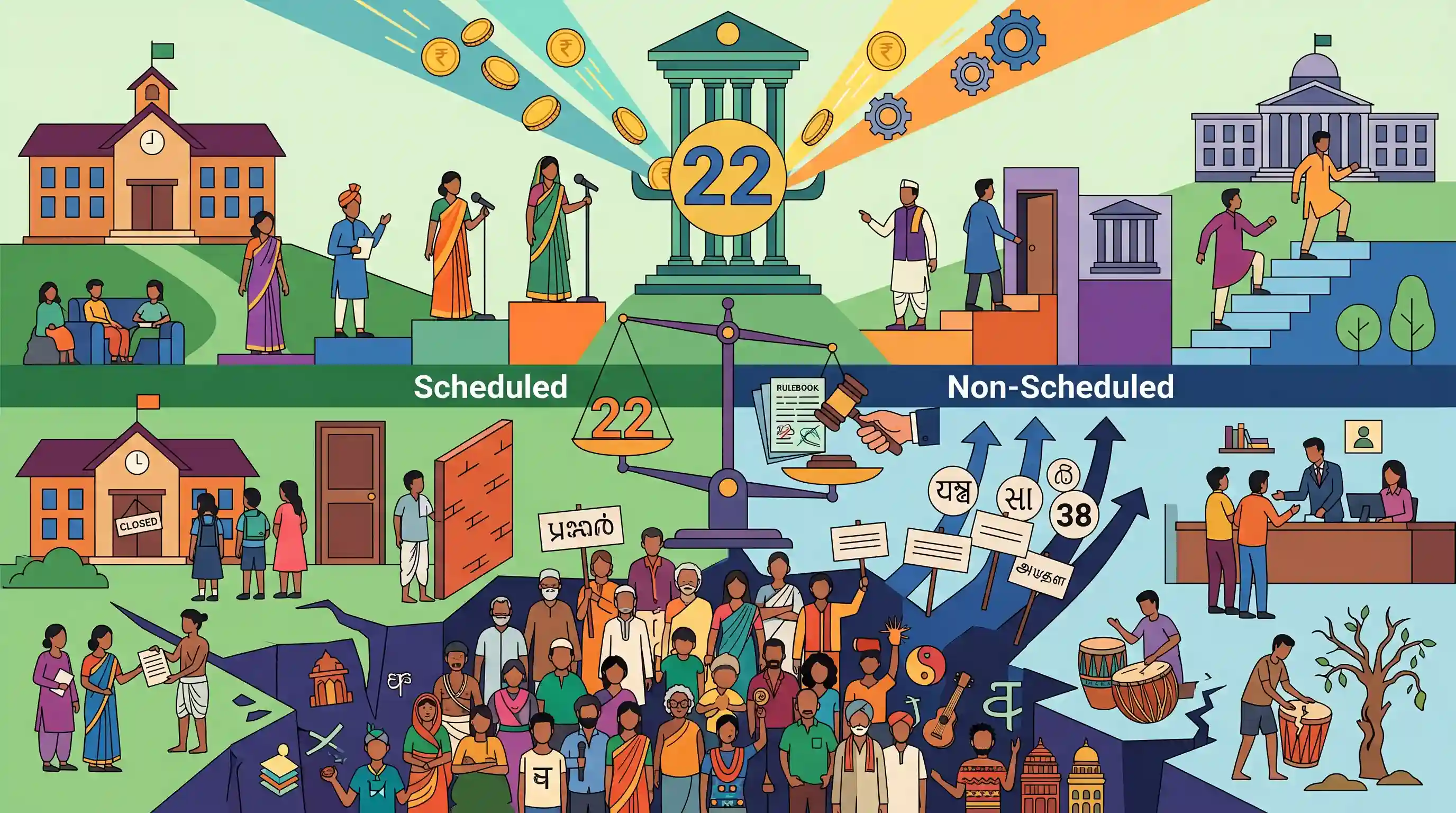
Why It Matters
Linguistic diversity and the constitutional recognition of languages are critical areas in GS2 (Polity & Governance) and GS1 (Indian Society). Understanding how constitutional mechanisms like the Eighth Schedule can inadvertently marginalize minority languages is vital for questions on federalism, cultural rights, and social justice.
Summary
The article examines the exclusionary consequences of the Eighth Schedule of the Indian Constitution. While the Schedule grants official status, state funding, and administrative prominence to 22 languages, it inherently marginalizes non-scheduled languages and dialects. This dichotomy creates a linguistic hierarchy that disadvantages speakers of unlisted regional and tribal languages—such as Ho, Tulu, and Bhojpuri—in education, employment, and cultural preservation. With over 38 languages demanding inclusion, the piece highlights the tension between providing state patronage to recognized languages and the resultant neglect of India's broader linguistic diversity, raising questions about the objective criteria used for constitutional recognition.
Key Points
- The Eighth Schedule of the Indian Constitution confers official status and state patronage to 22 recognized languages.
- The process of scheduling certain languages inherently creates an exclusionary framework, marginalizing the unlisted regional and tribal languages.
- Over 38 non-scheduled languages, including Ho, Tulu, and Bhojpuri, are actively demanding inclusion to access benefits like education in the mother tongue and representation in competitive exams.
- The Scheduled versus Non-Scheduled dichotomy establishes a linguistic hierarchy that accelerates the decline of unlisted dialects and undermines India's linguistic diversity.
Important Terms
Eighth Schedule of the Indian Constitution

A constitutional list of 22 officially recognized languages (Articles 344(1) and 351) that receive state patronage, developmental funding, and eligibility for use in official examinations like the UPSC.
UPSC context
GS Paper II (Polity/Governance); tests linguistic federalism, constitutional recognition criteria, and rights of diverse linguistic groups.
Constitution (71st Amendment) Act, 1992
A 1992 constitutional amendment that added Konkani, Manipuri (Meitei), and Nepali to the Eighth Schedule, increasing the number of recognized languages from 15 to 18.
UPSC context
GS Paper II (Polity); tests evolution of the Eighth Schedule and historical milestones in linguistic recognition.
Constitution (92nd Amendment) Act, 2003
A 2003 constitutional amendment that added Bodo, Dogri, Maithili, and Santhali to the Eighth Schedule, bringing the total number of scheduled languages to the current 22.
UPSC context
GS Paper II (Polity); tests the expansion of linguistic rights and specific groups granted constitutional status.
Constituent Assembly (Language Policy)
The drafting body (1946–1950) that established the Eighth Schedule to represent major regional languages and provide a vocabulary base for the development of Hindi as an official language.
UPSC context
GS Paper II (Constitution); tests historical debates on national identity and the "Official Language" vs. "National Language" distinction.
Article 351 of the Indian Constitution
A Directive Principle mandating the Union to promote the spread of Hindi and enrich it by drawing from the forms, style, and expressions of other Eighth Schedule languages.
UPSC context
GS Paper II (Polity); tests the constitutional framework for language promotion and the concept of India's composite culture.
Linguistic Minorities
Groups whose mother tongue differs from the state's majority language; protected by Article 350A (primary education in mother tongue) and Article 350B (Special Officer for safeguards).
UPSC context
GS Paper II (Social Justice/Governance); tests safeguards for vulnerable sections and educational rights of non-dominant language speakers.
Prelims Trap
"The Constitution prescribes objective criteria, such as a minimum number of speakers, for a language to be included in the Eighth Schedule."
The Constitution does not specify any fixed or objective criteria for inclusion. Attempts by the Pahwa and Mohapatra committees to establish benchmarks were never officially adopted.
Static Concepts Connected
Which Constitutional Amendments expanded the Eighth Schedule to the current 22 languages?
- 21st Amendment (1967): Added Sindhi as the 15th language.
- 71st Amendment (1992): Added Konkani, Manipuri, and Nepali.
- 92nd Amendment (2003): Added Bodo, Dogri, Maithili, and Santhali (BDMS).
What are the key Constitutional safeguards for linguistic minorities in India?
- Article 29: Protects the right of any section of citizens to conserve their distinct language, script, or culture.
- Article 350A: Mandates state facilities for instruction in the mother-tongue at the primary stage for children of linguistic minority groups.
- Article 350B: Establishes a Special Officer for Linguistic Minorities to investigate matters relating to constitutional safeguards.
Cross-Topic Patterns
8th Schedule + NEP 2020 Mother Tongue
The National Education Policy 2020 pushes for mother-tongue instruction up to Grade 5, creating friction when marginalized languages like Ho or Tulu lack the institutional backing of the 8th Schedule.
Classical Languages vs. 8th Schedule
Unlike the 8th Schedule which has no fixed criteria, Classical Language status requires strict historical parameters (1500-2000 years antiquity) and confers specific university-level funding.

Expect a 2026 question contrasting the rigid criteria for Classical Languages with the undefined process for 8th Schedule inclusion.
Linked PYQs · 4
Linked PYQs · 4
- 2024PrelimsGS1
The Constitution (71st Amendment) Act, 1992 amends the Eighth Schedule to the Constitution to include which of the following languages? 1. Konkani 2. Manipuri 3. Nepali 4. Maithili Select the correct answer using the code given below:
- 2008PrelimsGS1
Under which one of the following Constitution Amendment Acts, four languages were added to the languages under the Eighth Schedule of the Constitution of India, thereby raising their number to 22?
- 2016MainsGS1
Has the formation of linguistic States strengthened the cause of Indian Unity?
- 2021PrelimsGS1
With reference to India, the terms 'Halbi, Ho and Kui' pertain to
