Commercialisation of education and private coaching centre dominance
Source:The Hindu ↗
Why It Matters
It addresses key syllabus areas in GS-II (issues relating to development and management of social sectors/services relating to Education, Human Resources). Understanding the impacts of commercialisation and policy shifts in education is vital for answering questions on social justice and the National Education Policy.
Summary
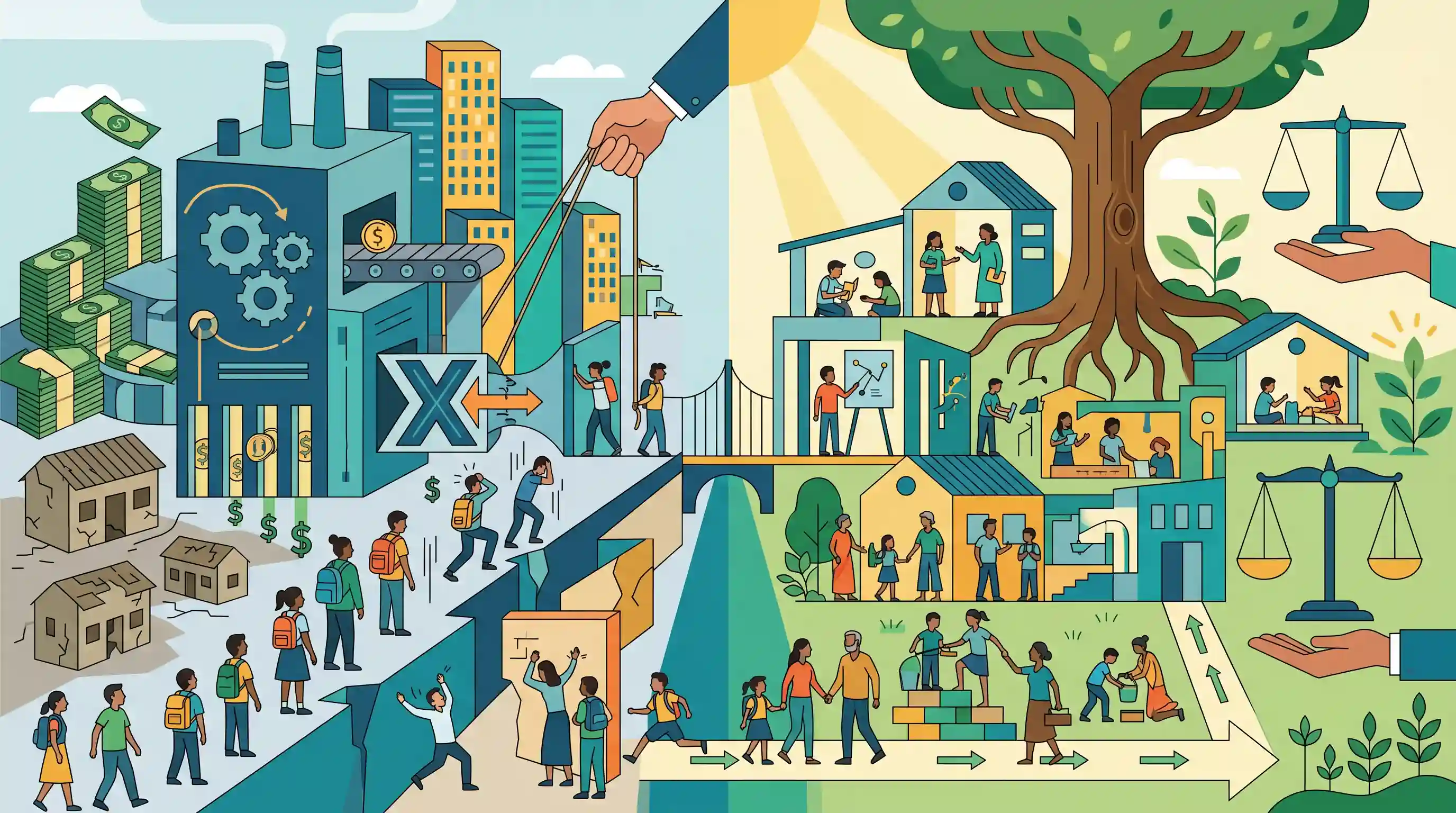
The article reflects on the disconcerting shifts in India's educational landscape, emphasizing the growing trend of commercialisation, the rising influence of private coaching centres, and the potential marginalization of formal schooling. It raises concerns over how centralised entrance examinations and market-driven approaches to education are exacerbating inequities in access and quality. By stressing the importance of holistic human resource development, the piece calls for re-orienting the educational framework to align with the core objectives of equity, accessibility, and quality, ensuring that the system serves broader societal development rather than perpetuating systemic divides.
Key Points
- The article critically examines the disconcerting structural shifts in India's educational landscape, noting a growing reliance on shadow education systems and private coaching.
- It raises concerns regarding the increasing commercialisation of education and the marginalisation of the formal schooling system.
- The centralisation of entrance examinations is seen as a factor that exacerbates inequities and undermines the foundational objectives of access and quality.
- Stresses the urgent need to re-orient the educational framework towards genuine human resource development and critical thinking rather than rote learning and test-taking.
Important Terms
National Education Policy 2020 (NEP 2020)

India's first 21st-century education reform replacing the 1986 policy. It aims for universal access, equity, and quality through a 5+3+3+4 structure and 100% Gross Enrolment Ratio by 2030.
UPSC context
GS Paper 2 (Education Policy); tests critical analysis of structural reforms and their alignment with Sustainable Development Goal 4.
Ministry of Education (MoE)
The central nodal department responsible for formulating and implementing national educational policies. It operates through two departments: School Education & Literacy and Higher Education.
UPSC context
GS Paper 2 (Governance); important for understanding the institutional framework and executive-led interventions in the social sector.
Human Resource Development (HRD)
The systematic nurturing of individual skills, knowledge, and capabilities to contribute to national growth. It is a critical component for leveraging India's demographic dividend.
UPSC context
GS Paper 2 & 3; fundamental for topics related to the social sector, services, and sustainable economic development.
Commercialisation of Education
The transition of education from a public service to a profit-driven market commodity, often leading to increased costs and reduced accessibility for marginalized groups.
UPSC context
GS Paper 2 (Social Justice); tests the ability to evaluate the socio-economic impacts of private sector dominance in welfare services.
Centralised Entrance Examinations
Standardized national-level tests (e.g., NEET, CUET) used for admissions. While aiming for uniformity, they are criticized for promoting coaching cultures and undermining regular schooling.
UPSC context
GS Paper 2 (Governance); assesses understanding of systemic issues like the "coaching industry" and educational inequity.
Equity in Education
Ensuring fair and impartial access to quality learning opportunities for all students regardless of socio-economic background, location, or identity. It is a foundational pillar of NEP 2020.
UPSC context
GS Paper 2 (Social Justice); critical for discussing policies aimed at bridging the rural-urban and socio-economic divide.
Prelims Trap
Education is a Union subject under the Seventh Schedule, enabling the Centre to unilaterally mandate centralized exams like CUET.
Education is in the Concurrent List (Entry 25), transferred via the 42nd Amendment, 1976. While the Union can legislate, States retain significant jurisdiction.
Static Concepts Connected
What is the constitutional distribution of powers regarding education in India?
- Concurrent List: Education was moved from the State List to the Concurrent List (Entry 25) by the 42nd Constitutional Amendment Act of 1976.
- Fundamental Right: Article 21A mandates free and compulsory education for children aged 6 to 14, introduced by the 86th Constitutional Amendment Act.
- DPSP: Article 45 directs the State to provide early childhood care and education for all children until they complete the age of six years.
What are the foundational pillars and structural shifts of the National Education Policy (NEP) 2020?
- Five Pillars: The policy is fundamentally built on five pillars: Access, Equity, Quality, Affordability, and Accountability.
- Pedagogical Shift: Replaces the traditional 10+2 system with a 5+3+3+4 design, shifting focus from rote memorisation to holistic, critical thinking.
Cross-Topic Patterns
Federalism vs. Centralised Examinations
Centralised tests like NEET and CUET frequently spark State-Centre friction, directly linking GS2 federal structure debates to educational access and social justice outcomes.
Regulating the "Shadow Education" Economy
The unregulated boom of private coaching centres and dummy schools connects GS2 human resource development directly with GS2 regulatory governance challenges.

Expect a GS2 Mains question assessing whether centralized exams (CUET/NEET) undermine the NEP 2020’s goals of equity and critical thinking.
Linked PYQs · 4
Linked PYQs · 4
- 2015MainsGS2
The quality of higher education in India requires major improvements to make it internationally competitive. Do you think that the entry of foreign educational institutions would help improve the quality of higher and technical education in the country? Discuss.
- 2020MainsGS2
National Education Policy 2020 is in conformity with the Sustainable Development Goal-4 (2030). It intends to restructure and reorient education system in India. Critically examine the statement.
- 2023MainsGS2
The crucial aspect of development process has been the inadequate attention paid to Human Resource Development in India. Suggest measures that can address this inadequacy.
- 2023MainsGS2
Skill development programmes have succeeded in increasing human resources supply to various sectors. In the context of the statement analyse the linkages between education, skill and employment.
