Durand Line border disputes and internal security challenges
Source:The Hindu ↗
Why It Matters
The ongoing instability along the Durand Line directly feeds into the resurgence of cross-border terrorism and destabilizes Pakistan, creating a volatile neighborhood for India. Understanding this historical and contemporary border dispute is vital for UPSC aspirants analyzing South Asian geopolitics, the Af-Pak strategic theater, and internal security challenges arising from porous borders.
Summary
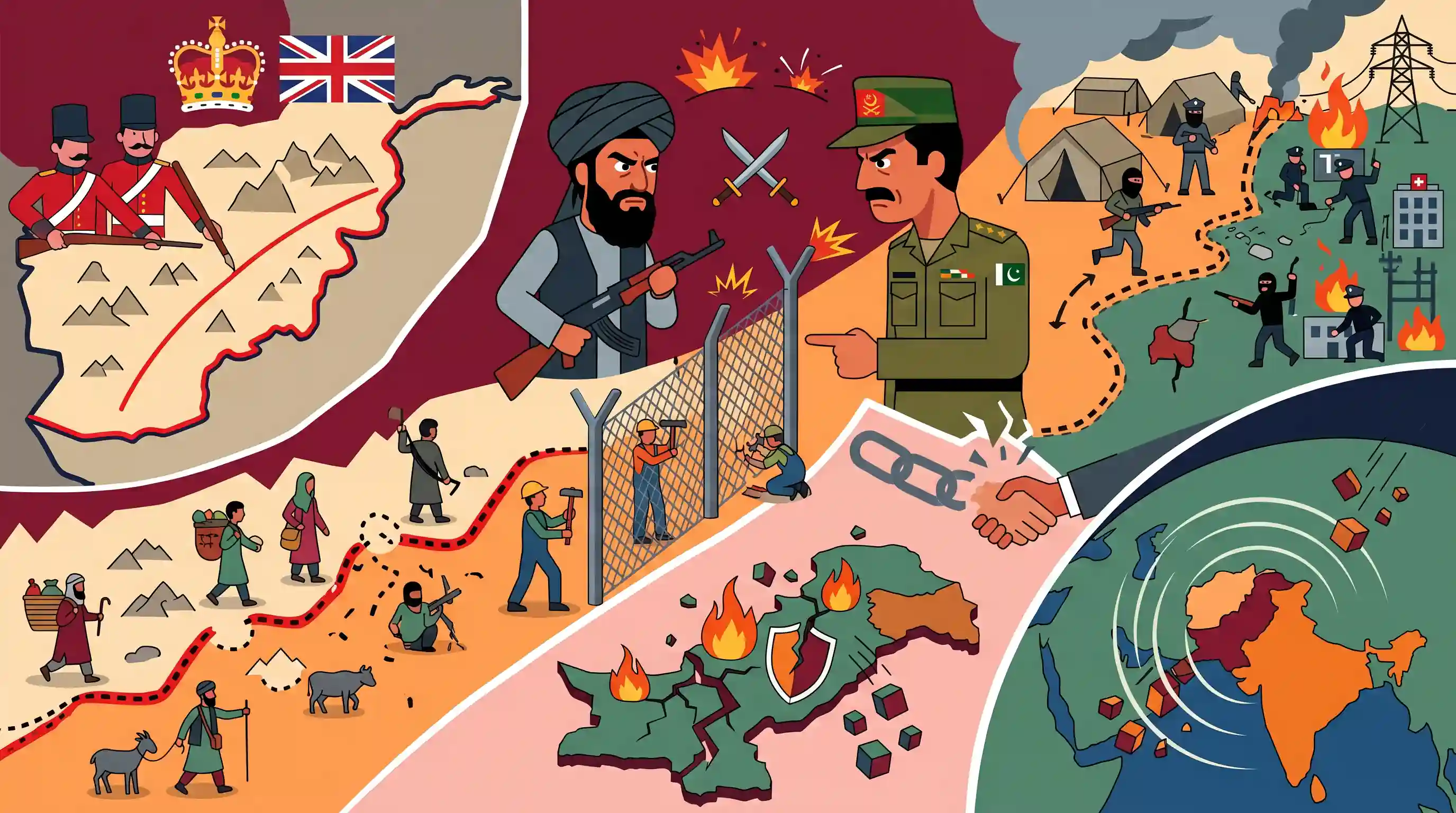
The article highlights the fragility of the Durand Line, the porous 2,640 km border separating Afghanistan and Pakistan. Drawn by the British in 1893, it remains a heavily contested frontier that is unrecognised by successive Afghan regimes, including the current Taliban administration. Following the Taliban's return to power in Kabul, border skirmishes with Pakistani forces have surged. This escalation is primarily driven by disputes over border fencing initiated by Islamabad and Pakistan's allegations that the Afghan Taliban is sheltering the Tehreek-e-Taliban Pakistan (TTP). This volatile border situation exacerbates internal security challenges for Pakistan, strains Af-Pak bilateral relations, and poses broader risks to regional stability in South Asia.
Key Points
- The Durand Line, a 2,640 km border drawn by the British in 1893, artificially divides Pashtun tribal areas, resulting in historical and ongoing contention.
- The Afghan Taliban, consistent with previous Afghan governments, refuses to recognize the Durand Line as a legitimate international boundary.
- Tensions between Islamabad and Kabul have escalated due to Pakistan's efforts to fence the border to curb militancy and smuggling, actions the Taliban forces have actively resisted.
- Pakistan accuses the Afghan Taliban of providing safe havens to the Tehreek-e-Taliban Pakistan (TTP), which has led to a significant uptick in cross-border terror attacks inside Pakistan.
- The volatility of this frontier has broad implications for South Asian regional security, complicating counter-terrorism efforts and shaping India's strategic calculations regarding a destabilized Af-Pak region.
Important Terms
1893 Durand Line Agreement

The 2,640 km frontier established in 1893 between British India and Afghanistan. It remains unrecognized by successive Afghan regimes, serving as a primary source of bilateral friction.
UPSC context
GS-2 (International Relations/Neighborhood) and GS-3 (Border Management). Tests knowledge of colonial boundaries and modern geopolitical disputes.
Tehreek-e-Taliban Pakistan (TTP)
Also known as the "Pakistani Taliban," this 2007 umbrella group of militants aims to overthrow the Pakistani state and implement strict Sharia law through violent insurgency.
UPSC context
GS-3 (Internal Security/Non-state actors). Critical for understanding cross-border terrorism and security challenges in South Asia.
Taliban
A Deobandi Islamic fundamentalist movement and the de facto rulers of Afghanistan since 2021. They reject the Durand Line's legitimacy, complicating border security with Pakistan.
UPSC context
GS-2 (International Relations). Analyzes the impact of state-actor behavior on regional stability and Indian interests.
Porous Borders
Frontiers that allow easy crossing of people, militants, or contraband due to rugged terrain or lack of enforcement, significantly challenging national internal security.
UPSC context
GS-3 (Security challenges in border areas). Tests strategies for managing transborder crimes and infiltration.
Pashtunistan Issue
A nationalist concept calling for an independent state for the Pashtun people, bisected by the Durand Line. It fuels Afghan rejection of the current frontier.
UPSC context
GS-2 (Bilateral relations). Explains the ethnic and historical drivers behind territorial disputes in the region.
Border Fencing
Pakistan's strategic project to physical secure the Afghan border to regulate movement and curb terrorism. It has triggered frequent military skirmishes with Afghan forces.
UPSC context
GS-3 (Border Management). Focuses on physical infrastructure as a solution to security challenges.
Prelims Trap
"Unlike previous democratic Afghan governments, the Taliban regime refuses to recognize the Durand Line."
No Afghan administration—including the previous US-backed democratic governments—has ever officially recognized the Durand Line, viewing it as a colonial imposition.
Static Concepts Connected
What are the key colonial-era boundary lines defining South Asian geopolitical borders?
- Durand Line: Demarcated in 1893 between British India and Afghanistan by Sir Mortimer Durand, dividing Pashtun and Baloch tribal territories.
- McMahon Line: Demarcated in 1914 at the Simla Convention, defining the boundary between Tibet and British India (now India's Arunachal Pradesh).
- Radcliffe Line: The 1947 partition line drawn by Sir Cyril Radcliffe, dividing British India into independent India and Pakistan.
Why does the Pashtun ethnic distribution complicate Af-Pak relations?
- Artificial Bisection: The Durand Line bisected the traditional Pashtun homeland, leaving a large Pashtun minority in Pakistan and a majority in Afghanistan.
- Pashtunistan Demand: Historical Afghan demands for an independent or united "Pashtunistan" directly threaten Pakistan's territorial integrity and sovereignty.
- Porous Frontier: Shared tribal ties facilitate untracked cross-border movement, complicating counter-terrorism and enabling insurgent safe havens for groups like TTP.
Cross-Topic Patterns
Strategic depth and GS3 border security
The TTP-Taliban dynamic highlights Pakistan's failed "strategic depth" policy. This internal destabilization of Pakistan indirectly affects India's GS3 border management and regional security calculus.
Colonial cartography driving modern insurgencies
Like the McMahon Line (India-China) and Sykes-Picot (Middle East), the Durand Line illustrates how arbitrary imperial borders drawn without ethnic consensus fuel protracted modern insurgencies.

Expect a Prelims match-the-following on colonial boundary lines (Durand, McMahon, Curzon) and the specific ethnic groups they bisected.
Linked PYQs · 3
Linked PYQs · 3
- 2020MainsGS3
Analyze internal security threats and transborder crimes along Myanmar, Bangladesh and Pakistan borders including Line of Control (LoC). Also discuss the role played by various security forces in this regard.
- 2024MainsGS3
India has a long and troubled border with China and Pakistan fraught with contentious issues. Examine the conflicting issues and security challenges along the border. Also give out the development being undertaken in these areas under the Border Area Development Programme (BADP) and Border Infrastructure and Management (BIM) Scheme.
- 2016MainsGS2
Increasing cross-border terrorist attacks in India and growing interference in the internal affairs of several member-states by Pakistan are not conducive for the future of SAARC (South Asian Association for Regional Cooperation)." Explain with suitable examples.
