Donroe Doctrine and Its Impact on Postwar International Order
Source:The Hindu ↗
Why It Matters
The shift from a rule-based international order to one driven by sovereign nationalism and transactional diplomacy is a central theme in contemporary International Relations. Understanding this transition is essential for analyzing how global governance structures are weakening and how India must adapt its foreign policy to secure its strategic interests.
Summary
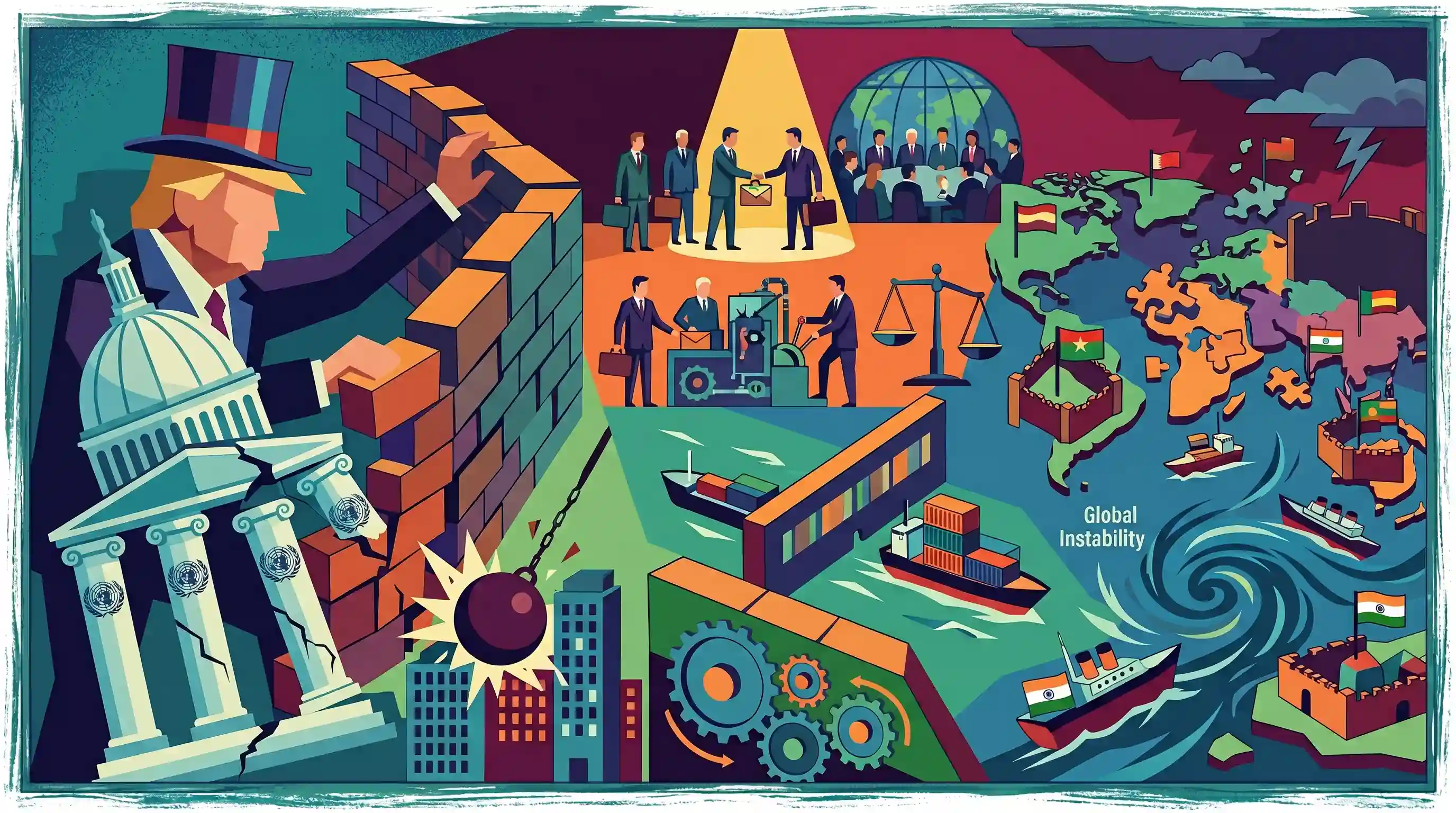
The article examines the geopolitical implications of the 'Donroe Doctrine'—a term combining the historical Monroe Doctrine with Donald Trump's 'America First' policy. It argues that this unilateral and transactional approach to foreign policy is accelerating the breakdown of the post-WWII liberal international order. By undermining key multilateral institutions like the UN and WTO, and favoring protectionism over globalization, the doctrine fosters an era of sovereign nationalism. The piece highlights the resulting global instability and the challenges countries face as they navigate an increasingly fragmented and multipolar world order.
Key Points
- The 'Donroe Doctrine' represents a fusion of the historical Monroe Doctrine's focus on hemispheric dominance with Donald Trump's modern 'America First' unilateralism.
- This approach actively dismantles the post-WWII liberal international order, replacing multilateral cooperation and alliances with transactional, issue-based diplomacy.
- The doctrine accelerates the decline of globalization, leading to a rise in protectionism, tariff wars, and sovereign nationalism across the globe.
- For emerging powers like India, navigating this fragmented world order requires balancing transactional US diplomacy with the need for strategic autonomy and engagement in alternative multilateral forums.
Important Terms
Monroe Doctrine

A 1823 US policy opposing European colonialism in the Americas, asserting that any intervention in the Western Hemisphere's political affairs was a potentially hostile act against the US.
UPSC context
GS Paper-II (International Relations); tests understanding of historical spheres of influence and precedents in US foreign policy evolution.
Liberal International Order
The post-WWII system of rules, norms, and institutions (like the UN and WTO) established to promote global cooperation, free trade, and collective security.
UPSC context
GS Paper-II (Global Groupings); tests knowledge of systemic shifts in global governance and challenges to a rules-based order.
WTO (World Trade Organization)
An international body established in 1995 to regulate global trade, provide a forum for negotiations, and resolve trade disputes through a rules-based framework.
UPSC context
GS Paper-III (Economy/Trade); critical for topics on multilateralism, protectionism, and India’s interests in the global trade architecture.
NATO (North Atlantic Treaty Organization)
A political and military alliance of North American and European countries founded in 1949 to provide collective defense against external aggression (Article 5).
UPSC context
GS Paper-II (IR); relevant for studying global security architecture and India's strategic autonomy in a fragmented world.
United Nations (UN)
The primary intergovernmental organization founded in 1945 to maintain international peace, develop friendly relations among nations, and promote social progress and human rights.
UPSC context
GS Paper-II (Important International Institutions); focuses on the efficacy of multilateralism and the urgent need for institutional reforms.
Protectionism
Economic policies of restricting imports from other countries through methods such as tariffs on imported goods, import quotas, and various other government regulations.
UPSC context
GS Paper-III (Economy); tests understanding of global trade trends, economic nationalism, and their impact on India’s export-led growth.
Prelims Trap
"The Monroe Doctrine is a post-WWII policy aimed at establishing the US-led liberal international order."
The Monroe Doctrine was established in 1823, exclusively warning European powers against further colonization in the Western Hemisphere, not a global post-WWII framework.
Static Concepts Connected
What was the original Monroe Doctrine (1823)?
- Hemispheric Focus: Declared the Americas closed to future European colonization and warned against foreign intervention.
- Non-intervention: Stated the US would not interfere in the internal affairs of European powers or their existing colonies.
- Sphere of Influence: Functionally asserted the Western Hemisphere (North and South America) as an exclusive US sphere of influence.
How does India's 'Strategic Autonomy' differ from Cold War 'Non-Alignment'?
- Bloc Avoidance: NAM focused on avoiding formal military blocs during the bipolar US-USSR rivalry based on anti-imperialist solidarity.
- Multi-alignment: Strategic Autonomy involves proactive, issue-based 'multi-alignment' to maximize national interest in a multipolar world.
- Transactional Engagement: India now actively engages in deep, intersecting partnerships (e.g., Quad, SCO, BRICS) without binding treaty-alliance constraints.
Cross-Topic Patterns
Protectionism & WTO's Appellate crisis
The 'America First' approach directly parallels the ongoing US blocking of WTO Appellate Body appointments, paralyzing the multilateral trade dispute mechanism and forcing a shift to bilateral trade agreements.
De-globalization & Friend-shoring
Sovereign nationalism and transactional diplomacy have shifted the global trade paradigm from purely cost-efficient globalization to supply-chain resilience, 'China-plus-one', and friend-shoring.

Expect a Prelims question matching US doctrines (Monroe, Truman) with their geographic focus, or a GS2 Mains on WTO paralysis and India.
Linked PYQs · 3
Linked PYQs · 3
- 2025MainsGS2
"With the waning of globalization, post-Cold War world is becoming a site of sovereign nationalism.” Elucidate.
- 2025MainsGS2
"The reform process in the United Nations remains unresolved, because of the delicate imbalance of East and West and entanglement of the USA vs. Russo-Chinese alliance.” Examine and critically evaluate the East-West policy confrontations in this regard.
- 2016MainsGS2
The broader aims and objectives of WTO are to manage and promote international trade in the era of globalization. But the Doha round of negotiations seem doomed due to differences between the developed and the developing countries." Discuss in the Indian perspective.
