Generational Disconnect and Intraparty Reforms in Politics
Source:The Hindu ↗
Why It Matters
This topic is central to the GS2 syllabus covering the Representation of the People Act, parliamentary democracy, and the functioning of political parties. It provides a nuanced sociological and institutional perspective on why the 'demographic dividend' has not fully translated into representative political leadership, offering critical fodder for mains questions on electoral reforms, dynastic politics, and internal party democracy.
Summary
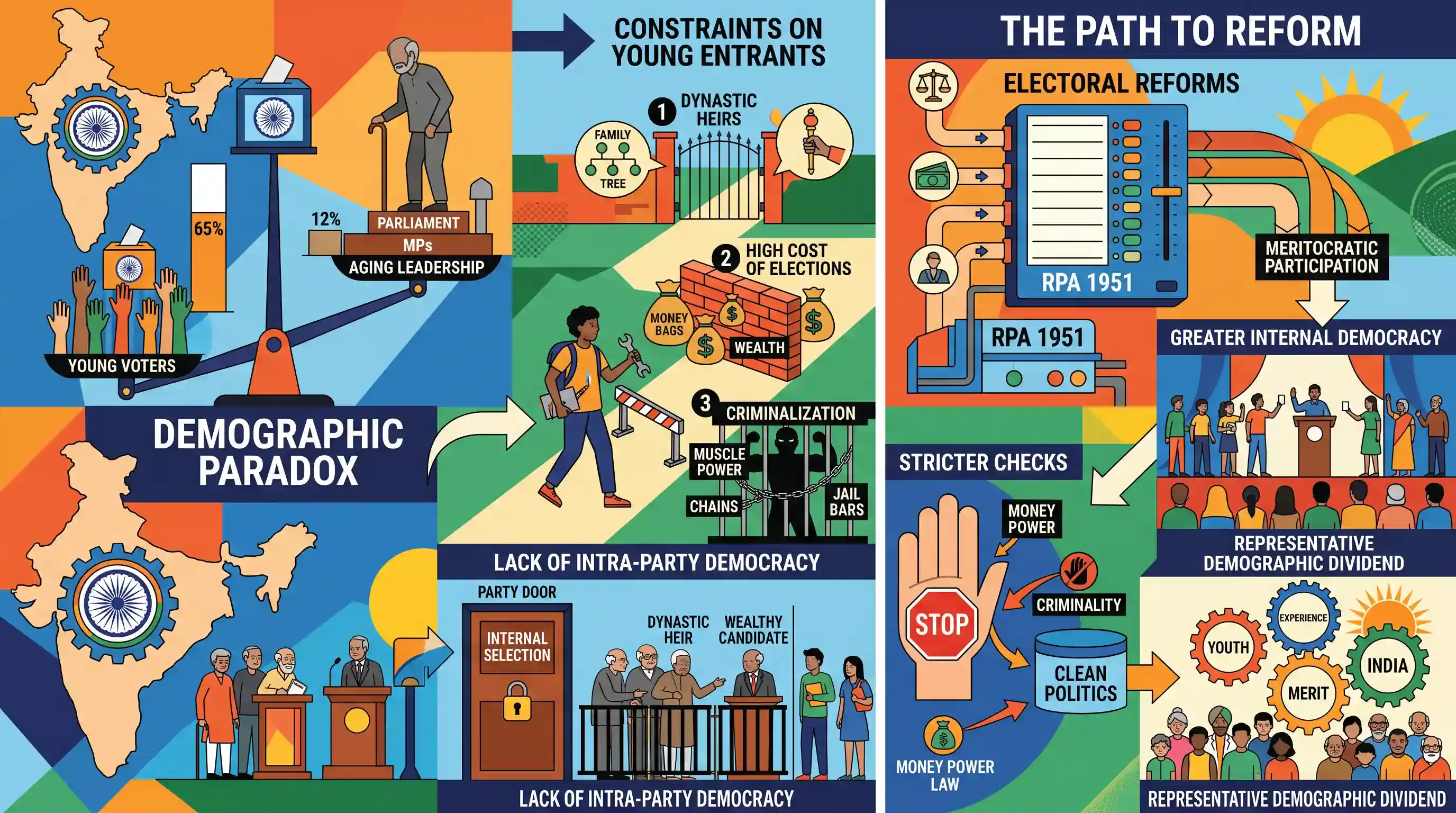
The article explores the generational transition in Indian politics, highlighting the paradox of a young electorate represented by an aging leadership. While a new generation of younger politicians is gradually emerging, their rise is heavily constrained by systemic issues. Due to the lack of intra-party democracy and the high cost of contesting elections, younger political entrants are disproportionately dynastic heirs or individuals with substantial wealth and criminal records. This underscores the need for comprehensive electoral reforms, greater internal democracy in political parties, and stricter checks on money and muscle power to make political participation truly meritocratic and representative of India's demographic dividend.
Key Points
- There is a significant generational mismatch in Indian politics; despite a young national demographic, the leadership of major parties and legislative bodies remains disproportionately older.
- The entry barriers for non-dynastic youth are exceptionally high, which has led to a situation where the rising younger generation of politicians is dominated by dynastic heirs (political dynasties).
- The high cost of election campaigning and the focus on 'winnability' drive political parties to favor candidates with significant financial backing and muscle power, leading to a high concentration of wealth and pending criminal cases among younger MPs.
- Despite systemic limitations, the new political generation is more tech-savvy, professional, and aspiration-driven, increasingly relying on digital mobilization, data analytics, and development-oriented governance (Vikas) rather than purely traditional patronage networks.
- Deepening India's democracy requires structural electoral and political reforms, including codifying intra-party democracy, ensuring transparent candidate selection, capping election spending, and curbing the criminalization of politics.
Important Terms
Representation of the People Act 1951

A key Indian legislation regulating the actual conduct of elections, detailing qualifications and disqualifications of candidates, electoral offenses, corrupt practices, and dispute resolution for Parliament and State Legislatures.
UPSC context
GS Paper II: Electoral reforms, statutory frameworks, and criteria governing democratic representation and candidate integrity.
Election Commission of India
An autonomous, permanent constitutional body established under Article 324 to superintend, direct, and control elections to India's Parliament, State Legislatures, and the offices of the President and Vice President.
UPSC context
GS Paper II: Constitutional bodies, their mandate, structural independence, and role in conducting free and fair elections.
Intra-Party Democracy
The practice of democratic principles—such as regular internal leadership elections, transparent candidate selection, and participatory decision-making—within the organizational structure of political parties.
UPSC context
GS Paper II: Governance, political parties, dynastic politics, and challenges to democratic representation and meritocracy.
Criminalization of Politics
The entry and participation of individuals with criminal backgrounds into electoral politics and legislatures, often driven by muscle power, financial resources, and the search for "winnability."
UPSC context
GS Paper II: Electoral reforms, governance, judicial activism (e.g., Lily Thomas case), and threats to the rule of law.
Demographic Dividend
The economic growth potential that arises when a country’s population age structure shifts, specifically when the share of the working-age population (15–64) exceeds the dependent population.
UPSC context
GS Paper I & III: Population dynamics, economic development, and utilizing youth aspirations for inclusive growth.
Prelims Trap
The Election Commission of India has statutory powers under the RPA 1951 to deregister political parties that fail to hold regular internal democratic elections.
Aspirants often assume the Election Commission of India has natural administrative power to deregister parties for violating democratic rules. However, the ECI has no general statutory power to deregister political parties on grounds of internal undemocratic functioning.
Static Concepts Connected
How does the RPA 1951 govern legislative disqualifications?
- Section 8(3): Mandates immediate disqualification for any legislator convicted of an offense and sentenced to two or more years of imprisonment.
- Lily Thomas ruling: Struck down Section 8(4), removing the three-month protection window for sitting legislators to appeal before disqualification takes effect.
- Section 9 and 9A: Disqualifies individuals for dismissal from government service due to corruption, disloyalty, or for entering into active government contracts.
What limits exist on election campaign expenditure in India?
- Candidate spending limits: Regulates individual campaign spending under Rule 90 of the Conduct of Elections Rules, setting strict maximum caps per constituency.
- Section 77 exemption: Excludes travel expenses of designated 'star campaigners' from the candidate's account, allowing political parties to inject vast, uncapped resources.
- Reporting mandates: Requires all candidates to lodge a true account of election expenses with the ECI within 30 days of the election results.
Cross-Topic Patterns
Demographics vs Gerontocratic Representation
The disconnect between India's youth median age and older legislative average exposes structural representation deficits, shifting mobilization away from physical patronage to digital-first ecosystems.
Judicial Mandates vs Legislative Inertia
Supreme Court mandates like Rambabu Singh Thakur highlight judicial activism filling legislative vacuums, as political parties prioritize electoral winnability over ethical self-regulation.

RPA 1951 questions in 2026 will likely test the exact boundaries of ECI’s deregistration powers and star campaigner expense exemptions.
Linked PYQs · 2
Linked PYQs · 2
- 2024MainsGS2
Examine the need for electoral reforms as suggested by various committees with particular reference to "one nation one election" principle.
- 2020MainsGS2
There is a need for simplification of procedure for disqualification of persons found guilty of corrupt practices under the Representation of Peoples Act". Comment.
