Environmental Governance Dilution and Ecological Degradation
Source:The Hindu ↗
Why It Matters
It provides a critical evaluation of India's environmental governance and regulatory frameworks, essential for UPSC aspirants to write balanced, analytical answers on the conflict between rapid economic development and sustainable environmental conservation.
Summary
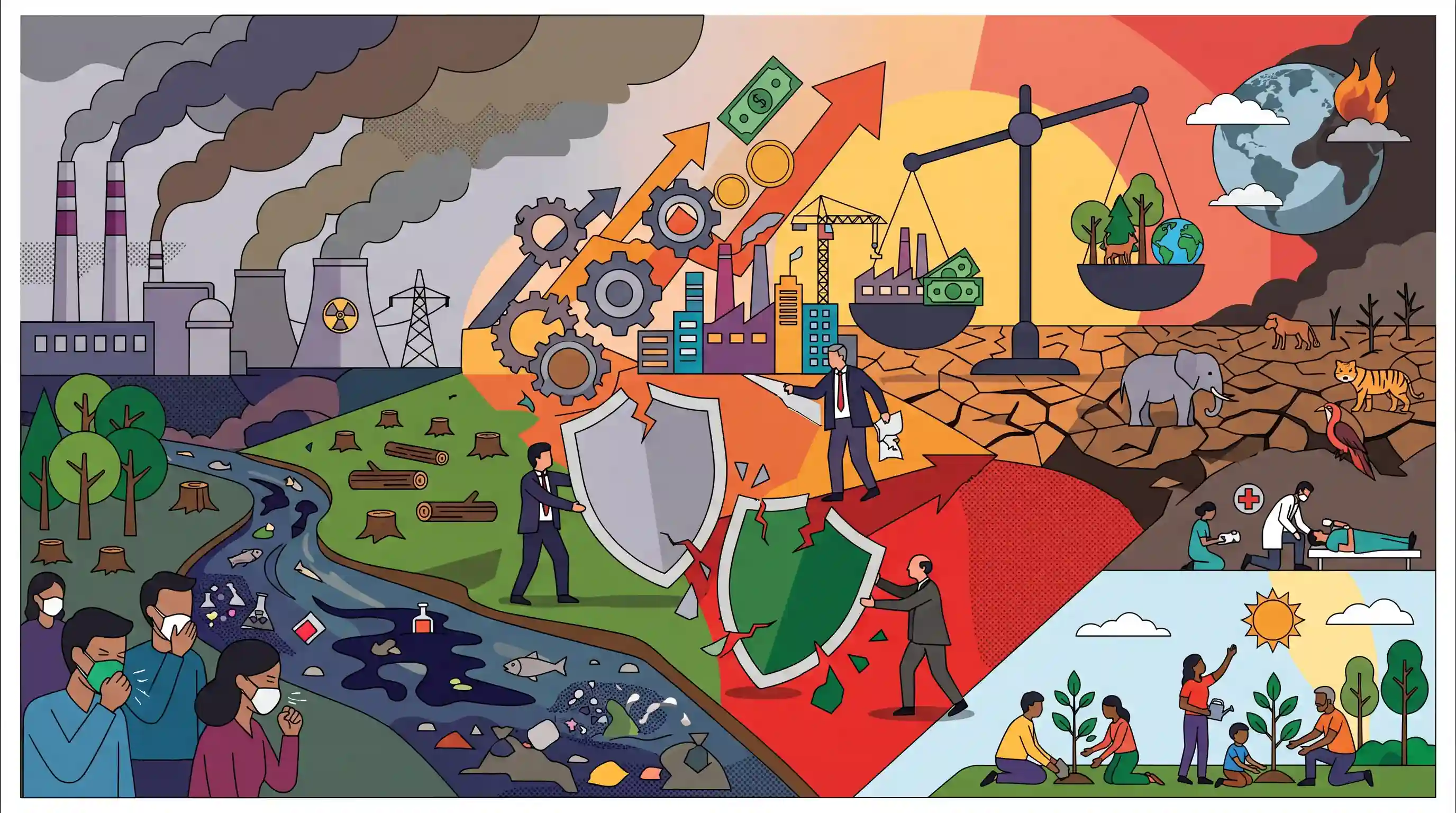
The article presents a critical overview of the deteriorating state of India's environment, highlighting the escalating crises of air and water pollution, deforestation, and biodiversity loss. It argues that recent policy shifts and legislative amendments have systematically weakened environmental governance, such as the Environmental Impact Assessment (EIA) processes and forest protection laws, in favor of rapid industrial and infrastructure development. This dilution of regulatory frameworks not only exacerbates public health risks but also contradicts India's global climate commitments. The piece underscores the urgent need to balance economic growth with stringent ecological safeguards, calling for empowered institutional oversight, transparent policy-making, and the active participation of local communities in conservation efforts.
Key Points
- India is facing an acute environmental crisis, marked by severe air and water pollution that poses significant public health risks and degrades ecological health.
- Recent amendments to environmental frameworks, including the Forest Conservation Act and EIA norms, reflect a trend of diluting ecological safeguards to fast-track infrastructure and industrial projects.
- There is a glaring contradiction between India's ambitious international climate pledges, such as the Net Zero target, and the ground reality of unchecked local environmental degradation.
- Regulatory bodies like pollution control boards and the NGT often struggle with enforcement due to systemic loopholes, lack of capacity, and policy overrides.
- A course correction is required that prioritizes sustainable development, ensures transparent and participatory environmental governance, and protects the rights of forest-dwelling and marginalized communities.
Important Terms
Environment Protection Act, 1986

An "umbrella" legislation enacted post-Bhopal Gas Tragedy (1984) that empowers the Central Government to coordinate state activities and set national standards for environmental quality and pollutant discharge.
UPSC context
GS Paper 3: Environmental Governance. Tests understanding of the constitutional basis (Article 253) and federal structure of environmental laws.
Forest (Conservation) Amendment Act, 2023
A 2023 law amending the 1980 Act, restricting its scope to 'notified' forests and exempting strategic projects (e.g., within 100km of borders) from clearance requirements to balance security and conservation.
UPSC context
GS Paper 3: Conservation. Crucial for discussing the 'development vs. environment' debate and recent legislative shifts in forest rights.
Environmental Impact Assessment (EIA) Notification
A statutory process under the 1986 Act to evaluate a project's potential socio-environmental impacts before approval. The 2020 Draft sparked controversy over 'post-facto' clearances and reduced public consultation.
UPSC context
GS Paper 3: EIA. A core syllabus topic; tests knowledge of the 'Precautionary Principle' and public participation in governance.
National Green Tribunal (NGT)
A specialized statutory body established in 2010 for the expeditious disposal of environmental cases, operating on principles of natural justice rather than the Code of Civil Procedure.
UPSC context
GS Paper 2 & 3: Statutory Bodies/Environment. Important for its 'suo motu' powers and role in environmental jurisprudence.
Central Pollution Control Board (CPCB)
A statutory organization (est. 1974) responsible for monitoring air and water quality, advising the government on pollution abatement, and coordinating State Pollution Control Boards.
UPSC context
GS Paper 3: Pollution control. Often compared with NGT (UPSC 2018) regarding statutory origins and functional mandates.
Ministry of Environment, Forest and Climate Change (MoEFCC)
The nodal agency of the Central Government for planning, promotion, coordination, and overseeing the implementation of India's environmental and forestry policies and programmes.
UPSC context
GS Paper 2: Government Policies. Tests knowledge of the executive's role in implementing international climate commitments and domestic laws.
Prelims Trap
The Forest Conservation Amendment Act 2023 exempts all forest lands within 100 km of borders from clearance for any infrastructure project.
The exemption applies only to "strategic linear projects of national importance and concerning national security" within 100 km of borders, not blanket commercial or general infrastructure.
Static Concepts Connected
What principles and laws guide the National Green Tribunal's (NGT) adjudications?
- Natural Justice: The NGT is not bound by the Code of Civil Procedure, 1908, but is guided by the principles of natural justice.
- Core Principles: It is legally mandated to apply the precautionary principle, sustainable development, and the polluter pays principle in its orders.
- Jurisdictional Limits: Hears civil cases under 7 specific laws (e.g., Water Act, Forest Act, EPA 1986). It does NOT have jurisdiction over the Wildlife Protection Act, 1972.
What are the key stages of the Environmental Impact Assessment (EIA) process in India?
- Screening & Scoping: Determining if a project requires EIA (Screening) and defining the comprehensive terms of reference for the environmental study (Scoping).
- Public Consultation: Gathering concerns from local communities. Notably, certain projects (like Category B2 or strategic projects) are exempt from this mandatory step.
- Appraisal: Final evaluation by the Expert Appraisal Committee (EAC) of the EIA report before granting or rejecting environmental clearance.
Cross-Topic Patterns
Global climate diplomacy vs. Domestic ecological relaxations
India's ambitious Net-Zero 2070 and Panchamrit targets contrast sharply with domestic policies diluting forest clearances, highlighting the tension between international climate diplomacy and domestic 'ease of doing business' initiatives.
Urban governance and water pollution metrics
The degradation of rivers via untreated urban effluents connects directly to municipal solid waste management rules, testing the Biological Oxygen Demand (BOD) metric—a frequent Prelims favorite.

Expect a Prelims question comparing NGT's statutory jurisdiction with CPCB's powers, specifically testing exemptions in the FCA 2023.
Linked PYQs · 4
Linked PYQs · 4
- 2024MainsGS3
What role do environmental NGOs and activists play in influencing Environmental Impact Assessment (EIA) outcomes for major projects in India? Cite four examples with all important details.
- 2024MainsGS3
Industrial pollution of river water is a significant environmental issue in India. Discuss the various mitigation measures to deal with this problem and also the government's initiatives in this regard.
- 2019PrelimsGS1
Consider the following statements : The Environment Protection Act, 1986 empowers the Government of India to 1. state the requirement of public participation in the process of environmental protection, and the procedure and manner in which it is sought 2. lay down the standards for emission or discharge of environmental pollutants from various sources Which of the statements given above is/are correct?
- 2017MainsGS3
'Climate change' is a global problem. How India will be affected by climate change? How Himalayan and coastal states of India will be affected by climate change?
