Air Pollution and the Governance Gap in Public Health Policy
Source:Indian Express ↗
Why It Matters
Understanding the intersection of environmental issues and public health is crucial for civil servants to design holistic, multi-sectoral policies. This article highlights the governance gaps caused by treating interlinked crises in silos, a frequent analytical theme in Mains GS2 and GS3.
Summary
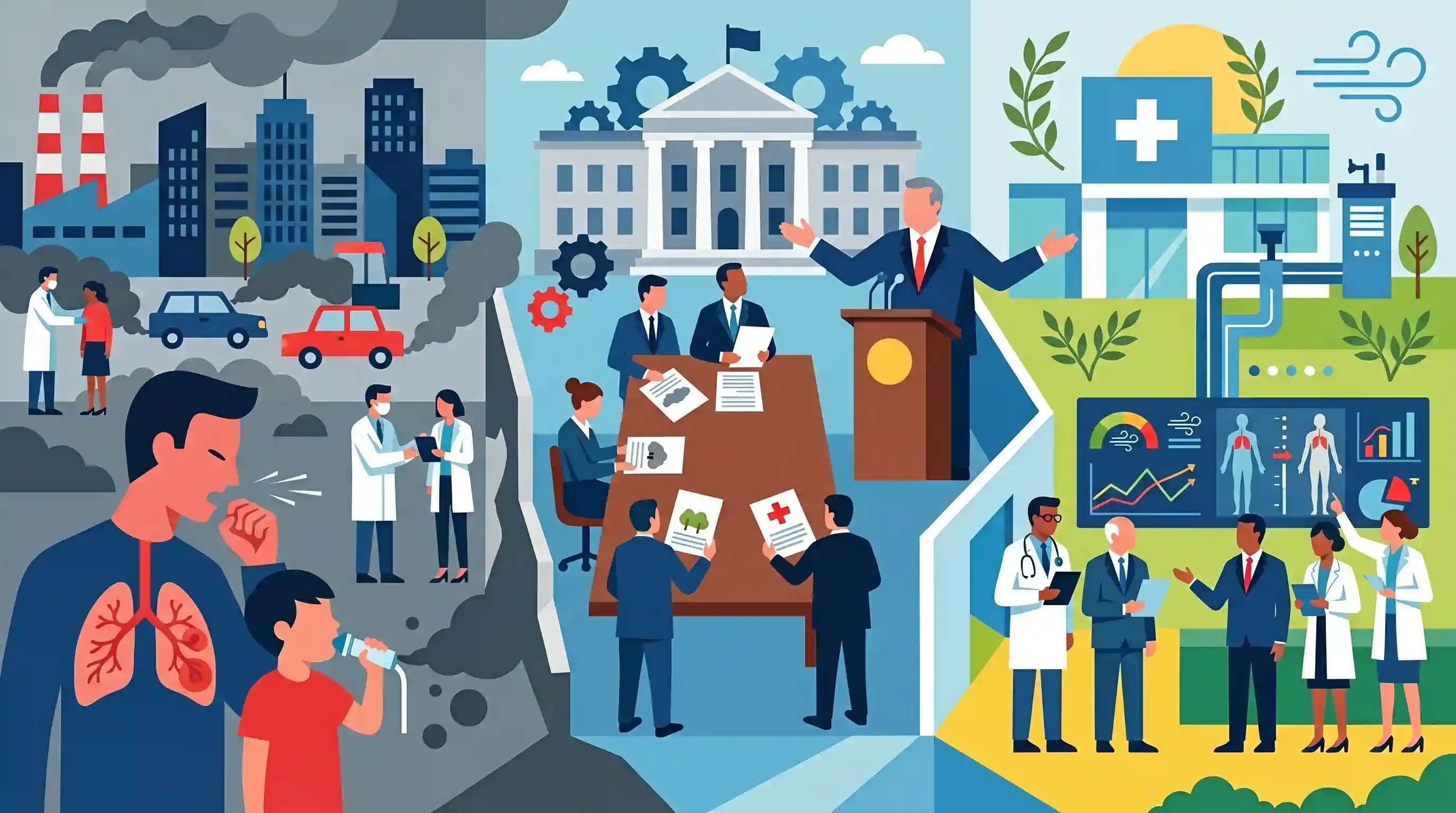
The article explores the critical disconnect in Indian policymaking where air pollution, despite its devastating toll on human life and health, is not treated as a top-tier public health priority. It argues that while seasonal smog and environmental degradation capture headlines, the systemic health crisis—manifesting in respiratory and cardiovascular diseases—fails to drive health policy or political action. The piece underscores the need to reframe air quality from a purely environmental concern to an urgent public health imperative, calling for the integration of air pollution mitigation into mainstream health infrastructure and governance frameworks.
Key Points
- Air pollution in India is widely acknowledged as a severe environmental and meteorological issue, but it is rarely treated with the urgency of a public health crisis.
- Despite staggering health impacts—including chronic respiratory diseases, cardiovascular issues, and a reduction in life expectancy—clean air is seldom prioritized in healthcare policies or political agendas.
- The disconnect stems from siloing pollution as purely an environmental problem rather than integrating it into the core of health governance and primary health infrastructure planning.
- Bridging this gap requires recognizing clean air as a fundamental aspect of the Right to Health (Article 21), necessitating multi-sectoral coordination between health, environment, and urban planning bodies.
Important Terms
National Clean Air Programme (NCAP)

A flagship central scheme launched in 2019 to reduce particulate matter (PM10 and PM2.5) concentrations by 20-30% by 2024, later revised to a 40% reduction target by 2026.
UPSC context
GS3/Environment. Focuses on central policy frameworks, time-bound pollution targets, and urban air quality management.
Non-attainment Cities
Cities identified by the Central Pollution Control Board (CPCB) that have consistently failed to meet the National Ambient Air Quality Standards (NAAQS) for a period of five years.
UPSC context
GS3/Environment. Key for understanding the geographical targeting and implementation of the National Clean Air Programme.
National Programme on Climate Change and Human Health (NPCCHH)
A Ministry of Health initiative launched in 2019 to increase health sector preparedness and response to climate-sensitive illnesses, including respiratory diseases caused by air pollution.
UPSC context
GS2/Health. Essential for topics regarding inter-ministerial coordination and the integration of environmental issues into public health policy.
WHO Air Quality Guidelines (AQGs)
International health-based benchmarks for air quality; the 2021 update significantly tightened the recommended safe limits for pollutants like PM2.5 (from 10 to 5 μg/m³) to protect human health.
UPSC context
GS2/Health & GS3/Environment. Relevant for comparing India's national standards (NAAQS) against global scientific health recommendations.
Particulate Matter (PM2.5)
Fine inhalable particles with diameters 2.5 micrometers or smaller; they are a primary public health concern as they can enter the bloodstream and cause systemic cardiovascular and respiratory diseases.
UPSC context
GS3/Science & Environment. Tests understanding of specific pollutants and their direct biological impact on the human health crisis.
Ministry of Health and Family Welfare (MoHFW)
The nodal agency for India's health policy; in the context of pollution, it manages the health adaptation plans and surveillance of pollution-linked respiratory illnesses.
UPSC context
GS2/Governance. Evaluates the role of health governance in addressing environmental determinants of health and non-communicable diseases.
Ministry of Environment, Forest and Climate Change (MoEFCC)
The central ministry responsible for planning and overseeing environmental policies, implementing the Air Act (1981), and serving as the nodal agency for the National Clean Air Programme.
UPSC context
GS3/Environment. Focuses on the institutional and regulatory framework for pollution control and environmental legislation in India.
Prelims Trap
The National Clean Air Programme (NCAP) sets legally binding public health targets to reduce respiratory diseases by 2026.
NCAP is a non-binding framework primarily focused on environmental compliance (reducing PM concentration) in non-attainment cities. It explicitly lacks integrated public health targets.
Static Concepts Connected
How does the Indian Constitution protect the right to clean air?
- Article 21: The Supreme Court (Subhash Kumar v. State of Bihar, 1991) expanded the right to life to include the right to a pollution-free environment.
- DPSP (Article 48A): Directs the State to protect and improve the environment and safeguard forests and wildlife.
- Fundamental Duties (51A): Mandates citizens to protect and improve the natural environment including forests, lakes, and rivers.
What are the core features of the National Clean Air Programme (NCAP)?
- Objective: Updated target to achieve a 40% reduction in particulate matter (PM2.5 and PM10) concentrations by 2026.
- Target Area: Implemented in 131 'non-attainment' cities that consistently failed to meet National Ambient Air Quality Standards (NAAQS) over five years.
- Non-binding Nature: It is a collaborative, cross-sectoral framework, not legally binding, functioning without penal provisions for non-compliance.
Cross-Topic Patterns
Urbanization & Non-Communicable Diseases
The link between vehicular emissions, poor urban planning, and rising cardiovascular/respiratory ailments connects GS1 (Urbanization) directly with GS2 (Health).
Siloed Governance vs. Welfare Policies
The disconnect between MoEFCC and MoHFW highlights a classic GS2 governance theme: siloed administration defeating overarching welfare goals like public health.

Mains GS2 2026 will likely test the 'Health in All Policies' (HiAP) approach, using air pollution as a case study for siloed governance.
Linked PYQs · 3
Linked PYQs · 3
- 2021MainsGS3
Describe the key points of the revised Global Air Quality Guidelines (AQGs) recently released by the World Health Organisation (WHO). How are these different from its last update in 2005? What changes in India's National Clean Air Programme are required to achieve these revised standards?
- 2021MainsGS2
“Besides being a moral imperative of a Welfare State, primary health structure is a necessary precondition for sustainable development.” Analyze.
- 2020MainsGS2
In order to enhance the prospects of social development, sound and adequate health care policies are needed particularly in the fields of geriatric and maternal health care. Discuss.
