Digital divide and exclusion in public infrastructure delivery
Source:The Hindu ↗
Why It Matters
The transition to digital governance is a cornerstone of modern administration. Understanding the limitations and exclusionary impacts of technology in welfare delivery is critical for civil servants to formulate balanced policies that prioritize inclusive, citizen-centric governance over mere technological integration.
Summary
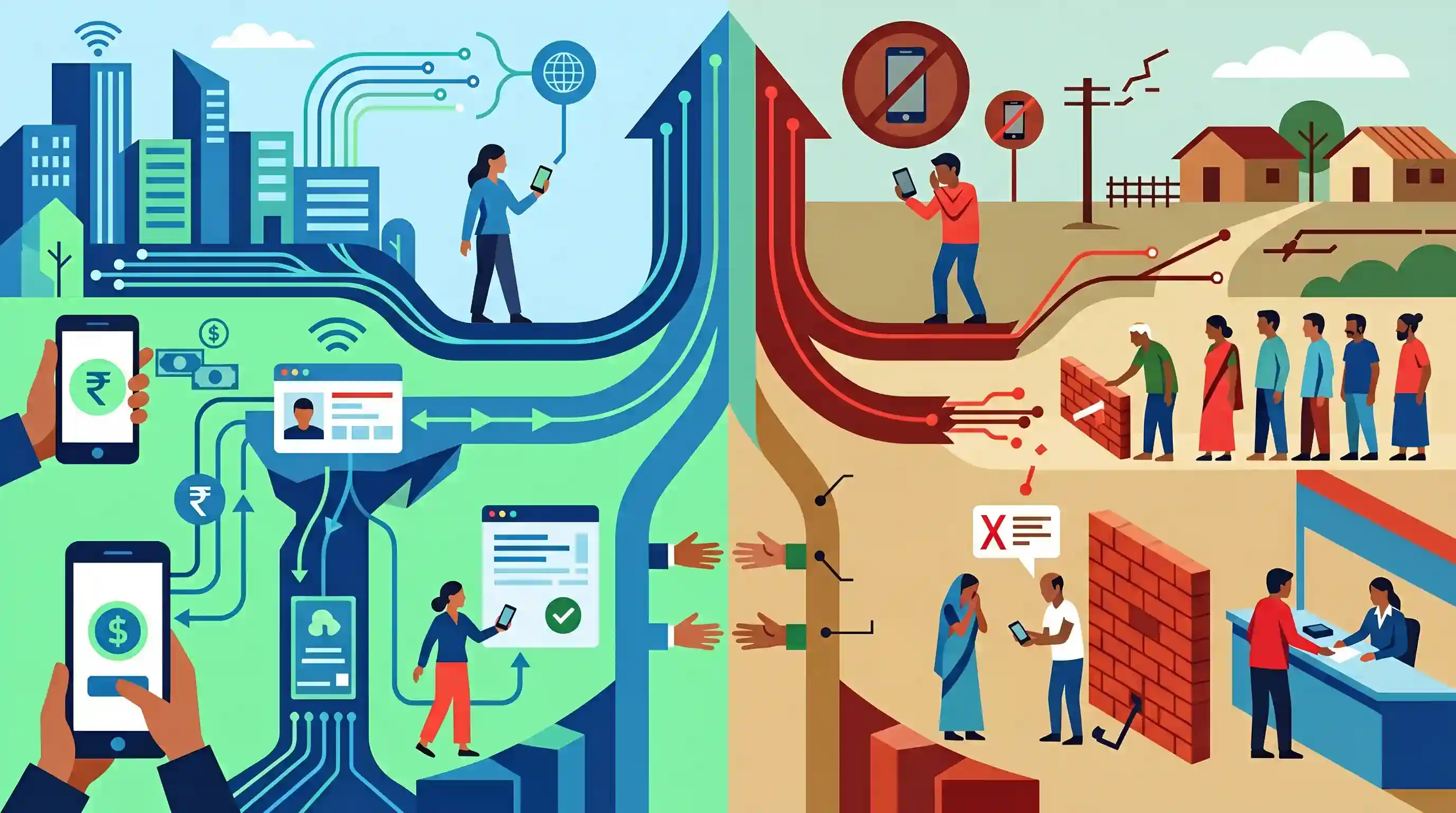
The article explores the 'Digital India paradox,' wherein India's aggressive push toward digitalization and the widespread success of its Digital Public Infrastructure (DPI) coexist with a deepening digital divide. While digital payments and e-governance initiatives have improved macro-level efficiency and service delivery, they frequently exclude the most vulnerable populations. Barriers such as digital illiteracy, poor rural connectivity, lack of access to smartphones, and strict technological mandates in welfare schemes often deny essential services to those who need them most. The piece argues that true inclusive growth requires acknowledging this paradox, ensuring alternative non-digital safety nets, and focusing on user-centric governance rather than merely backend technological integration.
Key Points
- India's rapid expansion of Digital Public Infrastructure (DPI) has revolutionized e-governance, but it has simultaneously created systemic dependencies on technology.
- A persistent digital divide continues to marginalize rural populations, the elderly, and economically weaker sections who lack reliable internet, devices, or digital literacy.
- The mandatory integration of digital tools in welfare delivery (e.g., Aadhaar-enabled systems or digital attendance) often leads to the exclusion of vulnerable beneficiaries due to technical glitches or biometric failures.
- The core paradox of Digital India is that tools intended to democratize access and drive inclusive economic growth are inadvertently erecting new barriers for the already disadvantaged.
- Addressing this paradox requires a citizen-centric approach to e-governance that retains accessible non-digital alternatives and heavily invests in grassroots digital literacy.
Important Terms
Digital Public Infrastructure (DPI)

Foundational, open-source digital systems (e.g., Aadhaar, UPI) enabling large-scale public and private service delivery. They function as 'digital rails' for an inclusive digital economy.
UPSC context
GS Paper 2 & 3: Governance, S&T, and Economy. Focuses on 'India Stack' and public service delivery models.
Digital Divide
The gap between social, economic, and geographic groups in access to, use of, and benefits from information and communication technologies.
UPSC context
GS Paper 2: Social Justice and Governance. Highlights exclusion in welfare schemes and educational inequality.
Digital India
A flagship 2015 initiative aimed at transforming India into a digitally empowered society and knowledge economy by improving online infrastructure and internet connectivity.
UPSC context
GS Paper 2 & 3: Major government flagship programme. Tests understanding of digital transformation and administrative reforms.
Unified Payments Interface (UPI)
A real-time, instant payment system developed by the National Payments Corporation of India (NPCI) allowing inter-bank peer-to-peer and person-to-merchant transactions via mobile.
UPSC context
GS Paper 3: Indian Economy and Financial Inclusion. Key component of India's leadership in real-time payments.
E-governance
The use of Information and Communication Technology (ICT) to provide government services, enhance transparency, and improve administrative efficiency.
UPSC context
GS Paper 2: Governance. Tests 'Minimum Government, Maximum Governance' and citizen-centric service delivery models.
JAM Trinity
The integration of Jan Dhan (bank accounts), Aadhaar (biometric identity), and Mobile (connectivity) to facilitate direct benefit transfers and financial inclusion.
UPSC context
GS Paper 2 & 3: Welfare schemes and Economy. Critical for discussing leakages in subsidies and financial empowerment.
Prelims Trap
"Digital public infrastructure guarantees 100% financial inclusion and eliminates exclusion errors in welfare delivery."
While DPI plugs leakages (reduces inclusion errors), strict technological mandates often INCREASE exclusion errors by denying the genuinely deserving due to server or biometric failures.
Static Concepts Connected
What are the core components of India's Digital Public Infrastructure (India Stack)?
- Identity Layer: Aadhaar provides a foundational, biometric-based digital identity for authentication (e.g., eKYC, eSign).
- Payments Layer: Unified Payments Interface (UPI) and Aadhaar Enabled Payment System (AePS) facilitate interoperable, high-volume, fast financial transfers.
- Data Layer: Data Empowerment and Protection Architecture (DEPA) enables secure, user-consent-based data sharing (e.g., the Account Aggregator framework).
What is the difference between Exclusion and Inclusion errors in welfare schemes?
- Exclusion Error: When eligible, deserving beneficiaries are denied benefits, often due to strict mandates or technical glitches like biometric mismatch.
- Inclusion Error: When ineligible people receive benefits, such as through duplicate ration cards or "ghost" beneficiaries. Technology primarily targets this.
Cross-Topic Patterns
JAM Trinity vs Right to Food
The drive to eliminate PDS leakages via Aadhaar-Based Biometric Authentication (ABBA) is frequently challenged under the National Food Security Act when biometric or server failures deny vital rations.
MGNREGA & Digital Attendance mandates
The mandate for the NMMS app links statutory rural employment rights to smartphone ownership and internet availability, merging digital divide issues with rural poverty schemes.

A GS-2 Mains question analyzing the 'exclusion errors' caused by mandatory DPI in welfare schemes (like ABBA and NMMS) is highly probable.
Linked PYQs · 5
Linked PYQs · 5
- 2025MainsGS2
e-governance projects have a built-in bias towards technology and back-end integration than user-centric designs. Examine.
- 2019MainsGS2
Performance of welfare schemes that are implemented for vulnerable sections is not so effective due to absence of their awareness and active involvement at all stages of policy process. Discuss.
- 2021MainsGS3
“Investment in infrastructure is essential for more rapid and inclusive economic growth.” Discuss in the light of India's experience.
- 2018PrelimsGS1
Which of the following is/are the aim/aims of "Digital India" Plan of the Government of India? 1. Formation of India's own Internet companies like China did. 2. Establish a policy framework to encourage overseas multinational corporations that collect Big Data to build their large data centres within our national geographical boundaries. 3. Connect many of our villages to the Internet and bring Wi-Fi to many of our schools, public places and major tourist centres. Select the correct answer using the code given below:
- 2023PrelimsGS1
Consider the following statements about G-20: 1. The G-20 group was originally established as a platform for the Finance Ministers and Central Bank Governors to discuss the international economic and financial issues. 2. Digital public infrastructure is one of India's G-20 priorities. Which of the statements given above is/are correct?
