Ecological Degradation and Conservation of Western Ghats Forests
Source:Indian Express ↗
কেন এটি গুরুত্বপূর্ণ
It addresses the perpetual conflict between developmental/renewable energy projects and biodiversity conservation in fragile ecosystems like the Western Ghats, highly relevant for GS3 Environment and Ecology.
সারসংক্ষেপ
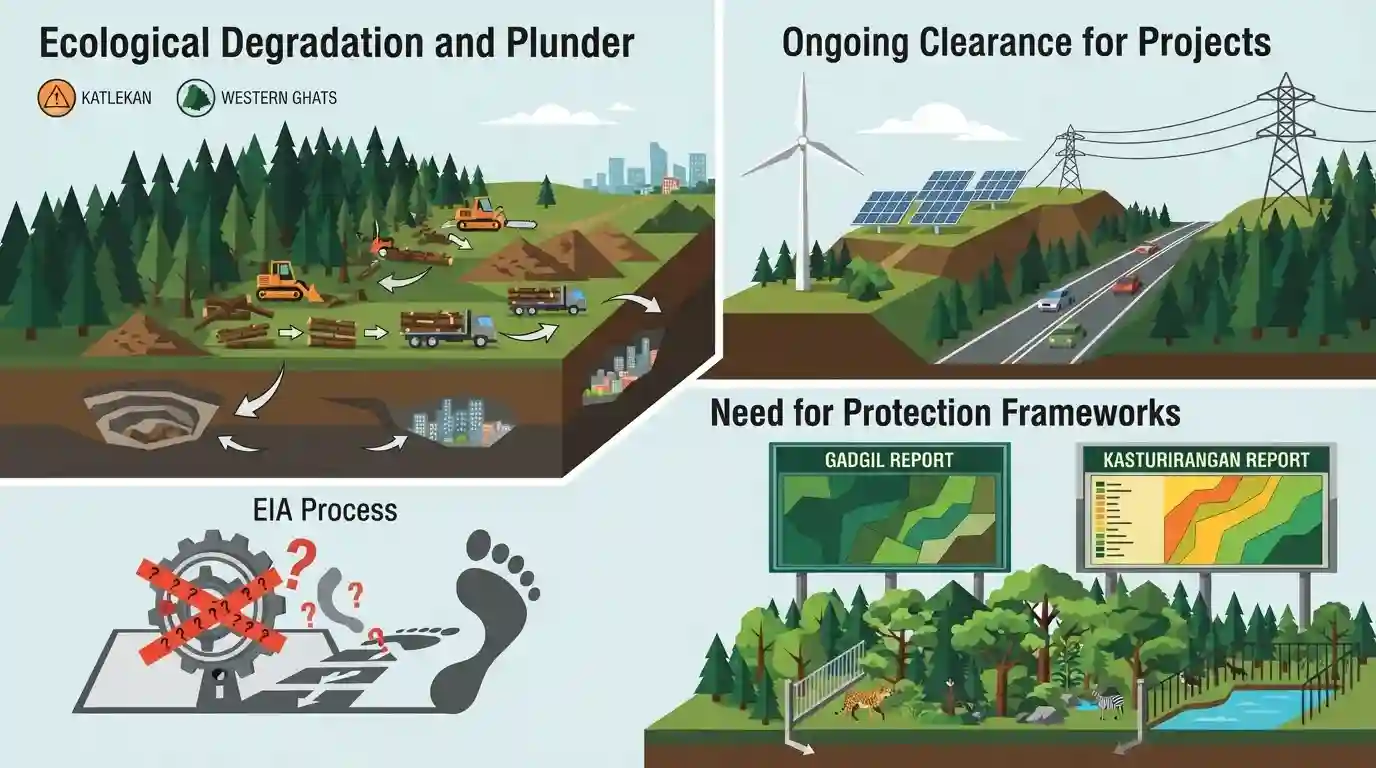
The article discusses the systematic plunder and ecological degradation of the Western Ghats, using the case of Katlekan's dark forests in Karnataka. It critiques the ongoing clearance of pristine evergreen forests for infrastructure and renewable energy projects, stressing the urgent need to implement ecological protection frameworks like the Gadgil and Kasturirangan committee reports.
মূল বিষয়
- The article highlights the severe ecological degradation and plunder of the Western Ghats, particularly focusing on the dark forests of Katlekan in Karnataka.
- It criticizes current developmental models, including poorly planned infrastructure and renewable energy projects (such as pumped storage hydro and transmission lines) that threaten pristine evergreen forests.
- It emphasizes the failure to implement expert panel recommendations like the Gadgil and Kasturirangan committee reports regarding the protection of Ecologically Sensitive Areas (ESAs).
- The piece calls for a balance between green energy transitions and local ecological preservation, arguing that destroying ancient evergreen ecosystems for energy projects is self-defeating.
গুরুত্বপূর্ণ শব্দ
Gadgil Committee

An expert panel chaired by Madhav Gadgil (2011) that recommended declaring nearly 64% of the Western Ghats as an Ecologically Sensitive Area, proposing decentralized, bottom-up governance and strict bans on environmentally destructive activities.
UPSC context
GS Paper III (Environment and Ecology): Evaluates developmental pressures versus ecological security, federalism, and recommendations of expert committees on fragile ecosystems.
Kasturirangan Committee
A high-level working group chaired by K. Kasturirangan (2013) that proposed designating roughly 37% of the Western Ghats as an Ecologically Sensitive Area, aiming to balance strict conservation with sustainable development.
UPSC context
GS Paper III (Environment): Important for questions on balancing biodiversity conservation with infrastructure development and energy needs in eco-sensitive zones.
Ecologically Sensitive Area (ESA) notification
A specific land classification designating vulnerable regions where commercial activities, mining, and large infrastructure projects are heavily restricted or prohibited to protect unique biodiversity and fragile ecology.
UPSC context
GS Paper III (Biodiversity and Environmental Impact Assessment): Crucial for studying legal mechanisms protecting biodiversity hotspots against anthropogenic threats.
Forest Conservation Act
Primary legislation enacted in 1980 to regulate the diversion of forest land for non-forestry purposes, requiring central government approval and compensatory afforestation, recently amended in 2023.
UPSC context
GS Paper II / III (Polity & Environment): Evaluates statutory checks on deforestation, rights of forest-dwelling communities, and amendments altering forest definitions.
Western Ghats Task Force
State-level institutional mechanisms formed in states like Karnataka to oversee ecological preservation, curb illegal encroachments, and implement integrated management plans for the Western Ghats.
UPSC context
GS Paper III (Environment Governance): Tests sub-national administrative accountability, enforcement challenges, and state-level policy execution in biodiversity hot-spots.
প্রিলিমস ফাঁদ
both the Gadgil and Kasturirangan committees recommended designating the entire Western Ghats as an Ecologically Sensitive Area
Aspirants often confuse the two reports: the Gadgil Committee recommended designating the entire Western Ghats as ecologically sensitive, whereas the Kasturirangan Committee recommended covering only about 37%.
সংযুক্ত স্থির ধারণা
What are the key differences between the Gadgil Committee and Kasturirangan Committee reports on the Western Ghats?
- Gadgil Report: WGEEP (2011) classified the entire Western Ghats into ESA 1, 2, and 3, restricting all developmental activities and promoting decentralized governance.
- Kasturirangan Report: HLWG (2013) adopted a broader remote-sensing approach, recommending that only 37% of the Western Ghats be notified as Ecologically Sensitive Area (ESA).
- State Pushback: Both reports faced intense pushback from six concerned states due to livelihood concerns, land restrictions, and fears of stifling local economic growth.
আন্তঃবিষয় প্যাটার্ন
Renewable Energy vs. Ecological Carrying Capacity
Unplanned infrastructure and pumped storage hydro projects in pristine forests highlight the conflict between India's net-zero transition and local carrying capacity limits.
Gadgil vs. Kasturirangan: Conservation Governance Models
The debate over whether to implement the Gadgil or Kasturirangan report reflects the classic tension between decentralized grassroots conservation and top-down developmental models.

Expect a multi-statement statement comparing Gadgil (WGEEP) and Kasturirangan committee recommendations on Western Ghats ESAs.
সংযুক্ত PYQ · 2
সংযুক্ত PYQ · 2
- 2019MainsGS3
Define the concept of carrying capacity of an ecosystem as relevant to an environment. Explain how understanding this concept is vital while planning for sustainable development of a region.
- 2024MainsGS3
What role do environmental NGOs and activists play in influencing Environmental Impact Assessment (EIA) outcomes for major projects in India? Cite four examples with all important details.
