Misuse of Conspiracy Charges and Anti Terror Laws in India
Source:The Hindu ↗
Why It Matters
The misuse of anti-terror laws and conspiracy charges has become a critical issue in Indian polity, directly impacting the fundamental rights to free speech and dissent. It is a recurring theme in UPSC Mains (both GS-2 for constitutional rights and GS-3 for internal security), requiring aspirants to critically analyze the balance between national security and human rights.
Summary
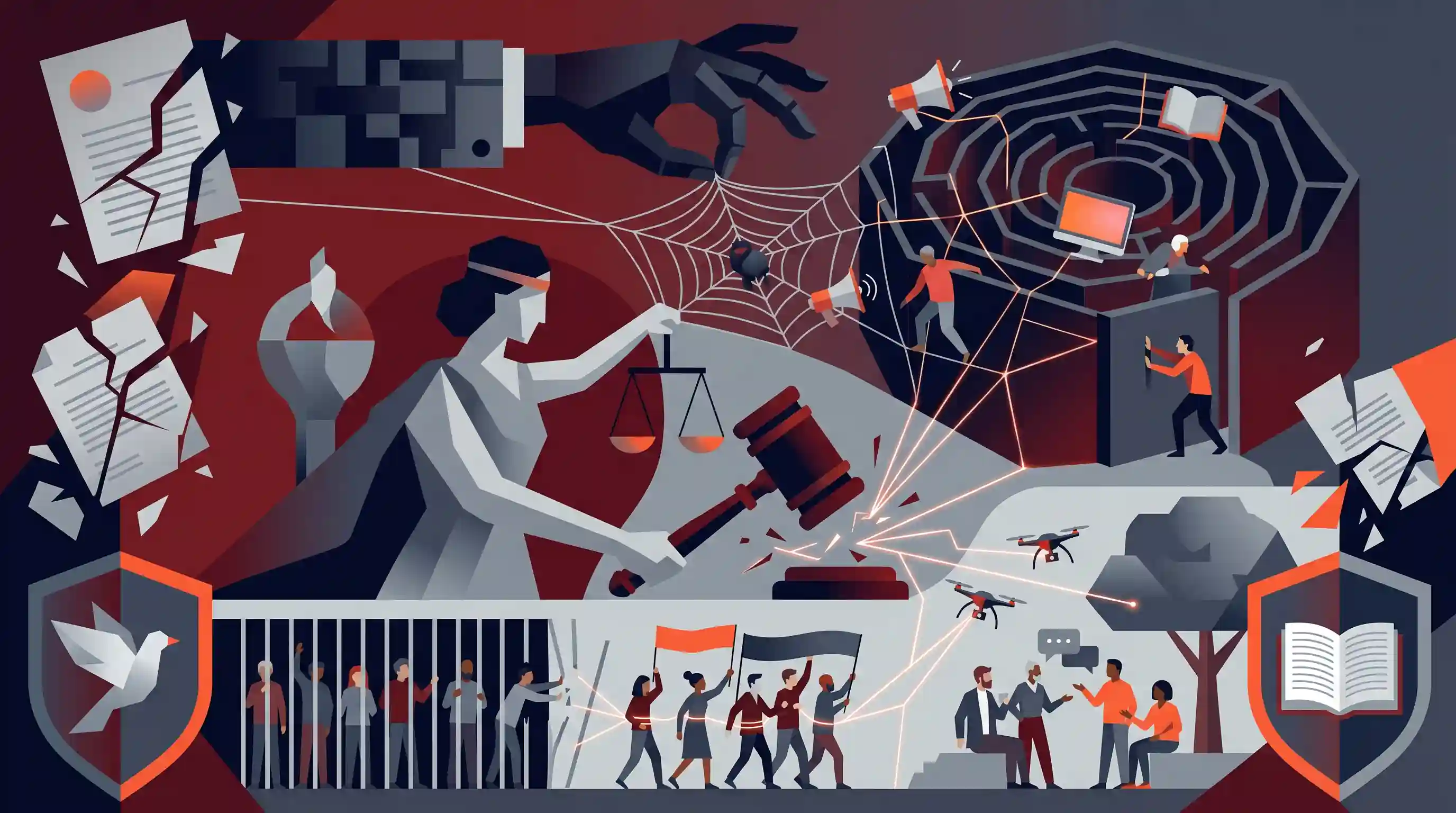
The article critically examines the increasing tendency of state investigative agencies to weave isolated incidents, electronic communications, and democratic dissent into grand 'criminal conspiracy' narratives. By leveraging stringent laws like the UAPA, agencies wire together disparate individuals—who may only share common ideologies rather than actual criminal intent—to deny bail and prolong incarceration. The piece warns that this broad application of conspiracy charges poses a grave threat to civil liberties, highlighting the urgent need for judicial vigilance to protect fundamental rights and prevent the criminalization of legitimate democratic opposition.
Key Points
- Investigating agencies increasingly invoke the legal doctrine of 'criminal conspiracy' to link disparate individuals, activists, and isolated events into a singular overarching narrative.
- By utilizing stringent anti-terror laws such as the Unlawful Activities (Prevention) Act (UAPA), the state effectively shifts the burden of proof, making it exceptionally difficult for the accused to secure bail.
- The practice of 'wiring together' electronic communications, participation in protests, and civic activism into a larger terrorist or seditious conspiracy severely undermines fundamental rights, including freedom of speech and expression.
- The article underscores the urgent need for the judiciary to rigorously scrutinize these overarching conspiracy narratives to prevent the weaponization of the criminal justice system against democratic dissent.
Important Terms
Unlawful Activities (Prevention) Act (UAPA)

India's primary anti-terror legislation designed to curb activities threatening national sovereignty. It features stringent bail conditions (Section 43D(5)) that often result in prolonged incarceration without trial.
UPSC context
GS Paper 2/3: Tests internal security, anti-terror laws, and the tension between state power and fundamental rights.
Prevention of Money Laundering Act (PMLA)
A law enacted to combat the laundering of proceeds of crime. It empowers the Enforcement Directorate (ED) with extensive search, seizure, and arrest capabilities to prevent financial crimes.
UPSC context
GS Paper 3: Essential for studying economic offences, money laundering, and the role of specialized investigative agencies.
Criminal Conspiracy (Section 120B)
A legal provision where an agreement between two or more persons to commit an illegal act is itself a substantive offense, even if the crime is not completed.
UPSC context
GS Paper 2: Concerns criminal justice system reforms and the legal threshold for establishing collective criminal intent.
Article 21
A fundamental right guaranteeing that no person shall be deprived of life or personal liberty except via fair, just, and reasonable procedure established by law.
UPSC context
GS Paper 2: Most critical fundamental right; tests knowledge of landmark judicial interpretations (Maneka Gandhi, Puttaswamy).
Judicial Vigilance
The proactive oversight by courts to prevent the state from misusing stringent laws to suppress dissent or violate fundamental rights.
UPSC context
GS Paper 2: Tests the judiciary’s role as the protector of civil liberties and its check on executive overreach.
Code of Criminal Procedure (CrPC)
The procedural law for administering criminal justice in India, currently being replaced by the Bharatiya Nagarik Suraksha Sanhita (BNSS) to modernize legal processes.
UPSC context
GS Paper 2: Focuses on the transition from colonial-era codes to new indigenous criminal laws (BNSS).
Prelims Trap
Mere membership or association with a banned organization automatically attracts terrorism charges and bail denial under UAPA.
The Supreme Court (Vernon Gonsalves case, 2023) clarified that mere association or possession of literature does not attract UAPA; proving active intent is mandatory.
Static Concepts Connected
What are the statutory bail restrictions under the UAPA?
- Section 43D(5): Under Section 43D(5), courts must deny bail if the accusations against the individual are deemed 'prima facie true' based on the case diary.
- Burden of Proof: Unlike ordinary criminal law, the burden shifts heavily to the accused, requiring them to demonstrate the charges are baseless without a full trial.
- Constitutional Override: The Supreme Court (K.A. Najeeb case) ruled that statutory bail bars cannot override the Article 21 right to a speedy trial in cases of prolonged pre-trial detention.
How is 'Criminal Conspiracy' defined in Indian penal law?
- Meeting of Minds: Defined under Section 120A (IPC)/BNS as an agreement between two or more persons to commit an illegal act, or a legal act by illegal means.
- Independent Offense: The conspiracy itself is a standalone offense punishable under Sec 120B; the actual illegal act does not need to be successfully executed.
- Evidentiary Scope: This doctrine allows investigating agencies to link individuals who haven't met, based purely on shared communications or ideological alignment.
Cross-Topic Patterns
UAPA & PMLA: The 'twin conditions' hurdle
Both UAPA (Sec 43D) and PMLA (Sec 45) impose strict statutory bail hurdles, reversing the traditional 'bail is rule, jail is exception' norm by requiring courts to find the accused prima facie innocent.
State security mandates vs. Democratic dissent
The framing of 'conspiracy' bridges GS3 Internal Security mandates (counter-terrorism) with GS2 Fundamental Rights (Art 19, Art 21), a classic friction point often tested in Mains essays.

Expect a GS2 Mains question in 2026 balancing UAPA's stringent bail conditions against Article 21's right to speedy trial.
Linked PYQs · 2
Linked PYQs · 2
- 2019MainsGS3
Indian Government has recently strengthened the anti-terrorism laws by amending the Unlawful Activities (Prevention) Act (UAPA), 1967 and the NIA Act. Analyze the changes in the context of prevailing security environment while discussing the scope and reasons for opposing the UAPA by human rights organizations.
- 2014MainsGS2
What do you understand by the concept "freedom of speech and expression"? Does it cover hate speech also ? Why do the films in India stand on a slightly different plane from other forms of expression ? Discuss.
