Critical Minerals Supply Chain Forms Foundation for Clean Energy Goals
Source:The Hindu ↗
Why It Matters
The transition to clean energy shifts geopolitical dependence from fossil fuels to critical minerals. For UPSC aspirants, understanding the supply chain constraints of rare earth elements and critical minerals is crucial for questions on India's energy independence, EV policy, and environmental sustainability.
Summary
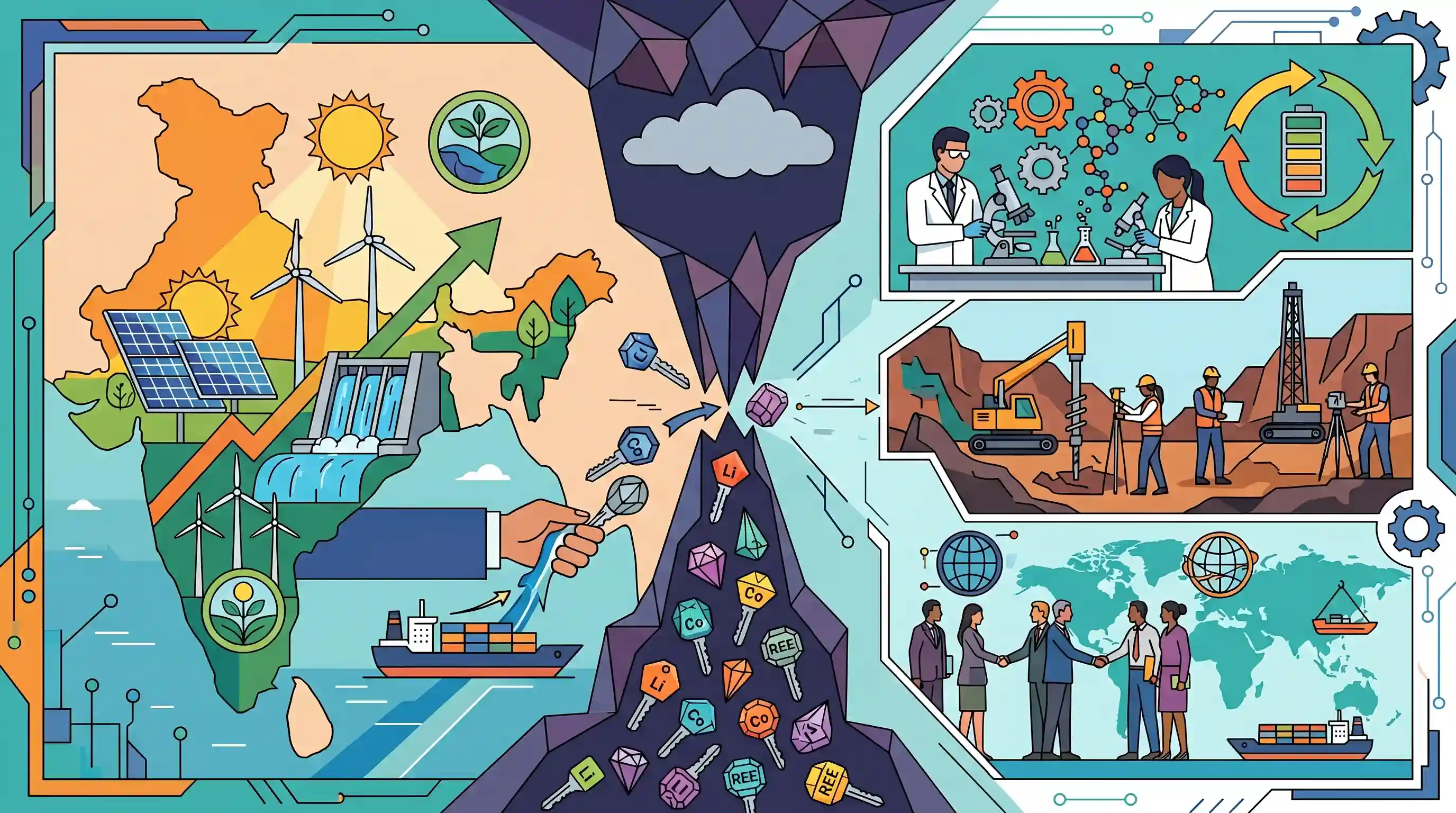
The article highlights that critical minerals are the defining bottleneck in India's clean energy transition. While India has set ambitious targets like achieving 500 GW of non-fossil fuel capacity by 2030 and a Net Zero economy by 2070, its near-total dependence on imported critical minerals (such as lithium, cobalt, and rare earth elements) poses a severe risk to energy security. To mitigate supply chain disruptions and geopolitical vulnerabilities, the analysis emphasizes the urgent need for a multi-pronged strategy. This includes accelerating domestic exploration, leveraging platforms like KABIL for overseas asset acquisition, actively participating in global frameworks like the Minerals Security Partnership (MSP), and promoting domestic R&D in battery recycling and circular economy practices.
Key Points
- Critical minerals (like lithium, cobalt, nickel, and rare earth elements) are indispensable for manufacturing clean energy technologies such as solar panels, wind turbines, and EV batteries.
- India faces profound supply chain vulnerabilities, heavily depending on imports from countries like China, which dominates the global processing of these essential minerals.
- Achieving ambitious climate commitments—including 50% cumulative electric power installed capacity from non-fossil sources by 2030 and Net Zero emissions by 2070—requires securing a stable critical mineral supply chain.
- Strategic interventions must include ramping up domestic exploration and block auctions, securing overseas mining assets through entities like KABIL, joining international alliances like the MSP, and establishing a robust circular economy for battery recycling.
Important Terms
Panchamrit goals

India's five-fold climate action plan announced at COP26, including targets for 500 GW non-fossil energy capacity and achieving Net Zero emissions by 2070.
UPSC context
GS Paper III (Environment); key framework for India's Nationally Determined Contributions (NDCs) and climate diplomacy.
Minerals Security Partnership (MSP)
A US-led strategic alliance of 14 nations and the EU aimed at securing sustainable global supply chains for critical minerals like lithium and cobalt.
UPSC context
GS Paper II (International Relations) & Paper III (Energy Security); reflects India's strategic move to secure resources outside China's influence.
Khanij Bidesh India Limited (KABIL)
A joint venture of NALCO, HCL, and MECL under the Ministry of Mines focused on identifying and acquiring strategic mineral assets overseas.
UPSC context
GS Paper III (Economy/Infrastructure); a crucial institutional mechanism for ensuring raw material security for India's EV and battery sectors.
National Green Hydrogen Mission
A flagship mission to make India a global hub for green hydrogen, targeting 5 million metric tonnes of annual production by 2030.
UPSC context
GS Paper III (Energy/S&T); central to India's strategy for decarbonizing "hard-to-abate" sectors like steel and shipping.
International Energy Agency (IEA)
An autonomous intergovernmental body providing analysis and policy guidance on global energy security; India is currently an associate member seeking full membership.
UPSC context
GS Paper II (International Organizations); tests knowledge of global energy governance and India's expanding role in multilateral institutions.
Prelims Trap
"China holds the largest natural reserves and dominates the global extraction of all critical minerals."
While China dominates refining/processing (e.g., 87% of REEs, 58% of lithium), extraction is largely led by Australia (lithium) and DRC (cobalt). China does not hold the largest reserves for all critical minerals.
Static Concepts Connected
What are Rare Earth Elements (REEs) and their Indian reserves?
- Definition: A set of 17 metallic elements (15 lanthanides plus scandium and yttrium) crucial for high-tech manufacturing, EVs, and renewable energy components.
- Indian Reserves: Found primarily in monazite and ilmenite beach sand placers along the coastal areas of Kerala, Tamil Nadu, and Odisha.
- The 'Rare' Paradox: They are called "rare" not because they are scarce, but because they are highly dispersed in the Earth's crust and difficult to extract economically.
What is the mandate and composition of KABIL?
- Core Objective: A joint venture created to identify, explore, and acquire critical and strategic mineral assets overseas to ensure supply security for India.
- Focus Minerals: Primarily targets the acquisition of Lithium and Cobalt assets in countries like Argentina and Australia.
- Ownership: It is a joint venture of three CPSEs: NALCO, Hindustan Copper Ltd (HCL), and Mineral Exploration Corporation Ltd (MECL), under the Ministry of Mines.
Cross-Topic Patterns
Minerals Security Partnership (MSP) + Geopolitics
The US-led MSP acts as an economic counterpart to alliances like the Quad, aiming to "friend-shore" clean tech supply chains and reduce global dependence on Chinese refining capacity.
Critical Minerals + Battery Waste Rules
Reducing import dependence intersects directly with the Battery Waste Management Rules 2022, which mandate Extended Producer Responsibility (EPR) for recovering materials like lithium and cobalt domestically.

Expect a 2026 multi-statement question combining MSP membership, extraction vs. refining dominance, and India's overseas KABIL acquisitions.
Linked PYQs · 5
Linked PYQs · 5
- 2025MainsGS3
How can India achieve energy independence through clean technology by 2047? How can biotechnology can play a crucial role in this endeavour?
- 2022MainsGS3
Do you think India will meet 50 percent of its energy needs from renewable energy by 2030 ? Justify your answer. How will the shift of subsidies from fossil fuels to renewables help achieve the above objective ? Explain.
- 2025PrelimsGS1
Consider the following statements : Statement I: Some rare earth elements are used in the manufacture of flat television screens and computer monitors. Statement II : Some rare earth elements have phosphorescent properties. Which one of the following is correct in respect of the above statements?
- 2024PrelimsGS1
Consider the following: 1. Battery storage 2. Biomass generators 3. Fuel cells 4. Rooftop solar photovoltaic units How many of the above are considered "Distributed Energy Resources"?
- 2018MainsGS3
“Access to affordable, reliable, sustainable and modern energy is the sine qua non to achieve Sustainable Development Goals (SDGs).” Comment on the progress made in India in this regard.
