One Health Approach and Preventive Statecraft for Zoonotic Risks
Source:The Hindu ↗
Why It Matters
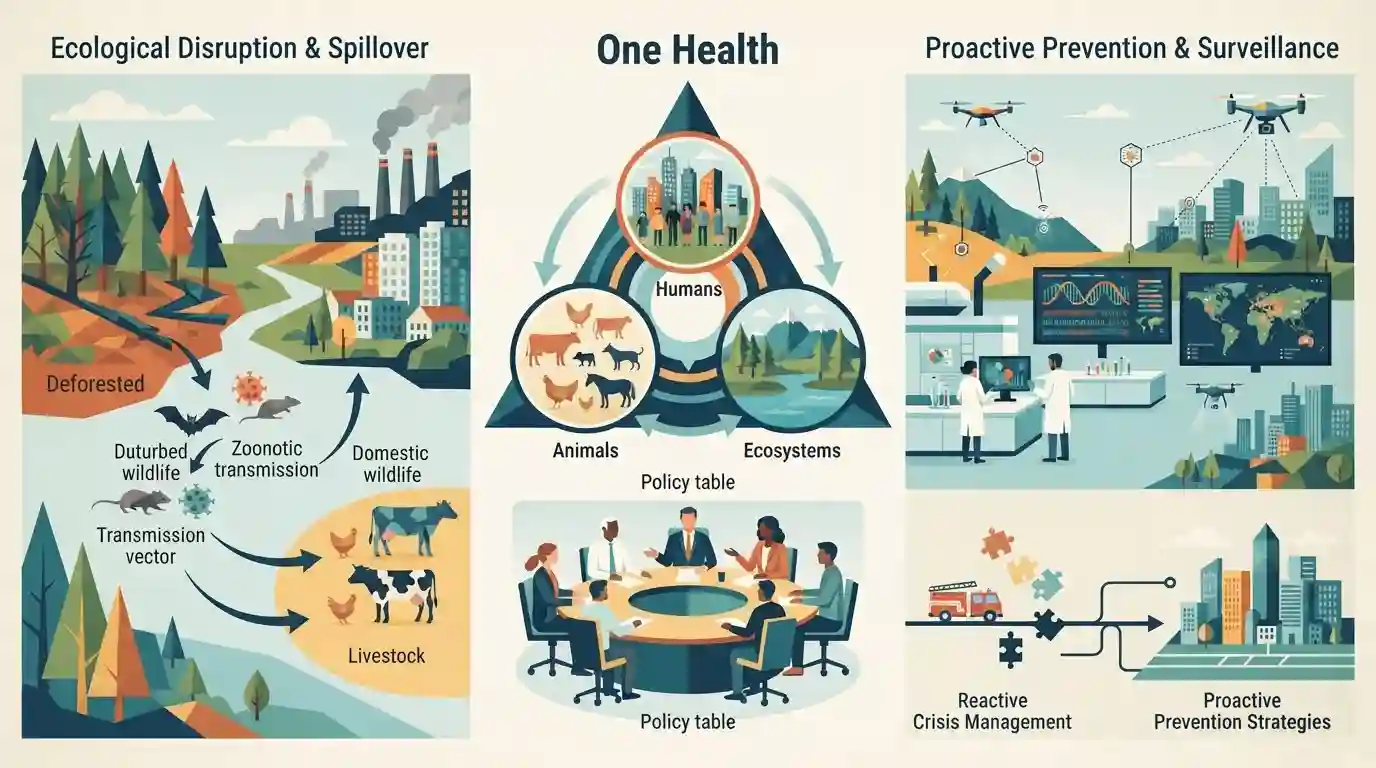
It provides a comprehensive perspective on the One Health framework, linking animal health, environmental changes, and zoonotic spillovers to strategic policy-making and pandemic preparedness, highly relevant for GS Paper 3.
Summary
The article explores the One Health framework through the lens of ecological disruption, zoonotic spillover, and the interconnected health of humans, animals, and ecosystems. It highlights how vectors, livestock management, and environmental changes drive disease emergence, arguing that statecraft must pivot from reactive healthcare to proactive prevention via cross-sectoral integration and genomic surveillance.
Key Points
- The One Health framework emphasizes the interconnectedness of human health, animal health, and the environment, recognizing that zoonotic spillover is heavily driven by ecological disruption and livestock management.
- Pathogens like vector-borne viruses and zoonotic agents thrive due to environmental changes, modern agriculture intensification, and habitat loss, shifting disease burdens globally.
- Effective public health statecraft requires proactive preventive governance—integrating veterinary medicine, wildlife surveillance, and environmental management rather than reactive clinical responses.
- Genomics and modern surveillance tools play a pivotal role in tracking pathogen evolution and cross-species transmission pathways before outbreaks cascade into pandemics.
Important Terms
One Health

An integrated, unifying approach that aims to sustainably balance and optimize the health of people, animals, and ecosystems, recognizing their deep interdependence and shared vulnerability to health threats.
UPSC context
GS Paper II (Health & International Organizations) and GS Paper III (Environment & Disaster Management); tests understanding of holistic disease prevention frameworks.
One Health High Level Expert Panel
A specialized advisory group established by the Quadripartite organizations (FAO, UNEP, WHO, WOAH) to provide scientific guidance on managing risks at the human-animal-environment interface.
UPSC context
GS Paper II (Global Governance & Health) and GS Paper III (Ecology); tests knowledge of institutional mechanisms handling zoonotic spillover.
World Health Organization
A specialized agency of the United Nations responsible for international public health, setting global norms, tracking disease outbreaks, and coordinating international responses to health emergencies.
UPSC context
GS Paper II (International Organizations); tests role of multilateral bodies in global health security and pandemic preparedness.
Prelims Trap
One Health framework emphasizes the interconnectedness of human health, animal health, and the environment
Aspirants often assume One Health is purely an animal-human veterinary initiative, ignoring its critical environmental and ecosystem health component.
Static Concepts Connected
What are the core institutional pillars and objectives of India's National One Health Mission?
- Institutional Scope: Multi-ministerial coordination integrating 16 departments across human health, animal husbandry, forestry, and environment.
- Surveillance Goal: Establishing robust surveillance and early-warning systems for zoonotic and vector-borne pathogens at human-animal-wildlife interfaces.
- Research Focus: Enhancing R&D capacity for diagnostics, vaccines, and genomic sequencing to prevent future pandemic cascades.
Cross-Topic Patterns
One Health and Climate Change Mitigation
Zoonotic spillover driven by deforestation and wetland conversion links public health directly to the National Action Plan on Climate Change and wildlife corridors.
Bureaucratic Silos and Multi-Sectoral Governance
Integrating 16 ministries under the National One Health Mission tests India's bureaucratic capacity for horizontal coordination across agriculture, health, and environment.

Expect an assertion-reason question linking anthropogenic ecological disruption to the efficacy of the National One Health Mission.
Linked PYQs · 2
Linked PYQs · 2
- 2023PrelimsGS1
'Wolbachia method' is sometimes talked about with reference to which one of the following?
- 2025PrelimsGS1
Consider the following statements : Statement I: At the 28th United Nations Climate Change Conference (COP28), India refrained from signing the 'Declaration on Climate and Health'. Statement II : The COP28 Declaration on Climate and Health is a binding declaration; and if signed, it becomes mandatory to decarbonize health sector. Statement III : If India's health sector is decarbonized, the resilience of its health-care system may be compromised. Which one of the following is correct in respect of the above statements?
