One Health Framework and Preventive Public Health Statecraft
Source:The Hindu ↗
Why It Matters
Understanding the One Health framework is vital for UPSC aspirants as zoonotic spillover events, antimicrobial resistance (AMR), and pandemic preparedness form core segments of the GS Paper III syllabus under health and environmental security.
Summary
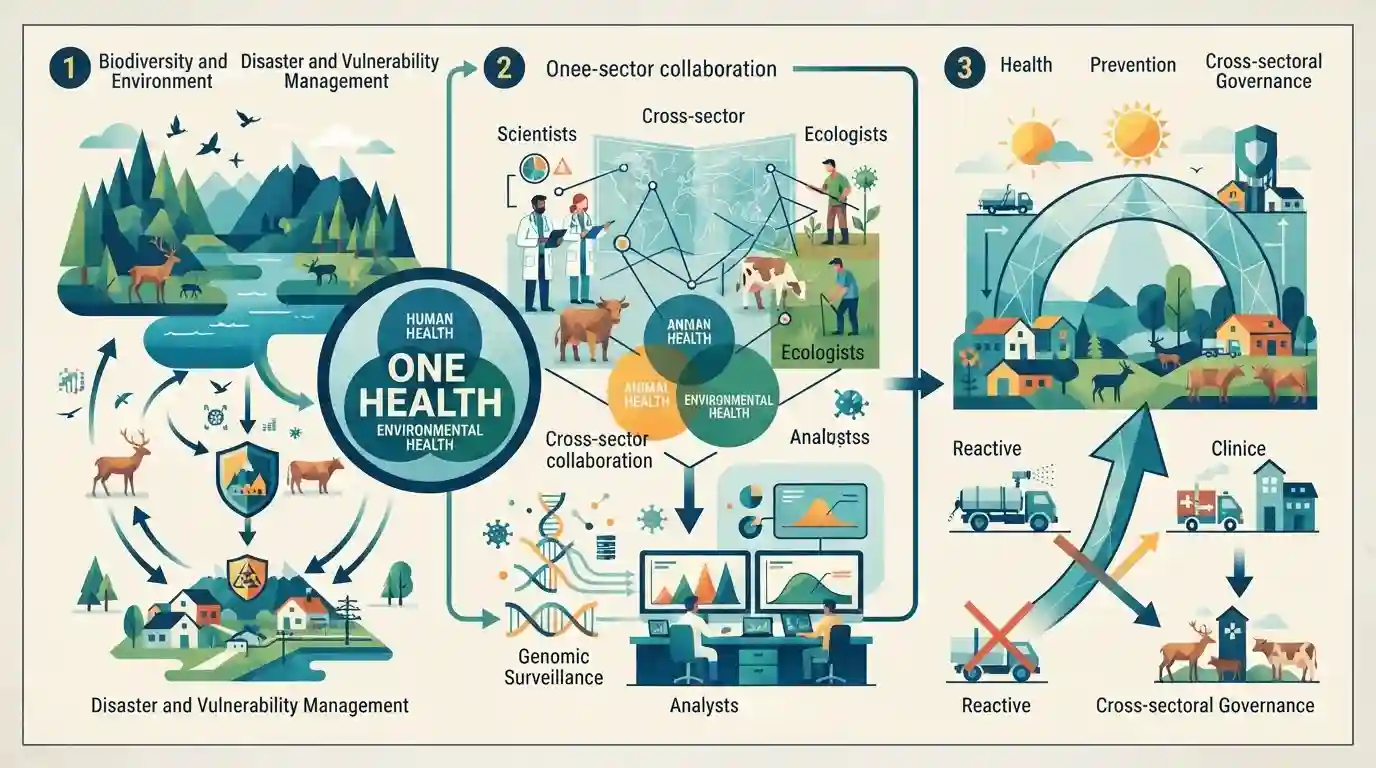
The article explores the principles of the 'One Health' framework, emphasizing that human health is inextricably linked to animal health and environmental ecosystems. It highlights the role of genomic surveillance, managing vector-borne risks from livestock and wildlife, and transitioning from reactive public health measures to proactive statecraft focused on prevention, disease ecology, and cross-sectoral governance.
Key Points
- The 'One Health' approach integrates human, animal, and environmental health to effectively prevent and combat zoonotic diseases and antimicrobial resistance (AMR).
- Modern genomic surveillance and tracking vectors like fleas and livestock reservoirs are critical for early warning systems against epidemics.
- Statecraft of prevention requires moving away from reactive healthcare responses toward systemic, cross-sectoral investments in ecological balance and biosecurity.
- Challenges include compartmentalized governance structures, underfunded public health infrastructure, and the interface between human activities and wildlife habitats.
Important Terms
National One Health Mission

An overarching inter-ministerial initiative in India designed to integrate human, animal, and environmental health surveillance systems to enhance national health security and pandemic preparedness.
UPSC context
UPSC GS Paper II (Health) & GS Paper III (Disaster Management/Science & Technology); tests policy responses to zoonotic risks and pandemic preparedness.
World Health Organization
The specialized United Nations agency responsible for international public health, coordinating global responses to health emergencies and disease outbreaks.
UPSC context
UPSC GS Paper II (International Organizations & Health Governance); tests multilateral frameworks for global health security and epidemic control.
Food and Agriculture Organization
A specialized UN agency leading international efforts to defeat hunger, improve nutrition, and promote sustainable agricultural and livestock management practices.
UPSC context
UPSC GS Paper II & III (Agriculture and Food Security); tests policies intersecting food systems, zoonosis, and rural livelihoods.
World Organisation for Animal Health
An intergovernmental organization tasked with improving animal health worldwide, establishing international veterinary standards for trade and disease control.
UPSC context
UPSC GS Paper III (Environment and Biodiversity); tests global governance standards for managing animal-to-human disease spillover.
Prelims Trap
The One Health framework is exclusively implemented and supervised by the Ministry of Health and Family Welfare.
Aspirants often assume 'One Health' is exclusively managed by the Ministry of Health and Family Welfare, overlooking its multi-ministerial nature spanning environment, livestock, and science departments.
Static Concepts Connected
What are the core objectives and institutional framework of India's National One Health Mission?
- Inter-sectoral synergy: Integrated coordination across human health, animal husbandry, dairy, fisheries, and environment ministries.
- Early warning: Focuses on genomic surveillance, rapid response teams, and tracking zoonotic spillover risks.
- AMR mitigation: Tackling AMR across food chains, agricultural runoff, and clinical environments.
Cross-Topic Patterns
One Health + Wildlife Corridor Fragmentation
Zoonotic spillover risks and AMR runoffs from intensive farming directly intersect with wildlife corridor fragmentation and climate-driven vector expansions.
Epidemic Prevention + Disaster Risk Governance
Moving from reactive disaster response to proactive genomic statecraft mirrors shifts in national climate adaptation and biosecurity doctrines.

One Health + National One Health Mission + Zoonotic % (75%) likely to be tested via matching or statement-based questions.
Linked PYQs · 1
Linked PYQs · 1
- 2014MainsGS3
Can overuse and free availability of antibiotics without Doctor's prescription, be contributors to the emergence of drug-resistant diseases in India? What are the available mechanisms for monitoring and control? Critically discuss the various issues involved.
