Electoral Reforms and the Role of Election Commission
Source:The Hindu ↗
Why It Matters
The integrity of the electoral process is foundational to Indian democracy. Electoral reforms, the functioning of the ECI, and debates like simultaneous elections are recurring themes in the UPSC GS2 syllabus, particularly concerning statutory provisions and constitutional bodies.
Summary
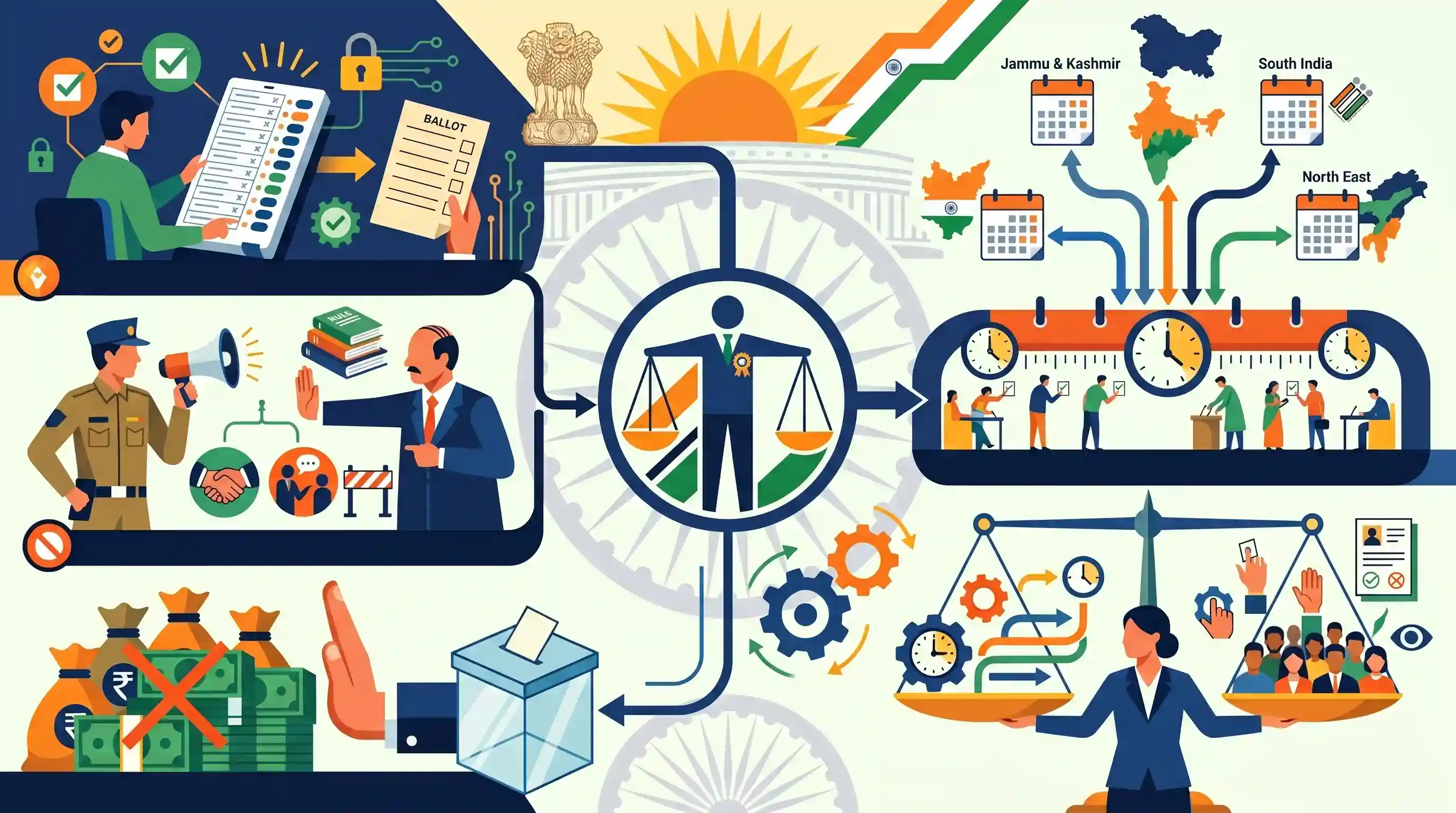
The article evaluates the ongoing discourse surrounding electoral reforms in India, emphasizing the continuous pursuit of a flawless democratic process. It highlights the pivotal role of the Election Commission of India in addressing contemporary challenges such as the trustworthiness of EVMs, the enforcement of the Model Code of Conduct, and the mitigation of money power. The piece also likely engages with significant proposed structural shifts, particularly the 'One Nation, One Election' initiative, discussing the balance between administrative efficiency and democratic accountability.
Key Points
- Evaluation of the evolving role of the Election Commission of India (ECI) in ensuring free, fair, and transparent elections amid modern challenges.
- Critical examination of systemic electoral reforms, including the heavily debated 'One Nation, One Election' proposal aimed at synchronizing election cycles.
- Scrutiny of technological and procedural safeguards, such as EVM trustworthiness, VVPAT implementation, and the need for stringent campaign finance regulations.
- The continuous requirement to update and strictly enforce statutory frameworks like the Representation of the People Act and the Model Code of Conduct to curb money and muscle power.
Important Terms
Election Commission of India (ECI)

An autonomous constitutional body established under Article 324 responsible for administering elections to the Parliament, State Legislatures, and the offices of President and Vice-President.
UPSC context
GS Paper II (Constitutional Bodies). Tests understanding of ECI's independence, structure, and role in ensuring 'free and fair' elections.
Representation of the People Act, 1951
A statutory act providing the legal framework for the conduct of elections, qualifications/disqualifications of members, registration of political parties, and prevention of corrupt practices.
UPSC context
GS Paper II (Salient features of RPA). Crucial for questions on legislator disqualification and the legal basis of electoral management.
Model Code of Conduct (MCC)
A set of guidelines issued by the ECI to regulate the conduct of political parties and candidates during elections to ensure a level playing field.
UPSC context
GS Paper II (Electoral Reforms). Tests knowledge of ECI’s moral authority versus statutory power and its impact on governance.
One Nation, One Election (ONOE)
A proposal to synchronize the cycles of Lok Sabha and State Assembly elections to reduce costs and minimize 'policy paralysis' caused by frequent polls.
UPSC context
GS Paper II (Federalism & Governance). Evaluates administrative efficiency against the federal 'Basic Structure' and required constitutional amendments.
Electronic Voting Machines (EVMs)
Electronic devices used to record and count votes, introduced to eliminate booth capturing, reduce invalid votes, and expedite the counting process.
UPSC context
GS Paper II (Electoral Reforms). Focuses on the technological evolution of voting and public trust in the integrity of the democratic process.
Voter Verifiable Paper Audit Trail (VVPAT)
An independent system attached to EVMs that produces a paper slip, allowing voters to verify that their vote was cast correctly before it is stored.
UPSC context
GS Paper II (Governance). Crucial for understanding the 'auditability' of elections and the Supreme Court's directives on transparency.
Prelims Trap
"The Model Code of Conduct derives its statutory backing explicitly from the Representation of the People Act, 1951."
The MCC is a consensus-based, non-statutory framework. It draws its enforcement power from the ECI's plenary powers under Article 324, not the RPA.
Static Concepts Connected
Which Constitutional provisions currently govern the tenure and dissolution of Indian legislatures?
- Union Legislature: Article 83 dictates the duration of Houses of Parliament, while Article 85 empowers the President to prorogue or dissolve the Lok Sabha.
- State Legislatures: Article 172 sets the five-year duration of State Legislative Assemblies, and Article 174 grants the Governor the power to dissolve them.
- ONOE Amendment Impact: Synchronizing elections would require amending these specific articles, likely via mechanisms like the proposed Article 82A, to artificially curtail or extend assembly tenures.
What is the legal and procedural standing of VVPATs in Indian elections?
- Statutory Backing: VVPATs were introduced through a statutory amendment to the Conduct of Elections Rules, 1961, following a 2013 Supreme Court directive (Subramanian Swamy case).
- Verification Mandate: The Supreme Court mandates a random cross-verification of VVPAT slips in 5% of EVMs per Assembly segment, rejecting demands for 100% verification.
- Post-election security: Following recent SC rulings, Symbol Loading Units (SLUs) must be sealed and stored securely for 45 days after election results are declared.
Cross-Topic Patterns
ONOE's Federalism friction
Curtailing State Assembly tenures to synchronize with the Lok Sabha cycle (via proposed Article 82A) directly intersects with federalism, repeatedly tested under the Basic Structure doctrine.
EVM integrity and tech hardware
The SC's ruling allowing runner-up candidates to verify EVM "burnt memory semi-controllers" connects core electoral polity with GS-III embedded systems and cybersecurity hardware themes.

The constitutional mechanics of 'One Nation, One Election' (Art 82A) and SC's new EVM semi-controller rules are prime 2026 Prelims targets.
Linked PYQs · 5
Linked PYQs · 5
- 2017MainsGS2
To enhance the quality of democracy in India the Election Commission of India has proposed electoral reforms in 2016. What are the suggested reforms and how far are they significant to make democracy successful?
- 2024MainsGS2
Examine the need for electoral reforms as suggested by various committees with particular reference to "one nation one election" principle.
- 2022MainsGS2
Discuss the role of the Election Commission of India in the light of the evolution of the Model Code of Conduct.
- 2018MainsGS2
In the light of recent controversy regarding the use of Electronic Voting Machines (EVM), what are the challenges before the Election Commission of India to ensure the trustworthiness of elections in India?
- 2020PrelimsGS1
Consider the following statements: 1. According to the Constitution of India, a person who is eligible to vote can be made a minister in a State for six months even if he/she is not a member of the Legislature of that State. 2. According to the Representation of People Act, 1951, a person convicted of a criminal offence and sentenced to imprisonment for five years is permanently disqualified from contesting an election even after his release from prison. Which of the statements given above is/are correct?
