Balancing Constitutional Morality and Religious Practices in India
Source:The Hindu ↗
Why It Matters
The balance between religious freedom (Articles 25/26) and the right to equality (Articles 14/15) is a core constitutional debate in India. Understanding this helps aspirants address questions on Indian secularism, the 'essential religious practices' doctrine, and the role of the judiciary in promoting social reform against entrenched traditions.
Summary
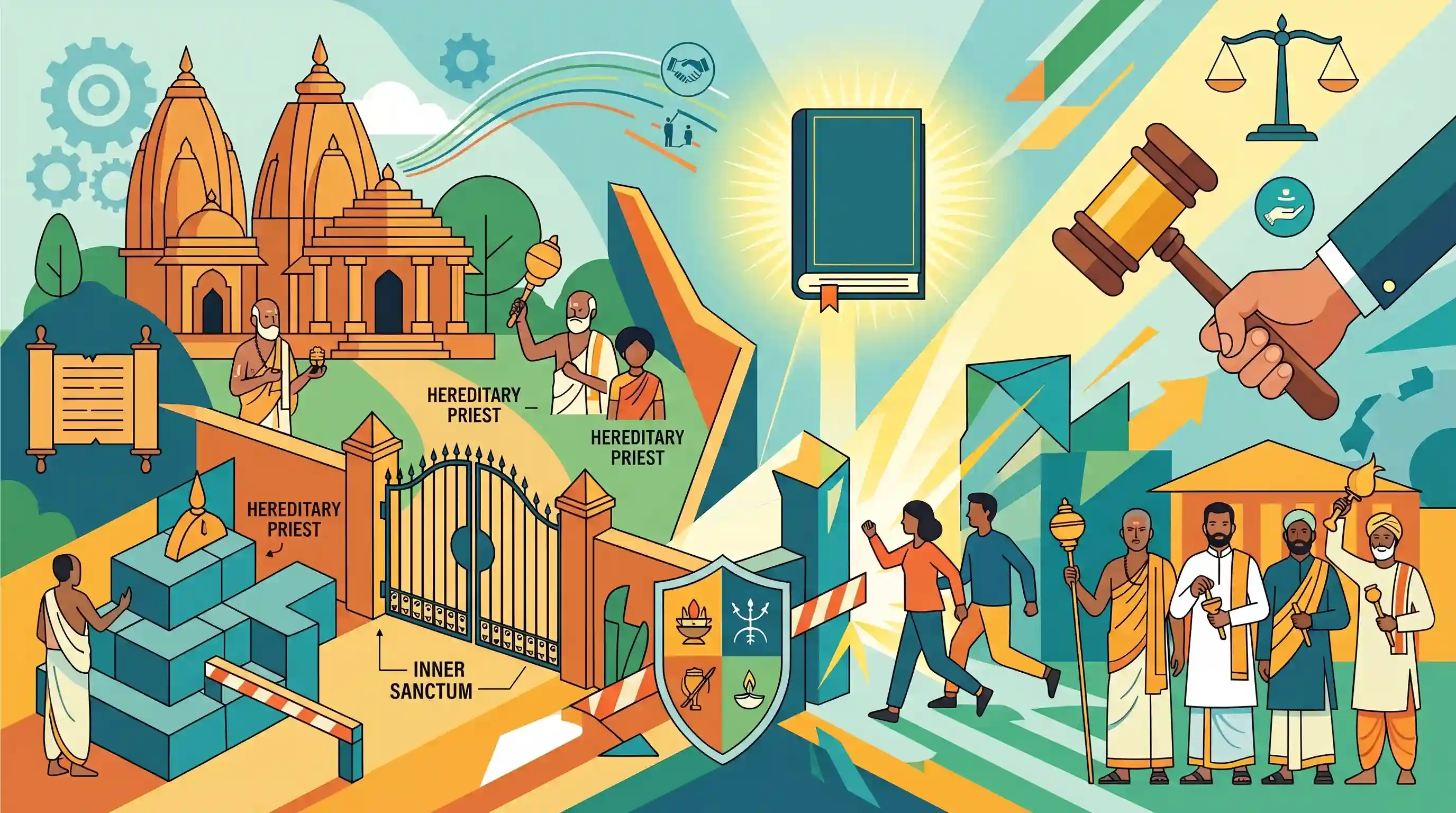
The article discusses the intersection of constitutional rights and religious practices, specifically focusing on the entry of constitutional principles like equality and non-discrimination into the inner sanctum of Hindu temples. It examines the tension between religious freedom (protected under Articles 25 and 26, often citing the 'essential religious practices' doctrine and Agamas) and fundamental rights (Articles 14, 15, and 17). By highlighting progressive judicial and state interventions that support the appointment of temple priests from all castes, the piece argues that constitutional morality must prevail over traditional caste monopolies, illustrating the reformative capacity of Indian secularism.
Key Points
- Explores the inherent conflict between traditional religious practices (Agamas) and the constitutional mandate for equality and non-discrimination.
- Analyzes judicial interventions that apply Articles 14, 15, and 17 to democratize the appointment of priests (Archakas), breaking caste-based monopolies.
- Highlights how 'Constitutional Morality' is increasingly taking precedence over orthodox religious customs, even within the inner sanctum of temples.
- Demonstrates the active nature of Indian secularism, which allows for State intervention in religious affairs to enact meaningful social reform.
Important Terms
Essential Religious Practices Doctrine

The judicial test used to determine which rituals and practices are integral to a religion and thus protected under Articles 25 and 26.
UPSC context
GS Paper II (Judiciary/Fundamental Rights). Tests the balance between state intervention and religious autonomy.
Constitutional Morality
A principle where the Constitution's core values—like equality and liberty—prevail over traditional social norms, majoritarian morality, or religious customs.
UPSC context
GS Paper II (Polity). Often tested in Mains regarding judicial activism and social reform.
Article 17
A fundamental right that abolishes 'untouchability' in all forms and makes its practice a punishable offence under the law.
UPSC context
GS Paper II (Social Justice). Key to discussions on caste-based exclusion in religious spaces.
Article 25
Guarantees every person's right to freedom of conscience and the freedom to profess, practice, and propagate their religion.
UPSC context
GS Paper II (Fundamental Rights). Central to the debate of individual rights versus institutional traditions.
Article 26
Grants religious denominations the right to manage their own affairs in matters of religion and establish/maintain religious institutions.
UPSC context
GS Paper II (Governance). Deals with collective religious rights and temple management autonomy.
Agamas
Ancient Hindu scriptures providing rules for temple rituals, priesthood, and architecture; often cited in legal battles over hereditary appointments.
UPSC context
GS Paper I (Art & Culture) / GS II (Polity). Essential for understanding the clash between tradition and reform.
Hindu Religious and Charitable Endowments (HR&CE) Department
A state-level administrative body (notably in Tamil Nadu) that manages temple finances and personnel, including non-Brahmin priest appointments.
UPSC context
GS Paper II (Statutory Bodies/Governance). Key actor in state-led religious and social reforms.
Article 15
Prohibits the State from discriminating against any citizen on grounds only of religion, race, caste, sex, or place of birth.
UPSC context
GS Paper II (Polity). Vital for arguments against caste-based barriers to temple priesthood.
Prelims Trap
Article 26 grants religious denominations absolute freedom to appoint priests based on Agamas without State interference.
Incorrect. The Supreme Court rules that appointing priests is a secular function, not a core religious practice. Article 26 is also subject to public order, morality, and health.
Static Concepts Connected
What is the 'Essential Religious Practices' (ERP) Doctrine?
- Judicial Origin: Established by the Supreme Court in the Shirur Mutt Case (1954) to determine what constitutes the core tenets of a religion.
- Protection Limit: Only practices deemed strictly 'essential' to the religion receive constitutional protection under Articles 25 and 26.
- Secular Differentiation: Allows the State to regulate non-essential, secular, or administrative activities associated with religious institutions without violating religious freedom.
How does Indian Secularism empower State intervention in religion?
- Principled Distance: Unlike Western strict separation, India maintains a 'principled distance', allowing intervention to protect fundamental rights.
- Article 25(2)(b): Explicitly empowers the State to enact laws providing for social welfare and reform within Hindu religious institutions.
- Constitutional Morality: Ensures that constitutional principles (justice, equality) override traditional social morality or orthodox religious customs.
Cross-Topic Patterns
Constitutional Morality vs Customary Law
This parallels the Sabarimala judgment and Uniform Civil Code debates, where constitutional morality (equality, liberty) is applied to override exclusionary orthodox customs and personal laws.
Article 17 and Absolute Rights
Excluding non-Brahmin priests triggers Article 17 (abolition of untouchability). UPSC often tests how Article 17 operates as an absolute right, even overriding religious freedoms under Article 26.

Expect a 2026 conceptual MCQ pitting Article 26 (religious denomination rights) against Article 25(2)(b) (State's social reform powers).
Linked PYQs · 5
Linked PYQs · 5
- 2024MainsGS2
Discuss India as a secular state and compare with the secular principles of the US constitution.
- 2019MainsGS2
What can France learn from the Indian Constitution's approach to secularism?
- 2025MainsGS2
"Constitutional morality is the fulcrum which acts as an essential check upon the high functionaries and citizens alike...." In view of the above observation of the Supreme Court, explain the concept of constitutional morality and its application to ensure balance between judicial independence and judicial accountability in India.
- 2022MainsGS1
Are tolerance, assimilation and pluralism the key elements in the making of an Indian form of secularism? Justify your answer.
- 2018MainsGS1
How the Indian concept of secularism is different from the western model of secularism? Discuss.
