Cloud infrastructure dependence and India digital sovereignty goals
Source:Indian Express ↗
Why It Matters
The article is highly relevant for GS Paper 3 (Science & Technology, Internal Security, Infrastructure) and GS Paper 2 (E-governance, IR). It critically evaluates the geopolitical and security risks associated with foreign dependence in cloud infrastructure and AI, providing a roadmap for achieving true digital sovereignty—a recurring theme in UPSC discussions on data protection and digital India.
Summary
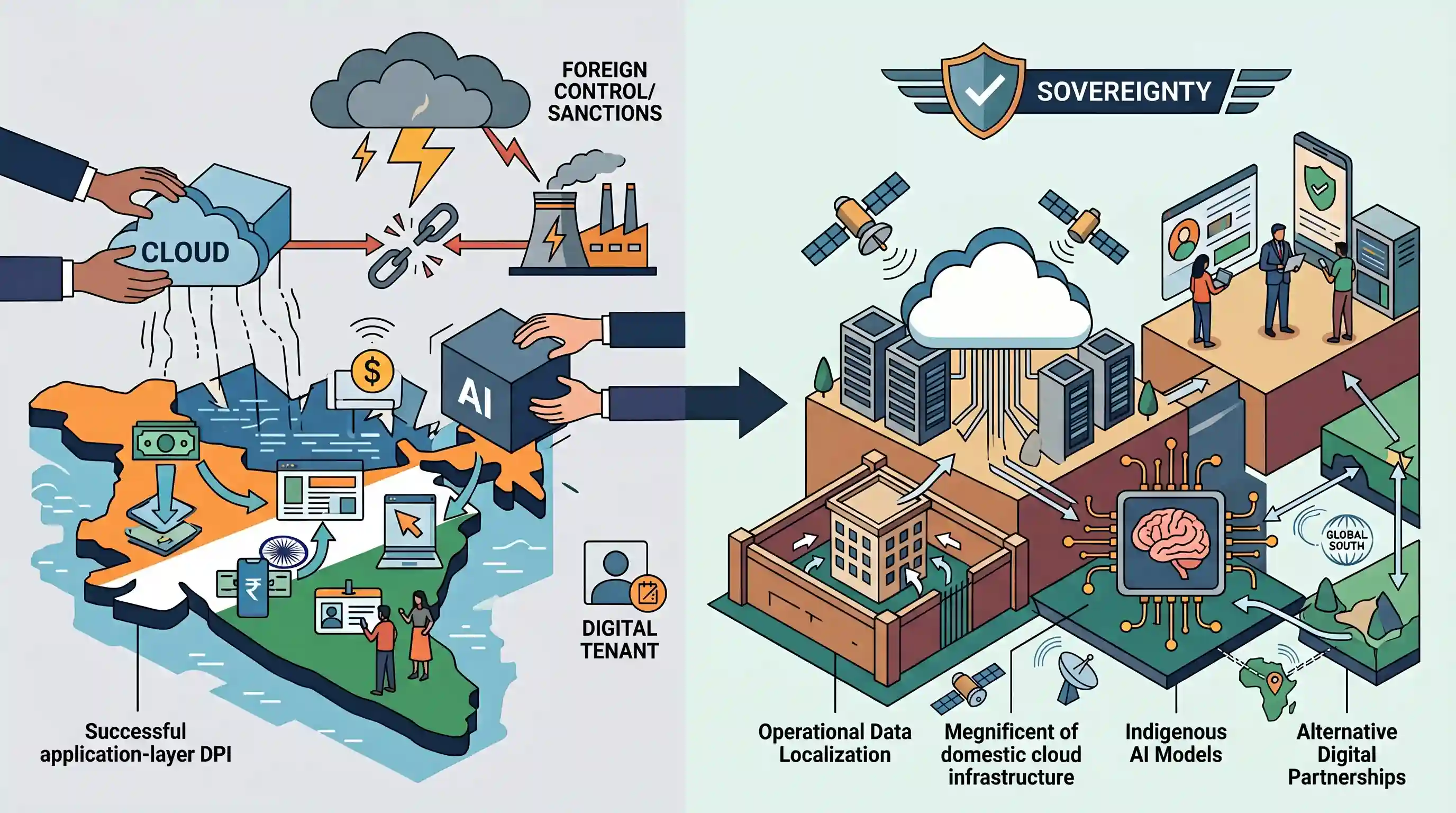
The article underscores the strategic vulnerability of India's digital ecosystem due to its heavy reliance on foreign-controlled cloud services, artificial intelligence, and microchips. Highlighting the Nayara Energy episode, where US sanctions threatened its cloud access, the author argues that true digital sovereignty goes beyond India's successful application-layer Digital Public Infrastructure (DPI). To secure its digital future, India must transition from 'digital tenancy' to infrastructural sovereignty by mandating operational data localisation, fostering domestic cloud infrastructure like MeghRaj, developing indigenous AI models, and forging alternative digital partnerships with the Global South.
Key Points
- India has developed a world-class application-layer Digital Public Infrastructure (DPI) stack, including Aadhaar, UPI, and ONDC.
- Despite owning the application layer, India suffers from 'digital tenancy' due to profound reliance on foreign hyperscaler clouds (AWS, Azure, Google Cloud), chips, and AI models.
- The potential restriction of Microsoft cloud services for Nayara Energy under US sanctions highlights the strategic vulnerability of foreign-owned digital infrastructure.
- True digital sovereignty resides at the infrastructural level, necessitating a shift from merely regulating apps to building and controlling foundational digital infrastructure.
- To achieve digital sovereignty, India must implement data localisation with operational control, develop domestic cloud capabilities (e.g., MeghRaj), create indigenous AI models, and foster Global South partnerships for an alternative digital order.
Important Terms
Digital Sovereignty

A nation's ability to control its digital destiny, including data, infrastructure, and software, without undue reliance on foreign-controlled technology or legal regimes.
UPSC context
GS Paper III: Cyber Security and S&T; tests understanding of strategic autonomy in the digital age.
Digital Public Infrastructure (DPI)
A set of shared, interoperable digital systems (like Aadhaar and UPI) that enable the delivery of essential services at societal scale through open standards.
UPSC context
GS Paper II: E-Governance; tests knowledge of India's 'India Stack' and digital governance model.
MeghRaj
The Government of India's national cloud initiative (GI Cloud) aimed at accelerating e-service delivery while ensuring domestic control over cloud infrastructure and optimizing ICT spending.
UPSC context
GS Paper II/III: E-governance and IT infrastructure; tests knowledge of domestic cloud solutions for digital sovereignty.
Nayara Energy episode
A 2025 incident where a major Indian refiner lost access to Microsoft cloud services due to foreign sanctions, highlighting India's vulnerability to foreign-controlled digital 'kill switches.'
UPSC context
GS Paper III: Internal Security/Cyber Security; tests analysis of geopolitical risks to critical digital infrastructure.
Open Network for Digital Commerce (ONDC)
An open-source network initiative aimed at democratizing e-commerce by allowing buyers and sellers to interact across different platforms, breaking the monopoly of giant marketplaces.
UPSC context
GS Paper III: Indian Economy; tests understanding of digital market regulation and inclusion.
Data Localisation
The policy requirement that data generated within a country's borders be stored and processed domestically to ensure legal jurisdiction and national security.
UPSC context
GS Paper II/III: Governance and Data Privacy; tests knowledge of the DPDP Act and digital trade.
Prelims Trap
India's Digital Public Infrastructure (DPI) ensures complete digital sovereignty by localising foundational infrastructure.
India's DPI (UPI, Aadhaar) operates entirely at the application layer. India heavily relies on foreign infrastructure (hyperscaler clouds, chips), making it a 'digital tenant'.
Static Concepts Connected
What is the MeghRaj (GI Cloud) initiative?
- Objective: A MeitY initiative launched to optimize ICT spending and accelerate e-governance service delivery across government departments.
- Architecture: Provides Platform-as-a-Service (PaaS) and Infrastructure-as-a-Service (IaaS) by encompassing multiple State and National clouds.
- Security & Compliance: Empanels private cloud service providers that comply with strict Standardisation Testing and Quality Certification (STQC) norms.
How does Data Localisation differ from Data Sovereignty?
- Data Localisation: The mandate to physically store and process digital data on servers located geographically within a country's borders.
- Data Sovereignty: The legal right and authority of a nation state to subject the data stored within its borders to its own domestic laws.
- Policy Shift: While Srikrishna Committee (2018) urged strict localisation, the DPDP Act 2023 relaxed this, allowing cross-border data flow to trusted geographies.
Cross-Topic Patterns
DPI as Soft Power vs China's BRI
India's push to export its Digital Public Infrastructure (DPI) to the Global South acts as digital soft power, contrasting with China's physical infrastructure-heavy Belt and Road Initiative (BRI).
Extraterritorial Sanctions expanding to Digital Tech
The Nayara Energy episode mirrors past CAATSA challenges India faced regarding defense imports and Iranian oil, demonstrating how Western extraterritorial sanctions now threaten digital ecosystems.

Expect a Mains GS3 question contrasting India's application-layer DPI success with infrastructure-layer vulnerabilities (Cloud/AI).
Linked PYQs · 5
Linked PYQs · 5
- 2025MainsGS2
India-Africa digital partnership is achieving mutual respect, co-development and long-term institutional partnerships. Elaborate.
- 2024MainsGS2
e-governance is not just about the routine application of digital technology in service delivery process. It is as much about multifarious interactions for ensuring transparency and accountability. In this context evaluate the role of the 'Interactive Service Model' of e-governance.
- 2025MainsGS2
e-governance projects have a built-in bias towards technology and back-end integration than user-centric designs. Examine.
- 2018MainsGS3
Data security has assumed significant importance in the digitized world due to rising cyber crimes. The Justice B. N. Srikrishna Committee Report addresses issues related to data security. What, in your view, are the strengths and weaknesses of the Report relating to protection of personal data in cyber space?
- 2023MainsGS3
Introduce the concept of Artificial Intelligence (AI). How does Al help clinical diagnosis? Do you perceive any threat to privacy of the individual in the use of Al in healthcare?
