Changing Patterns of Outbound Student Migration from India
Source:The Hindu ↗
Why It Matters
Understanding student migration is vital for grasping the challenges in India's higher education sector, the economic implications of human capital flight, and the policy interventions required under NEP 2020 to retain talent and harness the demographic dividend.
Summary
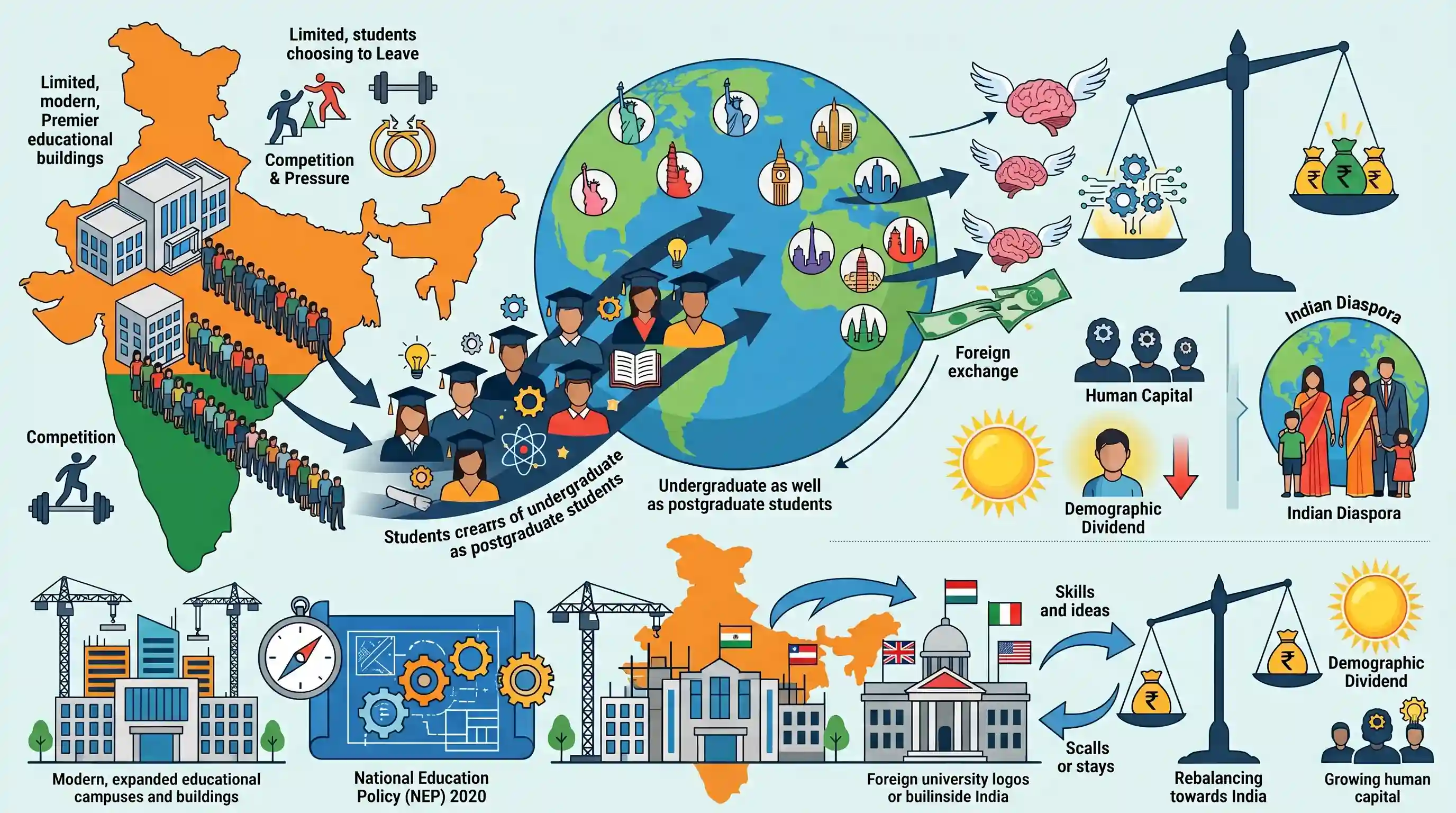
The article examines the shifting dynamics of student migration from India. Historically characterized by postgraduate STEM students heading to Western nations, the trend is now diversifying to include more undergraduate students and alternative destinations. This exodus is largely driven by a combination of limited seats in premier Indian higher education institutions, intense domestic academic competition, and the allure of better employment prospects and post-study work visas abroad. While this student mobility contributes to a strong Indian diaspora, it also leads to significant foreign exchange outflow and a 'brain drain' that can impact India's human capital and demographic dividend. To reverse or balance this trend, the focus must shift toward improving domestic educational infrastructure, operationalizing the National Education Policy (NEP) 2020, and encouraging foreign universities to establish campuses in India.
Key Points
- Student migration from India is diversifying, with students increasingly opting for undergraduate courses and non-traditional destinations.
- The trend is driven by push factors like hyper-competitive entrance exams and capacity constraints in top-tier Indian educational institutions.
- Pull factors include post-study work opportunities, global exposure, and better research facilities in destination countries.
- This outward migration results in a massive outflow of foreign exchange and exacerbates the 'brain drain', potentially hindering India's demographic dividend.
- Mitigating these challenges requires upgrading domestic higher education quality, effective implementation of NEP 2020, and welcoming foreign university campuses to India.
Important Terms
National Education Policy (NEP) 2020

A 2020 framework transforming India's education system by emphasizing multidisciplinary learning, flexibility, and internationalization to establish India as a "global knowledge superpower."
UPSC context
GS Paper II (Education Policy); tests understanding of structural reforms in the social sector.
University Grants Commission (UGC)
A statutory body under the Ministry of Education responsible for maintaining standards, providing grants, and regulating higher education institutions in India.
UPSC context
GS Paper II (Statutory Bodies); central to topics on higher education regulation and quality.
Brain Drain
The emigration of highly skilled or educated individuals to other countries, resulting in a loss of human capital and domestic investment returns for the home nation.
UPSC context
GS Paper III (Economy); tests analysis of talent migration and human resource challenges.
Demographic Dividend
Economic growth potential resulting from shifts in a population’s age structure, specifically when the working-age population (15-64) is larger than the dependent population.
UPSC context
GS Paper III (Economy); essential for analyzing population dynamics and national growth potential.
Indian Diaspora
The global community of people of Indian origin (NRIs/OCIs) who contribute to India’s soft power, remittances, and technology transfer.
UPSC context
GS Paper II (International Relations); focuses on the diaspora's impact on foreign policy and economy.
Foreign Higher Education Institutions (FHEIs)
Top-ranked global universities now permitted under UGC regulations to establish branch campuses in India with autonomy over admissions, fees, and curricula.
UPSC context
GS Paper II (Governance/Education); relevant to internationalizing higher education and reducing foreign exchange outflow.
Prelims Trap
Foreign university campuses set up in India must follow domestic reservation policies for student admissions.
Under UGC guidelines, foreign universities have autonomy over admission criteria, fee structure, and faculty recruitment; domestic reservation quotas do not mandatorily apply.
Static Concepts Connected
What are the key features of the Liberalised Remittance Scheme (LRS)?
- Limit: Resident individuals can remit up to USD 250,000 per financial year for permissible current or capital account transactions.
- Applicability: Available only to resident individuals, including minors. It is not available to corporates or partnership firms.
- Permitted Uses: Includes overseas education, medical treatment, tourism, maintenance of relatives, and purchasing foreign assets.
What conditions are required to reap India's Demographic Dividend?
- Definition: Economic growth potential resulting from a shift in a population's age structure, specifically a higher working-age ratio.
- Human Capital: Requires massive investments in health, quality higher education, and vocational skilling to make youth employable.
- Job Creation: Dependent on creating sufficient productive domestic employment to absorb the youth and prevent structural unemployment.
Cross-Topic Patterns
LRS outflow and TCS regulations
The surge in educational remittances triggered the government's move to impose a 5% TCS on LRS transactions for education exceeding ₹7 lakh, linking human capital flight directly to macroeconomic tax policy.
Middle-class exodus and "Brain Waste"
Unlike traditional elite "brain drain," middle-class youth taking low-skilled survival jobs abroad highlights a failure in domestic job creation, squandering India's narrow demographic dividend window.

Expect a GS2/GS3 crossover linking LRS forex outflows for education with NEP 2020's push for foreign university campuses in India.
Linked PYQs · 3
Linked PYQs · 3
- 2015MainsGS2
The quality of higher education in India requires major improvements to make it internationally competitive. Do you think that the entry of foreign educational institutions would help improve the quality of higher and technical education in the country? Discuss.
- 2014MainsGS3
While we flaunt India's demographic dividend, we ignore the dropping rates of employability. What are we missing while doing so? Where will the jobs that India desperately needs come from? Explain.
- 2023MainsGS2
Indian diaspora has scaled new heights in the West. Describe its economic and political benefits for India.
