Coal Gasification and India Industrial Feedstock Strategy
Source:The Hindu ↗
Why It Matters
This topic lies at the core of India's dual objectives: achieving Net-Zero carbon emissions by 2070 and securing self-reliance (Atmanirbharta) in energy and critical industrial chemicals. Understanding coal chemistry is vital for evaluating how India can creatively utilize its massive domestic fossil resources cleanly, balance its balance of payments, and protect local economies during the global green transition.
Summary
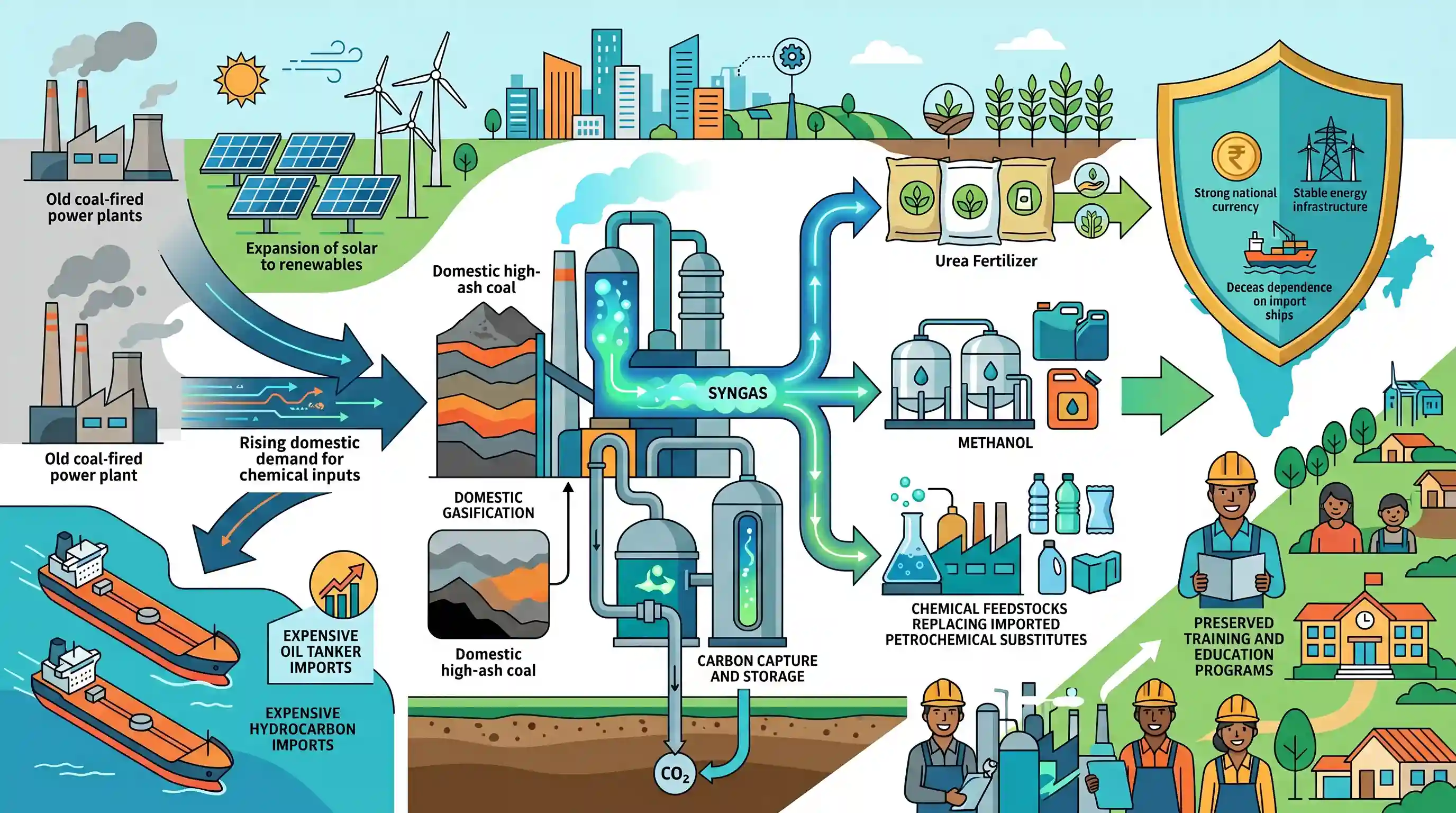
The article advocates for a paradigm shift in India's coal strategy—transitioning from burning coal for power to leveraging it as a chemical feedstock via coal gasification. While electricity generation is moving toward renewables, India's chemical, fertilizer, and plastic industries still require carbon-based inputs, driving up expensive hydrocarbon imports. By converting domestic high-ash coal into synthesis gas (syngas), India can manufacture urea, methanol, and petrochemical substitutes locally. This 'coal chemistry' approach strengthens national energy security, curbs import dependency, reduces emissions through integrated carbon capture (CCUS), and supports a 'just transition' by preserving livelihoods in traditional coal-producing states.
Key Points
- Strategic Shift in Coal Utilization: Direct burning of coal for electricity generation is facing steep environmental hurdles. Instead of treating coal purely as a combustive fuel, India must view it as a valuable source of carbon and hydrogen molecules for chemistry-driven industrial feedstocks.
- Enhancing Feedstock and Energy Security: India relies heavily on imported crude oil, natural gas, and petrochemical intermediates. Using coal gasification to produce synthesis gas (syngas) allows domestic high-ash coal to substitute for imported natural gas in manufacturing fertilizers (urea/ammonia), methanol, olefins, and other essential chemicals.
- Technological Adaptations for Indian High-Ash Coal: Indian coal possesses high ash content (often >40%) and low calorific value, making conventional Western gasifiers ineffective. Designing and scaling indigenous gasification technologies (such as fluidised bed gasifiers by BHEL) is crucial for commercial success.
- Cleaner Carbon Management: Coal gasification occurs in a closed system, making it far more amenable to Carbon Capture, Utilization, and Storage (CCUS) compared to conventional post-combustion power generation. This clean-coal pathway ensures chemical synthesis can occur with a significantly reduced carbon footprint.
- Enabling a 'Just Transition': Coal mining supports millions of livelihoods and constitutes a major revenue source for Eastern states. Developing coal chemistry and coal-to-chemicals industries offers a sustainable economic alternative for coal belt regions, avoiding abrupt socio-economic distress during the clean energy transition.
- Policy and Financial Support: The Indian government has launched the National Coal Gasification Mission targeting 100 million tonnes of coal gasification by 2030, backed by an ₹8,500 crore incentive scheme to catalyze public and private sector investments.
Important Terms
National Coal Gasification Mission

A flagship initiative launched during 2020-21 targeting 100 million tonnes (MT) of coal gasification by 2030 to promote cleaner utilisation of domestic coal and reduce energy import dependency.
UPSC context
GS Paper III (Economy/Energy); tests strategies for resource diversification, clean coal technology, and reducing import reliance.
Scheme for Promotion of Surface Coal/Lignite Gasification Projects
A government scheme (outlay enhanced to ₹37,500 crore in 2026) providing financial incentives up to 20% of machinery costs to accelerate syngas production and downstream industrial chemical manufacturing.
UPSC context
GS Paper III (Government Budgeting/Infrastructure); tests fiscal incentives and policy interventions for sustainable industrial development.
Panchamrit
A five-point climate action pledge unveiled by India at COP26, committing to achieve net-zero carbon emissions by 2070 and setting key targets for renewable energy capacity.
UPSC context
GS Paper III (Environment & Ecology); tests India’s climate change commitments, global environmental targets, and sustainable growth strategies.
Coal India Limited (CIL)
A Maharatna public sector undertaking and India's state-owned coal miner, spearheading major clean energy transitions and joint ventures to convert domestic high-ash coal into industrial chemicals.
UPSC context
GS Paper III (Infrastructure/Energy); tests public sector undertakings' strategic role in mineral resource utilization and clean tech shifts.
Ministry of Coal
The nodal union ministry responsible for regulating coal mining, managing domestic reserves, and overseeing national clean energy programs like the National Coal Gasification Mission.
UPSC context
GS Paper II (Governance/Ministries); tests institutional mechanisms for natural resource administration and transition to cleaner fuel pathways.
NITI Aayog
The premier policy think tank of the Indian government, which provides strategic direction and formulates roadmaps for clean energy initiatives, including coal gasification.
UPSC context
GS Paper II (Governance/Institutions); tests policy formulation, cooperative federalism, and long-term planning for energy security.
Prelims Trap
Indian coal is characterized by high sulfur content and low ash content, making it easily compatible with conventional imported gasification systems.
It is exactly the opposite: Indian coal is notoriously high-ash (>40%) but generally low-sulfur. Standard imported gasifiers require low-ash coal, which is why India needs indigenous adaptations.
Static Concepts Connected
What is Syngas and how is it produced via Coal Gasification?
- Composition: A mixture of carbon monoxide (CO), hydrogen (H2), carbon dioxide (CO2), and methane (CH4), produced by reacting coal with oxygen and steam under high temperatures.
- Key distinction: Unlike Coal Bed Methane (CBM) which is naturally occurring gas trapped in coal seams, syngas is industrially manufactured through thermochemical conversion.
- Downstream uses: Serves as an intermediate feedstock to produce synthetic natural gas, methanol, ammonia/urea (fertilizers), and liquid fuels via the Fischer-Tropsch process.
What are the unique properties and types of Indian Coal?
- Ash & Energy: Characterized by very high ash content (often exceeding 35-40%) and low calorific value compared to imported thermal coal.
- Sulfur levels: Contains exceptionally low sulfur content (usually <0.5%), which is environmentally favorable but reduces the collection efficiency of electrostatic precipitators.
- Geological origin: Over 98% of India's coal is Gondwana coal (low moisture, high ash), while the remaining is Tertiary coal (high moisture, high sulfur, found in NE regions).
Cross-Topic Patterns
Just Transition + Fiscal Federalism
Decarbonization threatens to wipe out mining royalties for Eastern states. Coal-to-chemicals preserves local economies and state-level tax bases without combusting coal for power.
Fertilizer Subsidies + Energy Security
India's high urea subsidy is tied to volatile LNG imports. Coal-to-urea projects decouple domestic agricultural inputs from global natural gas price shocks.

UPSC 2026 may contrast natural Coal Bed Methane (CBM) extraction with industrial Coal Gasification (Syngas) composition and technology.
Linked PYQs · 2
Linked PYQs · 2
- 2025PrelimsGS1
Consider the following substances: I. Ethanol II. Nitroglycerine III. Urea Coal gasification technology can be used in the production of how many of them?
- 2022MainsGS3
Do you think India will meet 50 percent of its energy needs from renewable energy by 2030 ? Justify your answer. How will the shift of subsidies from fossil fuels to renewables help achieve the above objective ? Explain.
