Union Budget Balances Fiscal Prudence With Growth Needs
Source:Indian Express ↗
Why It Matters
Understanding the nuances of the Union Budget, fiscal deficit targets, and the balance between capital and revenue expenditure is fundamental for the UPSC GS3 syllabus. It helps aspirants analyze the government's economic priorities and macroeconomic management strategies.
Summary
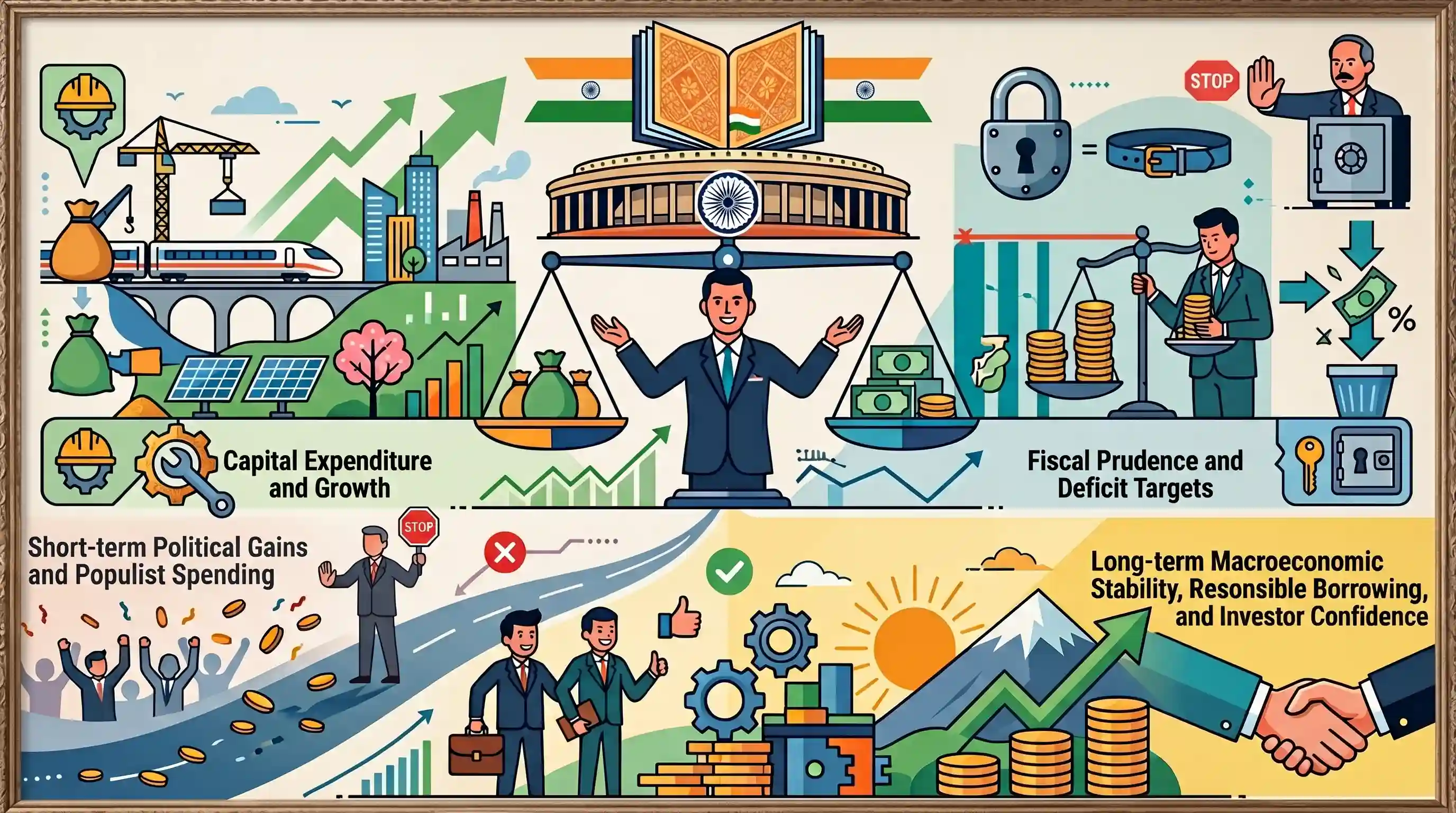
The opinion piece analyzes the Union Budget, highlighting its emphasis on fiscal prudence and cautious macroeconomic management. It underscores the government's delicate balancing act: sustaining capital expenditure to drive structural economic growth while adhering strictly to fiscal deficit targets. By avoiding populist spending pressures and maintaining conservative revenue estimates, the budget prioritizes long-term macroeconomic stability, responsible borrowing, and investor confidence over short-term political gains.
Key Points
- The government has prioritized fiscal consolidation by sticking to its fiscal deficit targets, resisting the temptation for populist spending.
- Revenue estimates in the budget are conservative and cautious, providing a buffer against unforeseen global macroeconomic shocks.
- A prudent balancing act is achieved by sustaining capital expenditure (capex) for long-term infrastructure creation while managing essential welfare needs.
- Controlled borrowing and financial discipline send positive signals to domestic and foreign investors regarding India's macroeconomic stability.
Important Terms
Union Budget

Known as the 'Annual Financial Statement' under Article 112, it estimates the government’s receipts and expenditures for a financial year to ensure parliamentary oversight.
UPSC context
GS Paper II (Polity) and III (Economy); fundamental for understanding government budgeting and resource mobilization.
Fiscal Deficit
The difference between the government's total expenditure and its total receipts (excluding borrowings), representing the total money the government needs to borrow.
UPSC context
GS Paper III; a key indicator of macroeconomic stability and fiscal health frequently tested in Prelims/Mains.
Fiscal Consolidation
Strategic policies aimed at reducing the fiscal deficit and debt-to-GDP ratio to improve the government's fiscal health and ensure sustainable growth.
UPSC context
GS Paper III; central to discussions on Indian Economy and sustainable public finance management.
Fiscal Responsibility and Budget Management (FRBM) Act
A 2003 law that institutionalized fiscal discipline by setting legally binding targets for reducing deficits and mandating transparency in fiscal operations.
UPSC context
GS Paper III; crucial for questions on fiscal policy, deficit management, and N.K. Singh Committee recommendations.
Capital Expenditure (Capex)
Government spending that creates long-term physical or financial assets, such as infrastructure, or reduces liabilities, thereby driving structural economic growth.
UPSC context
GS Paper III; vital for evaluating the 'quality' of government spending and its impact on growth.
Revenue Expenditure
Recurring expenditure for the day-to-day functioning of government departments and services (e.g., salaries, subsidies, interest payments) that does not create assets.
UPSC context
GS Paper III; essential for distinguishing between productive spending and routine maintenance costs.
Prelims Trap
"Grants given by the Centre to states for creating capital assets are classified as Capital Expenditure in the Union Budget."
Central grants are always Revenue Expenditure, regardless of end-use. The creation of state-level assets from these grants is accounted for via the "Effective Revenue Deficit."
Static Concepts Connected
What is the "Crowding-Out Effect" in macroeconomics?
- Mechanism: High government borrowing absorbs a large portion of available market funds, leaving a smaller pool of loanable funds for the private sector.
- Interest Rates: The government's increased demand for domestic credit drives up overall interest rates in the economy.
- Impact: Private sector investment is suppressed (crowded out) because the higher cost of borrowing makes private commercial projects unviable.
How does Capital Expenditure differ from Revenue Expenditure?
- Asset Creation: Capex either creates physical/financial assets (like roads or equity) or reduces government liabilities. Revenue expenditure does neither.
- Nature of Spending: Revenue expenditure is consumptive and recurring (e.g., salaries, pensions, subsidies). Capex is developmental and non-recurring (e.g., infrastructure development, loans given to states).
Cross-Topic Patterns
Fiscal math and Sovereign Ratings
Adherence to FRBM targets directly impacts India's sovereign credit ratings (Moody’s, S&P). This rating acts as a ceiling for domestic firms, influencing their External Commercial Borrowing (ECB) costs.
Fiscal-Monetary policy synchronization
A constrained fiscal deficit reduces demand-pull inflation pressures, helping the RBI manage its inflation targeting framework more effectively without having to aggressively hike repo rates.

Expect a multi-statement question interlinking government borrowing, the crowding-out effect, and G-Sec bond yields in the 2026 Prelims.
Linked PYQs · 4
Linked PYQs · 4
- 2021MainsGS3
Distinguish between Capital Budget and Revenue Budget. Explain the components of both these Budgets.
- 2017MainsGS3
One of the intended objectives of the Union Budget 2017-18 is to 'transform, energise and clean India'. Analyse the measures proposed in the Budget 2017-18 to achieve the objective.
- 2006PrelimsGS1
Which one of the following statements is correct? Fiscal Responsibility and Budget Management Act (FRBMA) concerns
- 2025PrelimsGS1
Suppose the revenue expenditure is ₹ 80,000 crores and the revenue receipts of the Government are ₹60,000 crores. The Government budget also shows borrowings of ₹ 10,000 crores and interest payments of ₹ 6,000 crores. Which of the following statements are correct? I. Revenue deficit is ₹ 20,000 crores. II. Fiscal deficit is ₹ 10,000 crores. III. Primary deficit is ₹ 4,000 crores. Select the correct answer using the code given below.
