Fiscal consolidation roadmap and macroeconomic stability in Budget
Source:The Hindu ↗
Why It Matters
Fiscal consolidation, deficit management, and public expenditure quality are cornerstones of India's macroeconomic stability. They are heavily tested areas in UPSC Civil Services Mains (GS3 - Government Budgeting, Fiscal Policy) and Prelims (Public Finance, FRBM, and deficit calculations). This topic helps aspirants understand the trade-offs between growth-oriented spending, welfare programs, and deficit targets.
Summary
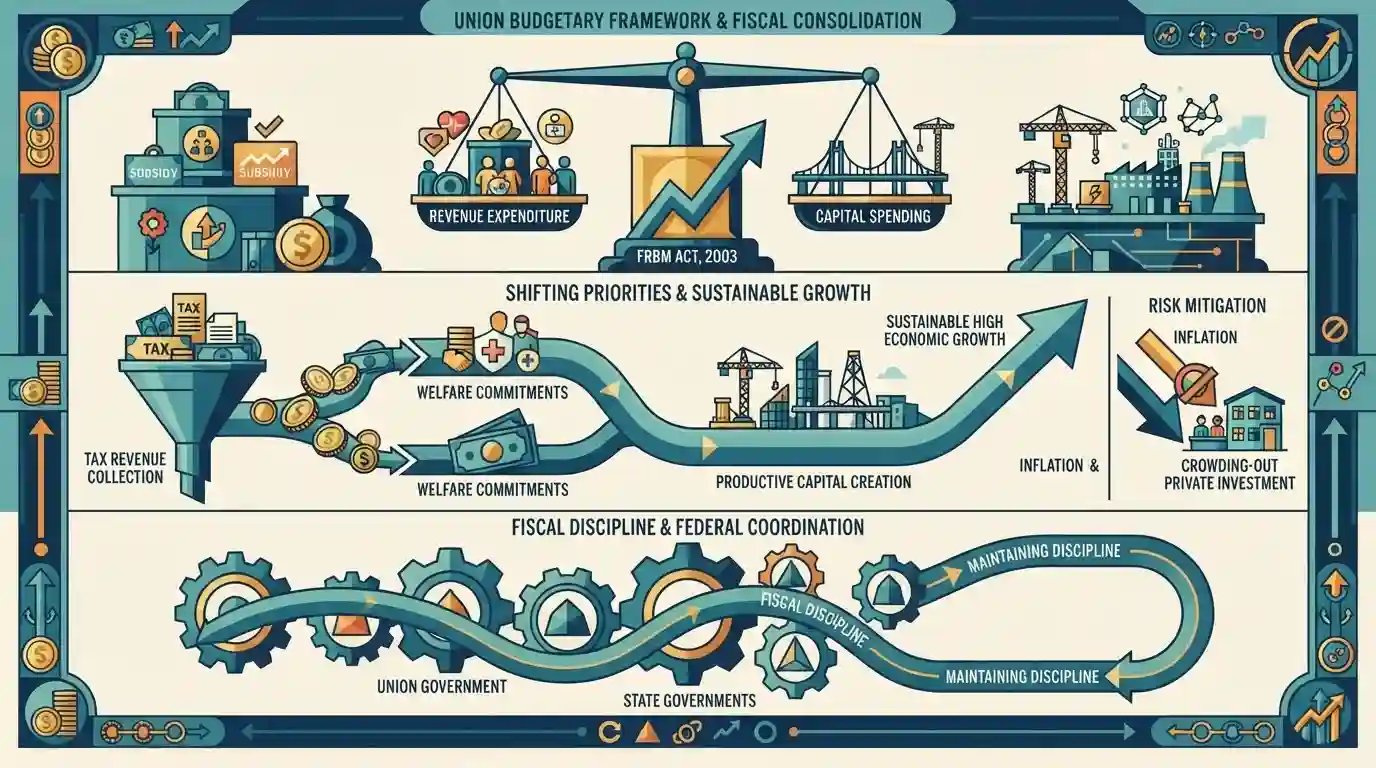
The article explores the critical necessity of adhering to a strict fiscal consolidation roadmap within the framework of the Union Budget. It emphasizes balancing welfare commitments and capital spending with the reduction of the fiscal deficit and public debt. By shifting expenditure towards productive capital creation and strengthening tax revenue collection, India can sustain high economic growth while mitigating the risks of inflation and private investment crowding-out. Additionally, the article underscores the need for federal coordination, urging state governments to maintain fiscal discipline.
Key Points
- Highlights the essential role of fiscal consolidation in preserving macroeconomic stability, anchoring inflation, and lowering sovereign borrow costs.
- Advocates for improving the 'quality of expenditure' by prioritizing Capital Expenditure (capex) over revenue consumption to stimulate long-term economic growth.
- Addresses the challenges of India's high general government debt-to-GDP ratio and the imperative of reducing the fiscal deficit towards the target glide path.
- Stresses the necessity of revenue-side measures, including tax base expansion, direct/indirect tax reforms, and leveraging non-tax avenues like central bank dividend transfers.
- Points out the importance of state-level fiscal compliance, monitoring sub-national debt, and aligning state borrowing with constitutional provisions under Article 293.
Important Terms
Fiscal Responsibility and Budget Management (FRBM) Act, 2003

A 2003 law enacted to institutionalize fiscal discipline by setting targets for the government to reduce fiscal and revenue deficits, stabilize debt, and ensure macroeconomic stability.
UPSC context
Important for GS Paper 3 (Economy). Tests understanding of fiscal policy, deficit management, and statutory frameworks for government borrowing.
Fiscal Consolidation
Government policies and actions aimed at reducing underlying fiscal deficits and curbing the accumulation of public debt, typically by increasing revenue collection and optimizing expenditure.
UPSC context
Crucial for GS Paper 3. Evaluates knowledge of public finance, macroeconomic stability, and the long-term sustainability of government debt.
Union Budget
Referred to as the Annual Financial Statement under Article 112 of the Constitution, it details the estimated receipts and proposed expenditures of the Government for the upcoming financial year.
UPSC context
Key for GS Paper 2 and 3. Tests knowledge of constitutional provisions, resource allocation, and the fiscal direction of the economy.
Capital Expenditure
Government spending that either creates long-term physical or financial assets, such as infrastructure, or reduces liabilities. It is vital for generating future economic benefits and growth.
UPSC context
Core GS Paper 3 concept. Tests the ability to distinguish between consumption-driven revenue expenditure and productive asset creation.
Finance Commission
A constitutional body established under Article 280 to recommend the distribution of tax revenues between the Union and the States, acting as the cornerstone of fiscal federalism.
UPSC context
Essential for GS Paper 2 (Polity). Tests understanding of fiscal federalism, center-state relations, and equitable resource devolution.
Prelims Trap
State governments require Centre's consent under Article 293 only when raising loans from external/international agencies.
Article 293(3) applies to any domestic open-market loan if the State has outstanding debts to the Centre. States cannot directly borrow from external international agencies under Article 293(1).
Static Concepts Connected
What are the key constitutional provisions governing Centre-State borrowing powers in India?
- Article 292: Empowers the Union government to borrow both domestically and externally upon the security of the Consolidated Fund of India, subject to parliamentary limits.
- Article 293(1): Restricts State governments to domestic borrowing only, secured against the Consolidated Fund of the State, within limits set by the State legislature.
- Article 293(3): Mandates Union consent for domestic borrowing if the State has any outstanding debt or loans owed to the Union government.
What is the framework governing RBI's surplus transfer to the Central Government?
- Section 47 Mandate: Under Section 47 of the RBI Act, 1934, profits after contingency provisions must be transferred annually to the Union government.
- Bimal Jalan Committee: Established the Economic Capital Framework, recommending that the Contingent Risk Buffer be maintained within a strict 5.5% to 6.5% range.
- Contingent Risk Buffer: The buffer maintained by the RBI to cover monetary, credit, and operational risks before declaring the final surplus dividend.
Cross-Topic Patterns
Fiscal Consolidation + Sovereign Credit Ratings
High debt-to-GDP ratios keep India's sovereign rating at the lowest investment grade, directly impacting domestic private sector borrowing costs abroad.
Sub-National Capex + Fiscal Federalism
The Centre uses 50-year interest-free capex loans to nudge states toward asset creation while enforcing fiscal discipline under Net Borrowing Ceilings.

Expect a conceptual question testing the legal basis of Net Borrowing Ceilings (Art 293) alongside RBI's Bimal Jalan CRB framework in 2026.
Linked PYQs · 5
Linked PYQs · 5
- 2020PrelimsGS1
Along with the Budget, the Finance Minister also places other documents before the Parliament which include 'The Macro Economic Framework Statement'. The aforesaid document is presented because this is mandated by
- 2013MainsGS3
What were the reasons for the introduction of Fiscal Responsibility and Budget Management (FRBM) Act, 2003 ? Discuss critically its salient features and their effectiveness.
- 2021MainsGS3
Distinguish between Capital Budget and Revenue Budget. Explain the components of both these Budgets.
- 2025MainsGS3
Explain how the Fiscal Health Index (FHI) can be used as a tool for assessing the fiscal performance of states in India. In what way would it encourage the states to adopt prudent and sustainable fiscal policies?
- 2025PrelimsGS1
Suppose the revenue expenditure is ₹ 80,000 crores and the revenue receipts of the Government are ₹60,000 crores. The Government budget also shows borrowings of ₹ 10,000 crores and interest payments of ₹ 6,000 crores. Which of the following statements are correct? I. Revenue deficit is ₹ 20,000 crores. II. Fiscal deficit is ₹ 10,000 crores. III. Primary deficit is ₹ 4,000 crores. Select the correct answer using the code given below.
