BRICS Indore Declaration on Digital Agriculture and Food Security
Source:insightsonindia ↗
Why It Matters
The BRICS Indore Declaration is highly significant for MPPSC Prelims as it represents a major international summit hosted within Madhya Pradesh (Indore), directly combining regional geography with international relations and agriculture policies—topics of high frequency in the state service examinations.
Summary
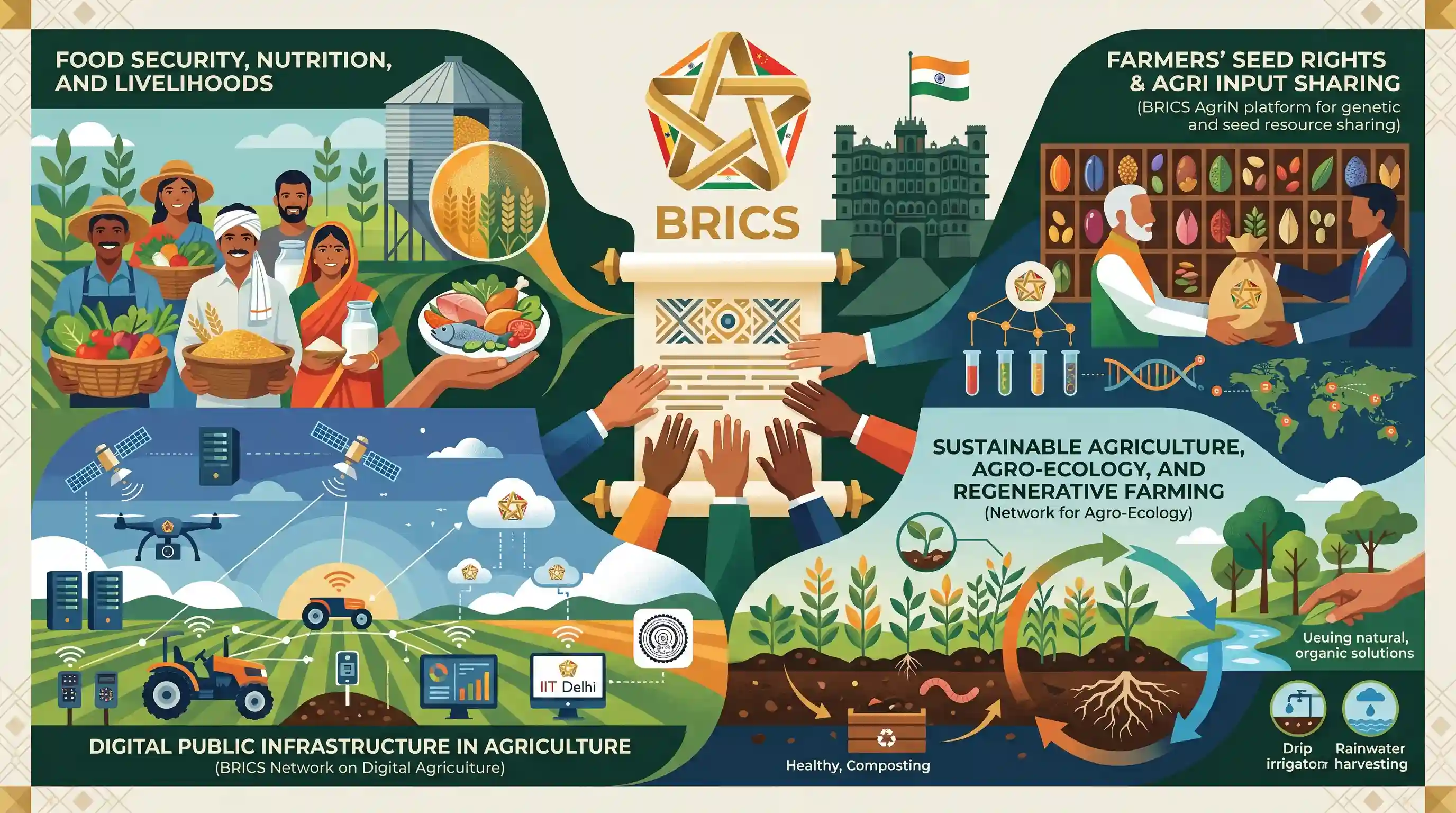
The BRICS Indore Declaration was unanimously adopted during the BRICS Agriculture Ministers' Meeting held in Indore, Madhya Pradesh in June 2026 under India's Presidency. It establishes a collaborative framework focusing on food security, digital agriculture, regenerative farming, and farmers' seed rights across member nations. Key initiatives include the BRICS Network on Digital Agriculture, a network for Agro-Ecology, and the BRICS AgriN platform for genetic and seed resource sharing.
Key Points
- India's BRICS Presidency culminated in the adoption of the BRICS Indore Declaration during the Agriculture Ministers' Meeting held in Indore, Madhya Pradesh in June 2026.
- The BRICS Indore Declaration is a unanimous, farmer-centric joint agricultural charter aiming to bolster food security, sustainable agriculture, and climate resilience.
- The declaration establishes the BRICS Network of Centres of Excellence on Agro-Ecology & Regenerative Agriculture to research and share knowledge on natural and organic farming.
- It launches the BRICS Network on Digital Agriculture to foster cooperation in AI, geospatial technologies, and digital public infrastructure.
- It introduces the Global Forum on Farmers' Rights in Seed Systems to protect indigenous seeds and traditional farming knowledge.
- It sets up BRICS AgriN (Agro Inputs, Genetic Resources & Information Network) to facilitate the exchange of agricultural inputs, genetic resources, and technical expertise.
Important Terms
BRICS Indore Declaration 2026

A farmer-centric agricultural cooperation framework adopted at the 16th BRICS Agriculture Ministers' Meeting in Indore, India, focusing on food security, climate-resilient farming, digital innovation, and seed rights across member states.
UPSC context
GS Paper II (International Relations) & GS Paper III (Agriculture); tests understanding of multilateral pacts on food security and sustainable farming.
BRICS AgriN
The 'Agro-inputs, Genetic Resources, and Information Network,' a collaborative framework established under the Indore Declaration to facilitate voluntary exchange of seeds, germplasm, fertilizers, and agricultural technologies among BRICS nations.
UPSC context
GS Paper III (Agriculture & Technology); evaluates platforms for international technology transfer, genetic resource sharing, and seed sovereignty.
BRICS
An intergovernmental grouping of major emerging economies—originally Brazil, Russia, India, China, and South Africa—collaborating on economic, political, and developmental issues to champion multipolar global governance.
UPSC context
GS Paper II (Bilateral & Multilateral Groupings); critical for analyzing India's strategic autonomy and influence in the Global South.
Prelims Trap
The Global Forum on Farmers' Rights in Seed Systems is an organ established under the FAO to ensure global compliance.
The "Global Forum on Farmers' Rights in Seed Systems" is a BRICS-centric initiative established under the Indore Declaration, not a UN-FAO or UPOV-led treaty body. UPSC often misattributes such newly formed forums to older, larger international organizations.
Static Concepts Connected
What are the key provisions of India’s PPV&FR Act, 2001 regarding farmers' rights?
- Seed Saving Right: Farmers are entitled to save, use, sow, resow, exchange, share, or sell their farm produce, including seed of a protected variety, as long as they do not sell branded seed.
- Farmer as Breeder: A farmer who has bred or developed a new variety is entitled to registration and protection in the same manner as a commercial breeder.
- Compensation Clause: Farmers can claim compensation if a registered variety fails to provide expected yields under specified conditions, protecting them from false corporate claims.
What core principles define agroecology and regenerative agriculture under Indian policy?
- No-Chemical Inputs: Prioritizing natural and biological inputs (like Jeevamrit) over synthetic fertilizers to restore soil microbiology.
- Soil Health Restoration: Enhancing soil organic carbon and moisture retention through cover cropping, mulching, and minimal tillage.
- Systemic Integration: Integrating livestock, trees (agroforestry), and multi-cropping to create closed, self-sustaining nutrient loops on the farm.
Cross-Topic Patterns
DPI as a diplomatic instrument
India's promotion of its agricultural DPI (like AgriStack) via the BRICS Network on Digital Agriculture reflects a strategic transition of domestic technology into a Global South diplomatic tool.
Seed sovereignty vs. Western IPR
The emphasis on indigenous seeds under the Indore Declaration serves as a geopolitical counterweight to Western-led, corporate-heavy UPOV regimes, defending traditional agrarian knowledge.

Expect 2026 Prelims to link BRICS smallholder statistics with the specific mandates of the newly established Indore Declaration platforms.
Linked PYQs · 3
Linked PYQs · 3
- 2016MPPSC_PRELIMSGS1
Which of the following is not one of the BRICS countries?
- 2024MPPSC_PRELIMSGS1
UNNATI (Agri-GISl project of Madhya Pradesh Government is for :
- 2019MPPSC_PRELIMSGS1
Which two cities of Madhya Pradesh included in 'town of export excellence'?
