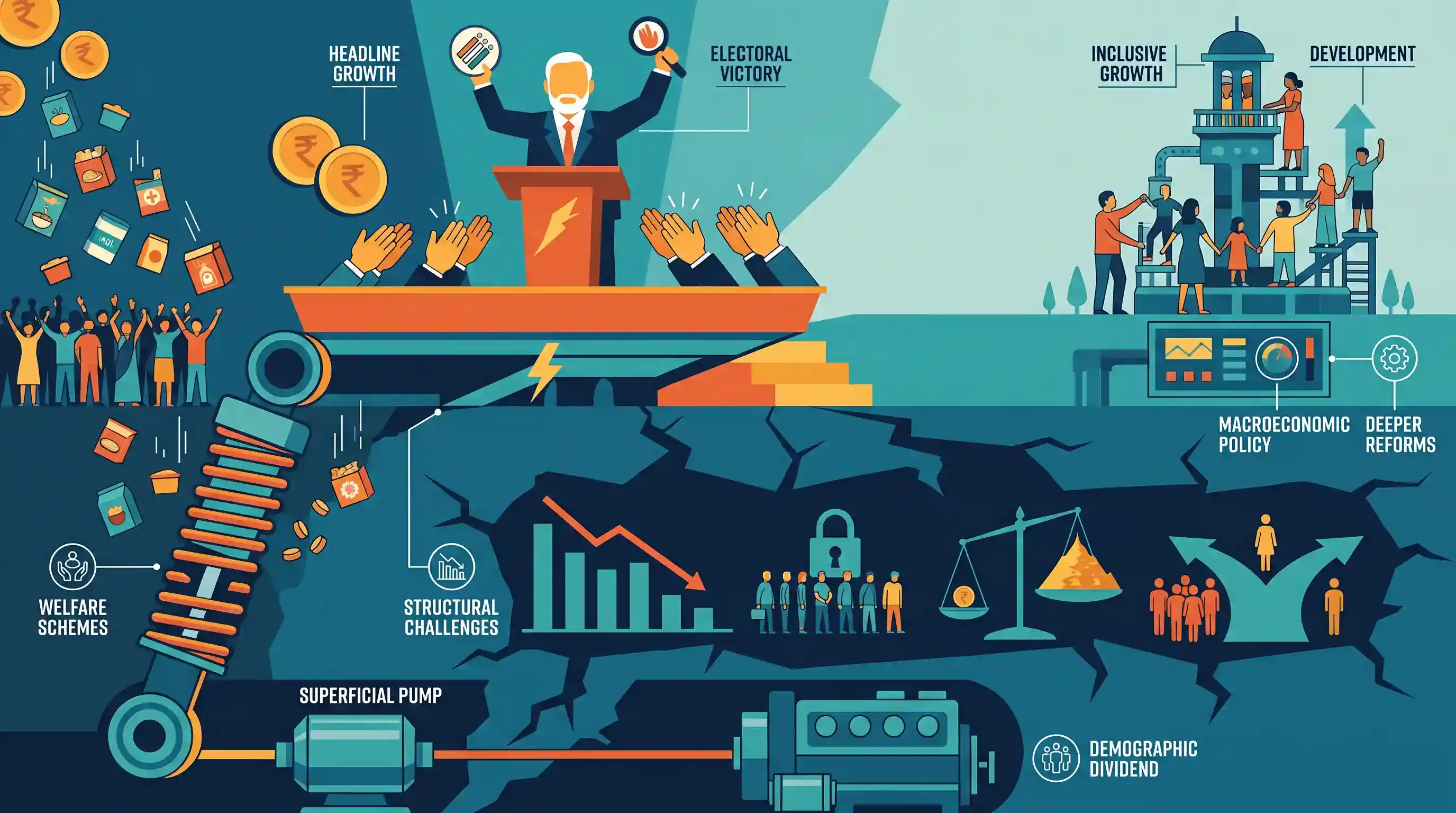
Structural economic challenges persist despite electoral success
Source:Indian Express ↗
Why It Matters
Provides a critical lens on the Indian economy, distinguishing between headline growth rates and structural realities like job creation and inclusivity. This is highly relevant for GS-3 (Economic Development) and GS-2 (Social Justice and Governance), especially in analyzing the effectiveness of welfare policies versus structural economic reforms.
Summary
The article highlights a growing paradox in India's political economy: the ruling party continues to secure electoral victories despite underlying macroeconomic vulnerabilities. While headline economic growth appears robust, the structural challenges of persistent unemployment, inflationary pressures, and unequal wealth distribution reveal a disconnect between political dominance and equitable development. The piece argues that targeted welfare schemes act as a political shock absorber, masking the urgent need for deeper structural economic reforms to foster genuine inclusive growth and harness the demographic dividend.
Key Points
- There is a stark divergence between headline economic growth figures and on-ground economic realities such as employment generation and income equality.
- Sustained electoral success by the ruling party is increasingly decoupled from broad-based economic performance, often buffered by targeted welfare schemes and direct benefit transfers.
- Structural economic challenges—including low employability, rural distress, and stress in the informal/MSME sector—persist and threaten to squander India's demographic dividend.
- Achieving sustainable and inclusive growth requires structural reforms and deft management of inflation and unemployment, rather than relying solely on welfare handouts.
Important Terms
Inclusive Growth

Economic expansion that is distributed fairly across society and creates opportunities for all, ensuring that benefits reach marginalized and vulnerable sections.
UPSC context
GS Paper 3 syllabus keyword; tests understanding of the link between GDP growth and equitable social development.
Direct Benefit Transfer (DBT)
A mechanism to transfer government subsidies and welfare payments directly into beneficiaries' bank accounts, leveraging the JAM (Jan Dhan-Aadhaar-Mobile) trinity to reduce leakages.
UPSC context
GS Paper 2 (Governance/Welfare) and GS Paper 3 (Economy); vital for discussing subsidy reform and digital governance.
Jobless Growth
A phenomenon where the economy expands (high GDP growth) without a proportional increase in employment opportunities, often due to capital-intensive growth or skill mismatches.
UPSC context
GS Paper 3 (Employment); used to critique the quality of India's growth trajectory and labor-intensive industry health.
Demographic Dividend
The economic growth potential resulting from shifts in a population's age structure, specifically when the working-age population (15-64) is larger than the dependent population.
UPSC context
GS Paper 1 (Social Issues) and GS Paper 3 (Economy); focuses on India's window of opportunity for rapid development.
MSMEs
Enterprises classified by investment and turnover; they are the second-largest employment provider after agriculture and crucial for decentralized industrial growth and exports.
UPSC context
GS Paper 3 (Industry/Growth); tests knowledge of the 'backbone' of the Indian economy and its resilience.
Structural Reforms
Long-term changes in the fundamental framework of an economy (e.g., labor laws, land acquisition, taxation) aimed at improving efficiency and productivity beyond short-term stimulus.
UPSC context
GS Paper 3 (Economic Development); distinguishes between temporary fiscal fixes and deep-seated institutional changes.
Prelims Trap
"Direct Benefit Transfers (DBTs) are classified as capital expenditure because they create long-term human capital."
DBTs are transfer payments classified as Revenue Expenditure. They do not create physical or financial assets for the government, despite their positive welfare impact.
Static Concepts Connected
What is the 'Employment Elasticity of Growth'?
- Definition: A macroeconomic measure of how employment varies with economic output (GDP).
- Formula: Calculated as the percentage change in employment divided by the percentage change in economic growth.
- Jobless Growth: A situation where employment elasticity approaches zero. It means the economy is expanding (GDP is rising) without creating a proportional number of new jobs.
How do transfer payments (welfare) differ structurally from Capital Expenditure?
- Revenue Expenditure: Welfare handouts, subsidies, and DBTs are revenue expenditures. They neither create government assets nor reduce government liabilities.
- Economic Impact: While welfare boosts short-term consumption among the poor, it does not directly expand the economy's productive capacity or structural infrastructure.
- Fiscal Trade-offs: Over-reliance on revenue-heavy welfare schemes can crowd out government Capital Expenditure (Capex), which is essential for long-term, structural job creation.
Cross-Topic Patterns
Formalization vs. MSME distress
Rapid economic formalization (via GST/digitalization) boosts headline GDP but often masks the decimation of the informal and MSME sectors, leading to a K-shaped growth trajectory and structural inequality.
Welfare vs. Electoral Freebies debate
The Supreme Court and Election Commission have actively debated the macroeconomic strain of electoral 'freebies' versus targeted merit-based welfare (DBT) necessary for poverty alleviation.

Mains 2026 GS3 will likely feature a 15-marker contrasting 'jobless growth' in MSMEs with the fiscal sustainability of expanding DBTs.
Linked PYQs · 4
Linked PYQs · 4
- 2022MainsGS2
Besides the welfare schemes, India needs deft management of inflation and unemployment to serve the poor and the underprivileged sections of the society. Discuss.
- 2022MainsGS3
Economic growth in the recent past has been led by increase in labour productivity." Explain this statement. Suggest the growth pattern that will lead to creation of more jobs without compromising labour productivity.
- 2014MainsGS3
While we flaunt India's demographic dividend, we ignore the dropping rates of employability. What are we missing while doing so? Where will the jobs that India desperately needs come from? Explain.
- 2022MainsGS3
Is inclusive growth possible under market economy ? State the significance of financial inclusion in achieving economic growth in India.
