Structural Unemployment and K Shaped Recovery Challenges in India
Source:Indian Express ↗
Why It Matters
Understanding the dichotomy between headline economic growth and micro-level realities (such as joblessness, inflation, and inequality) is critical for UPSC aspirants. It provides analytical depth for GS Paper 3 answers evaluating the quality of India's economic growth and the urgent need for inclusive policies.
Summary
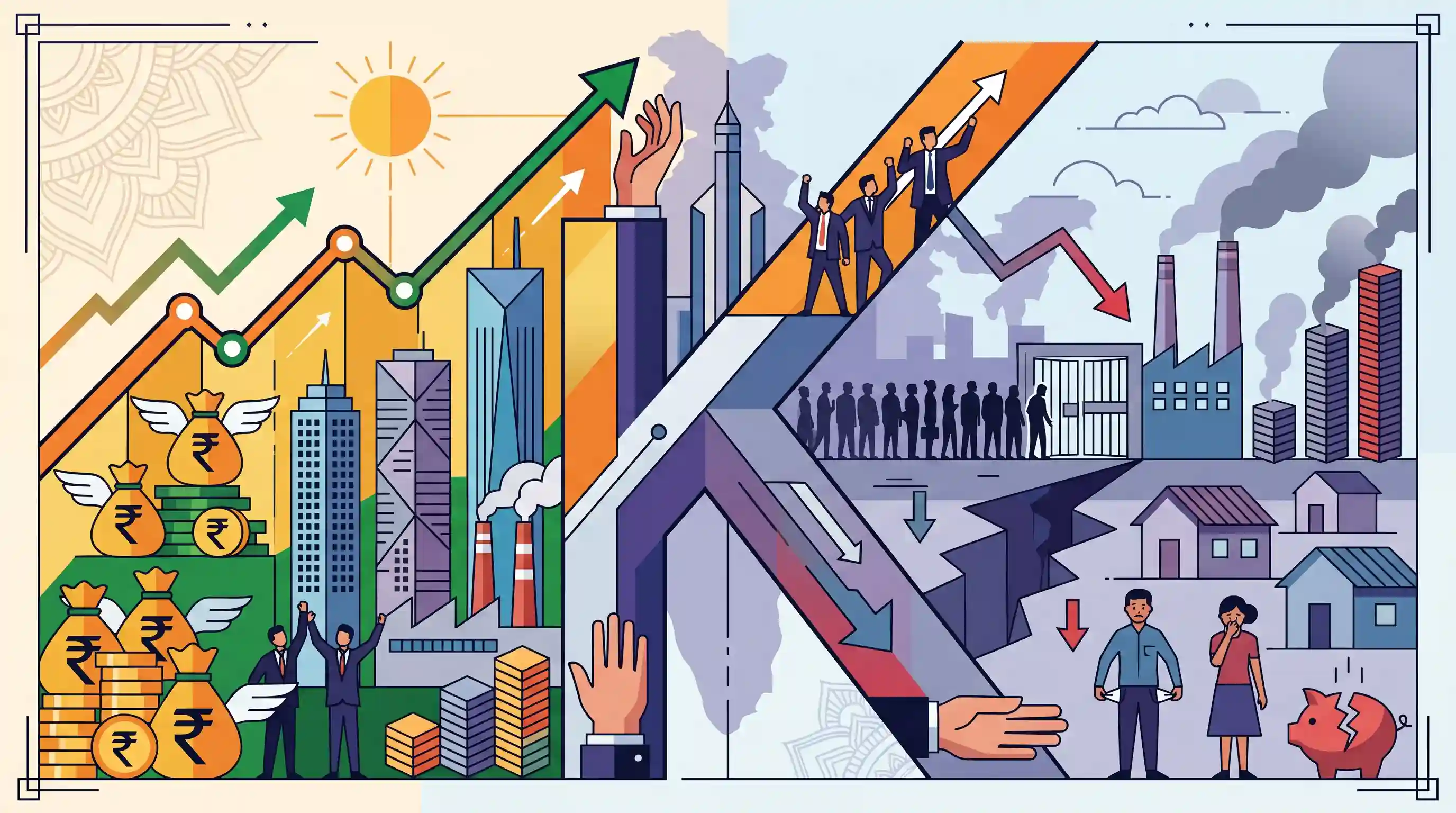
The article analyzes the paradox of the ruling party's continued electoral success despite underlying structural weaknesses in the Indian economy. It highlights a growing divergence between macroeconomic narratives and the ground reality, pointing to jobless growth, widening inequality, and a K-shaped recovery. While corporate wealth surges, ordinary citizens grapple with declining household savings, stagnant real wages, and chronic inflation, undermining the prospects of inclusive growth.
Key Points
- Despite strong electoral performances by the ruling party, the Indian economy exhibits deep structural vulnerabilities, particularly concerning employment and wealth distribution.
- The current economic trajectory reflects 'jobless growth,' characterized by persistent structural unemployment and stagnant real wages for the working class.
- India is witnessing a K-shaped economic recovery, where corporate profits and high-end consumption thrive while mass consumption and household savings decline.
- Chronic inflation and a lack of quality job creation are severely eroding the purchasing power and financial security of middle- and lower-income households.
Important Terms
Jobless Growth

An economic phenomenon where GDP increases while employment opportunities remain stagnant or decline, indicating that growth is driven by capital-intensive sectors rather than labor-intensive ones.
UPSC context
GS Paper 3: Indian Economy and issues relating to planning, mobilization of resources, growth, development, and employment.
K-shaped Recovery
A post-recession recovery where different sectors or social groups recover at divergent rates; some (e.g., formal/corporate) thrive while others (e.g., informal/poor) continue to decline.
UPSC context
GS Paper 3: Growth and Development. Tests understanding of economic inequality and post-pandemic recovery patterns.
Inclusive Growth
Economic growth that ensures equitable distribution of benefits across all sections of society, focusing on poverty reduction, job creation, and access to essential services like health and education.
UPSC context
GS Paper 3: Inclusive Growth and issues arising from it. A core theme in Indian development strategy.
Household Savings
The portion of disposable income that families save rather than consume. In India, it is a primary source of domestic capital for investment and infrastructure.
UPSC context
GS Paper 3: Mobilization of Resources. Tests awareness of domestic investment potential and financial health of citizens.
Real Wages
Wages adjusted for inflation to reflect their actual purchasing power. If prices rise faster than nominal wages, real wages decline despite any increase in salary figures.
UPSC context
GS Paper 3: Indian Economy. Crucial for analyzing the true standard of living and labor market conditions.
Chronic Inflation
A sustained increase in general price levels persisting over a long period. In India, it specifically concerns food and fuel prices affecting the poor's disposable income.
UPSC context
GS Paper 3: Indian Economy and issues relating to inflation. Tests understanding of macroeconomic stability.
Prelims Trap
"India's net household financial savings have steadily increased in tandem with rising GDP over the last decade."
High GDP growth and corporate profitability do not guarantee rising household savings. Recently, India's net household financial savings dropped to a multi-decade low.
Static Concepts Connected
What characterizes a K-shaped economic recovery?
- Divergent paths: Different sectors or income groups recover at contrasting rates, with one economic segment thriving while the other declines.
- Wealth inequality: It exacerbates structural inequality, as capital-owners and high-end consumers prosper while wage-earners and mass consumption stagnate.
What are the primary drivers of India's "Jobless Growth"?
- Capital-intensive growth: Economic expansion is primarily driven by capital and tech-heavy sectors (services/IT) rather than labor-intensive manufacturing.
- Skill mismatch: The existing workforce lacks the specific skills demanded by modern industries, leading to persistent structural unemployment.
- MSME dwarfism: Over 99% of Indian enterprises remain micro-units unable to scale up, severely limiting the creation of formal jobs.
Cross-Topic Patterns
MSME Dwarfism & Labour Laws
The failure of micro-enterprises to scale links directly to complex labor compliance and the 'missing middle' phenomenon, a recurring theme in GS3 Industrial Policy.
Household Savings & Capital Formation
Plunging net household financial savings reduces the domestic investible surplus, forcing reliance on foreign capital or aggressive state borrowing to fund national infrastructure pipelines.

Expect a multi-statement prelims question on 'Net Household Financial Savings' linking its multi-decade low to inflation and capital formation.
Linked PYQs · 5
Linked PYQs · 5
- 2023MainsGS3
Most of the unemployment in India is structural in nature. Examine the methodology adopted to compute unemployment in the country and suggest improvements.
- 2015MainsGS3
The nature of economic growth in India in recent times is often described as jobless growth. Do you agree with this view ? Give arguments in favour of your answer.
- 2022MainsGS3
Is inclusive growth possible under market economy ? State the significance of financial inclusion in achieving economic growth in India.
- 2017MainsGS3
What are the salient features of 'inclusive growth'? Has India been experiencing such a growth process? Analyse and suggest measures for inclusive growth.
- 2022PrelimsGS1
With reference to the Indian economy, consider the following statements: 1. A share of the household financial savings goes towards government borrowings. 2. Dated securities issued at market-related rates in auctions form a large component of internal debt. Which of the above statements is/are correct?
