Global Socio-Economic and Ethical Implications of AI Surge
Source:The Hindu ↗
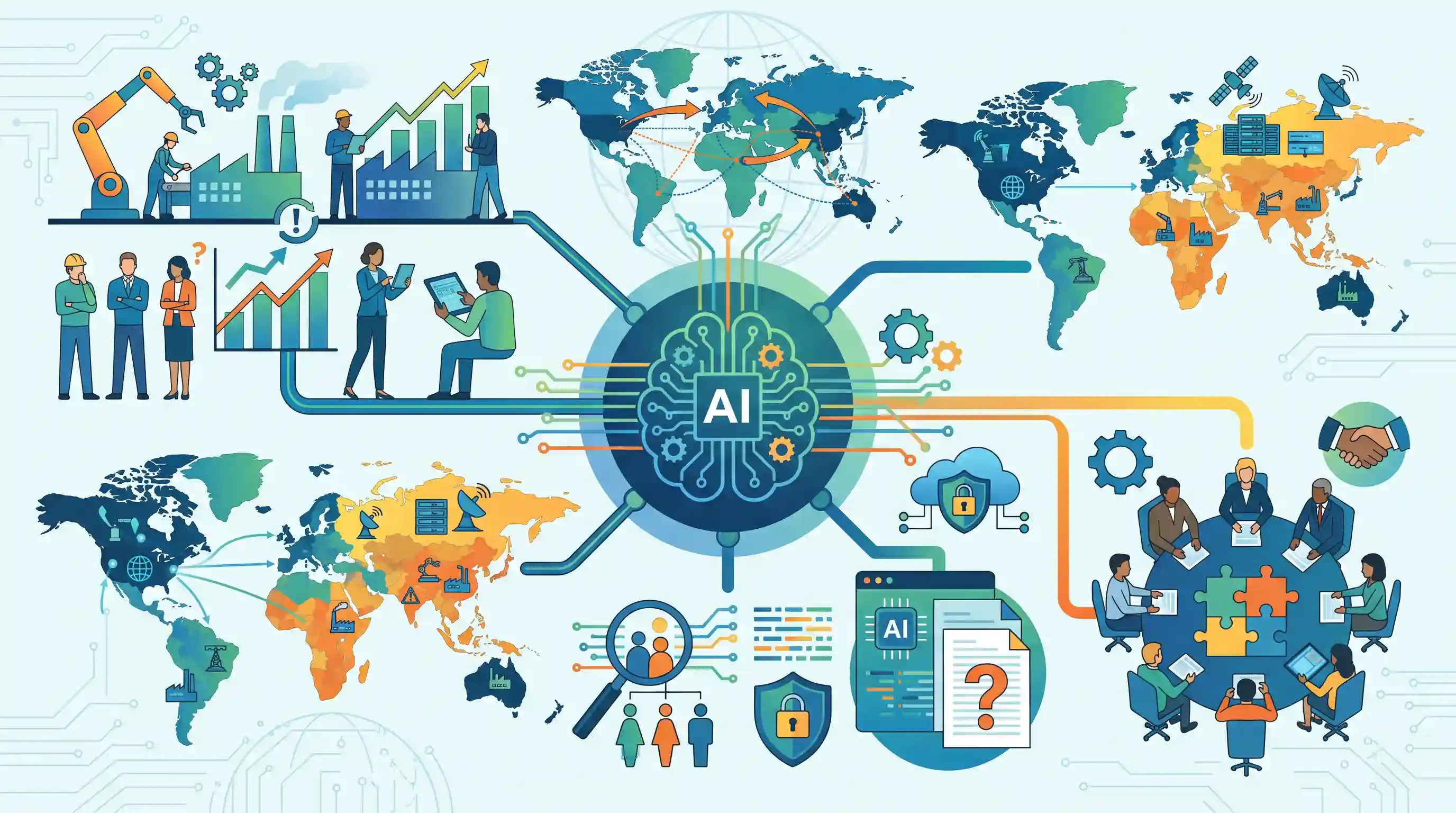
Why It Matters
The socio-economic and ethical impact of AI is a highly probable topic for both Prelims (identifying AI capabilities and emerging tech) and Mains (analyzing economic disruption, job market impact, privacy threats, and ethical dilemmas in AI deployment). Understanding the global consequences of AI is critical for aspirants when discussing technology governance and international relations.
Summary
The article examines the profound and far-reaching global consequences of the rapid surge in Artificial Intelligence (AI). As AI technologies evolve at an unprecedented pace, they are poised to disrupt global economies, restructure labor markets through automation, and reshape geopolitical dynamics. A central concern is the potential exacerbation of the global digital divide, with developed nations likely to disproportionately reap the economic rewards, potentially marginalizing developing countries. Furthermore, the piece highlights critical ethical and security challenges, including data privacy, algorithmic bias, and the implications of using AI in administrative decision-making. To navigate this technological revolution responsibly, the article underscores the urgent imperative for robust global governance frameworks and international cooperation to ensure equitable access and mitigate socio-economic risks.
Key Points
- The rapid advancement of Artificial Intelligence (AI), particularly generative AI, is transforming it into a general-purpose technology capable of disrupting traditional economic and social models.
- The AI surge threatens to widen the global digital divide, as advanced economies (Global North) are poised to capture the bulk of the economic benefits, while developing nations (Global South) may struggle to keep pace.
- Widespread automation and AI integration pose a significant risk of job displacement across various sectors, creating an urgent need for workforce reskilling, education reforms, and social safety nets.
- The deployment of AI brings profound ethical and security challenges, including issues of data privacy, algorithmic bias, and the application of AI in critical administrative or security decision-making.
- There is a pressing need for a comprehensive global governance framework and international cooperation to regulate AI development, ensuring its benefits are equitably shared and its risks are mitigated.
Prelims Trap
"The UN has established a legally binding global governance framework to regulate AI development."
No binding global UN treaty exists. Current frameworks like the Bletchley Declaration, GPAI, and the EU AI Act are voluntary multi-stakeholder initiatives or regional laws.
Static Concepts Connected
What characterizes a General-Purpose Technology (GPT) in economics?
- Pervasiveness: It spreads across most sectors of the economy, much like electricity, the internet, or steam power.
- Cost efficiency: It continuously lowers prediction and execution costs, becoming highly efficient as it evolves.
- Innovation spawning: It acts as a foundational layer that enables the invention and production of new products or processes across industries.
What are the primary ethical concerns surrounding 'algorithmic bias'?
- Data Reflection: AI models inherit and amplify historical prejudices present in their training datasets.
- Opacity: Complex AI systems often operate as a 'black box', making it difficult to trace how specific administrative decisions are reached.
- Discriminatory Outcomes: Biased algorithms can lead to unfair profiling and exclusion in public service delivery, predictive policing, and hiring.
Cross-Topic Patterns
Sovereign Compute & India's DPI
To counter "Digital Colonialism," India is integrating AI with its Digital Public Infrastructure (e.g., Bhashini for local language translation) to democratize tech benefits and build sovereign compute.
AI Automation vs. Demographic Dividend
AI-driven job displacement (Engels' Pause) directly threatens India's demographic dividend unless industrial policy aggressively pivots to AI-reskilling and tech-integrated, labor-intensive manufacturing.
Multilateral Tech Governance & GPAI
India's active role in the Global Partnership on Artificial Intelligence (GPAI) positions it as a critical negotiator for the Global South in shaping equitable AI guardrails.

Expect a Prelims question matching global AI frameworks (GPAI, Bletchley, EU AI Act) or a Mains GS3 prompt on "Digital Colonialism."
Linked PYQs · 5
Linked PYQs · 5
- 2023MainsGS3
Introduce the concept of Artificial Intelligence (AI). How does Al help clinical diagnosis? Do you perceive any threat to privacy of the individual in the use of Al in healthcare?
- 2020PrelimsGS1
With the present state of development, Artificial Intelligence can effectively do which of the following? 1. Bring down electricity consumption in industrial units 2. Create meaningful short stories and songs 3. Disease diagnosis 4. Text-to-Speech Conversion 5. Wireless transmission of electrical energy Select the correct answer using the code given below:
- 2024MainsGS4
The application of Artificial Intelligence as a dependable source of input for administrative rational decision-making is a debatable issue. Critically examine the statement from the ethical point of view.
- 2024MainsGS4
ABC Incorporated is a technological company named which is the second largest worldwide, situated in the Third World. You are the Chief Executive Officer and the majority shareholder of this company. The fast technological improvements have raised worries among environmental activists, regulatory authorities, and the general public over the sustainability of this scenario. You confront substantial issues about the business's environmental footprint. In 2023, your organization had a significant increase of 48% in greenhouse gas emissions compared to the levels recorded in 2019. The significant rise in energy consumption is mainly due to the surging energy requirements of your data centers, fuelled by the exponential expansion of Artificial Intelligence (AI). AI-powered services need much more computational resources and electrical energy compared to conventional online activities, notwithstanding their notable gains. The technology's proliferation has led to a growing concern over the environmental repercussions, resulting in an increase in warnings. Al models, especially those used in extensive machine learning and data processing, exhibit much greater energy consumption than conventional computer tasks, with an exponential increase. Although there is already a commitment and goal to achieve net zero emissions by 2030, the challenge of lowering emissions seems overwhelming as the integration of Al continues to increase. To achieve this goal, substantial investments in renewable energy use would be necessary. The difficulty is exacerbated by the competitive environment of the technology sector, where rapid innovation is essential for preserving market standing and shareholders' worth. To achieve a balance between innovation, profitability and sustainability, a strategic move is necessary that is in line with both, business objectives and ethical obligations. (a) What is your immediate response to the challenges posed in the above case? (b) Discuss the ethical issues involved in the above case. (c) Your company has been identified to be penalized by technological giants. What logical and ethical arguments will you put forth to convince about its necessity? (d) Being a conscience being, what measures would you adopt to maintain balance between AI innovation and environmental footprint?
- 2025PrelimsGS1
Consider the following statements: I. It is expected that Majorana 1 chip will enable quantum computing. II. Majorana 1 chip has been introduced by Amazon Web Services (AWS). III. Deep learning is a subset of machine learning. Which of the statements given above are correct?
