Andhra Pradesh Reorganisation Amendment Bill Legislative Updates
Source:prsindia ↗
Why It Matters
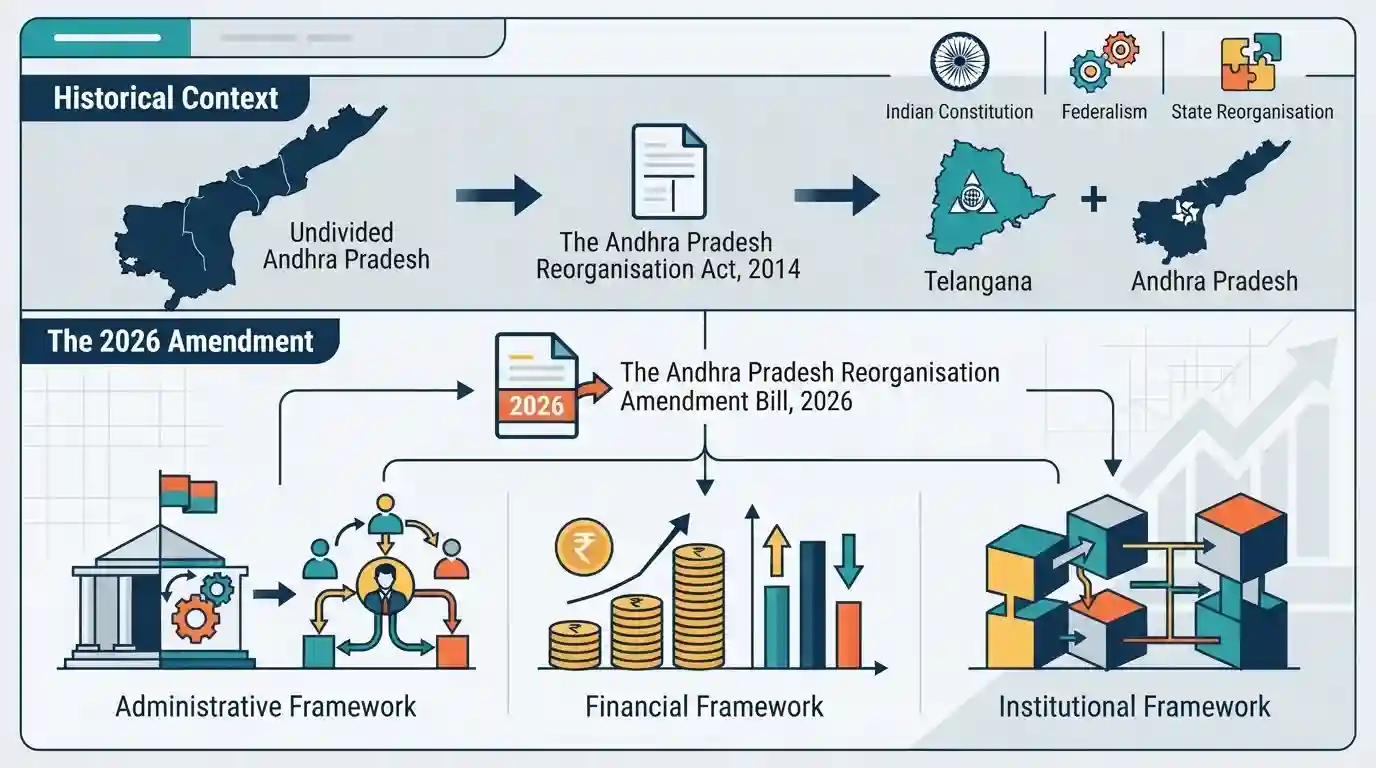
As an amendment to the foundational Andhra Pradesh Reorganisation Act, 2014, this bill directly affects the legislative and administrative dynamics, state bifurcation aftermath, and center-state relations relevant to Andhra Pradesh.
Summary
The Andhra Pradesh Reorganisation Amendment Bill, 2026 introduces key legislative changes to the Andhra Pradesh Reorganisation Act, 2014, impacting the administrative, financial, and institutional framework of the successor states.
Key Points
- The Andhra Pradesh Reorganisation Amendment Bill, 2026 seeks to amend the landmark Andhra Pradesh Reorganisation Act, 2014.
- Addresses key structural, financial, or institutional updates concerning the successor states of Andhra Pradesh and Telangana.
- Brings legislative focus back to outstanding provisions, division of assets, institutions, or infrastructural commitments outlined in the principal 2014 Act.
Important Terms
The Andhra Pradesh Reorganisation Amendment Bill, 2026

A legislative measure introduced to amend the 2014 Act, explicitly establishing Amaravati as the sole, permanent capital of Andhra Pradesh with retrospective effect from June 2, 2024.
UPSC context
Crucial for APPSC Group 1 & 2 (Andhra Pradesh History, Polity, and Reorganisation issues). Tests knowledge of state capital evolution and legislative developments.
Andhra Pradesh Reorganisation Act, 2014
The central legislation enacted by Parliament under Article 3 of the Constitution that bifurcated the erstwhile state of Andhra Pradesh into Andhra Pradesh and Telangana.
UPSC context
Core topic for APPSC syllabus under Indian Federalism and AP Reorganisation Act provisions, asset sharing, and administrative divisions.
Parliament
The supreme legislative body of India comprising the President, Lok Sabha, and Rajya Sabha, empowered under Articles 3 and 4 to form new states and alter state boundaries.
UPSC context
Important for Indian Polity and Constitution (Parliamentary powers, legislative procedure, and federal structure).
Government of Andhra Pradesh
The democratically elected executive organ of the state of Andhra Pradesh responsible for governance, policy execution, and economic administration of the successor state.
UPSC context
Relevant for APPSC Governance and State Administration syllabus, testing state-level executive functions and policy implementation.
Static Concepts Connected
What are the constitutional provisions governing the formation of new states and alteration of areas under Articles 3 and 4?
- Article 3 Power: Parliamentary Power: Parliament may by law form new states, increase or diminish area, or alter boundaries of any state (Article 3).
- Prior Reference: Presidential Recommendation: A Bill for this purpose requires prior recommendation of the President, who must refer it to the concerned State Legislature for expressing its views within a specified time.
- Simple Majority: Simple Majority: Laws enacted under Articles 2 and 3 are not considered constitutional amendments under Article 368 and require only a simple majority.
Cross-Topic Patterns
State Reorganisation & Fiscal Federalism Linkages
State bifurcation disputes over assets and institutional liabilities bridge Articles 3-4 of the Constitution with fiscal federalism principles and inter-state council mechanisms under Article 263.

APPSC often frames multi-statement questions on Article 3 powers, 2014 Act schedules, and common capital transition timelines.
Linked PYQs · 3
Linked PYQs · 3
- 2023APPSC_PRELIMSGS1
Part V of the Andhra Pradesh Reorganisation Act deals with
- 2023APPSC_PRELIMSGS1
How many Schedules are there in the Andhra Pradesh Reorganisation Act?
- 2019APPSC_PRELIMSGS1
According to 2014 Reorganization Act, after the bifurcation of the State how many revenue divisions are there in Andhra Pradesh ?
