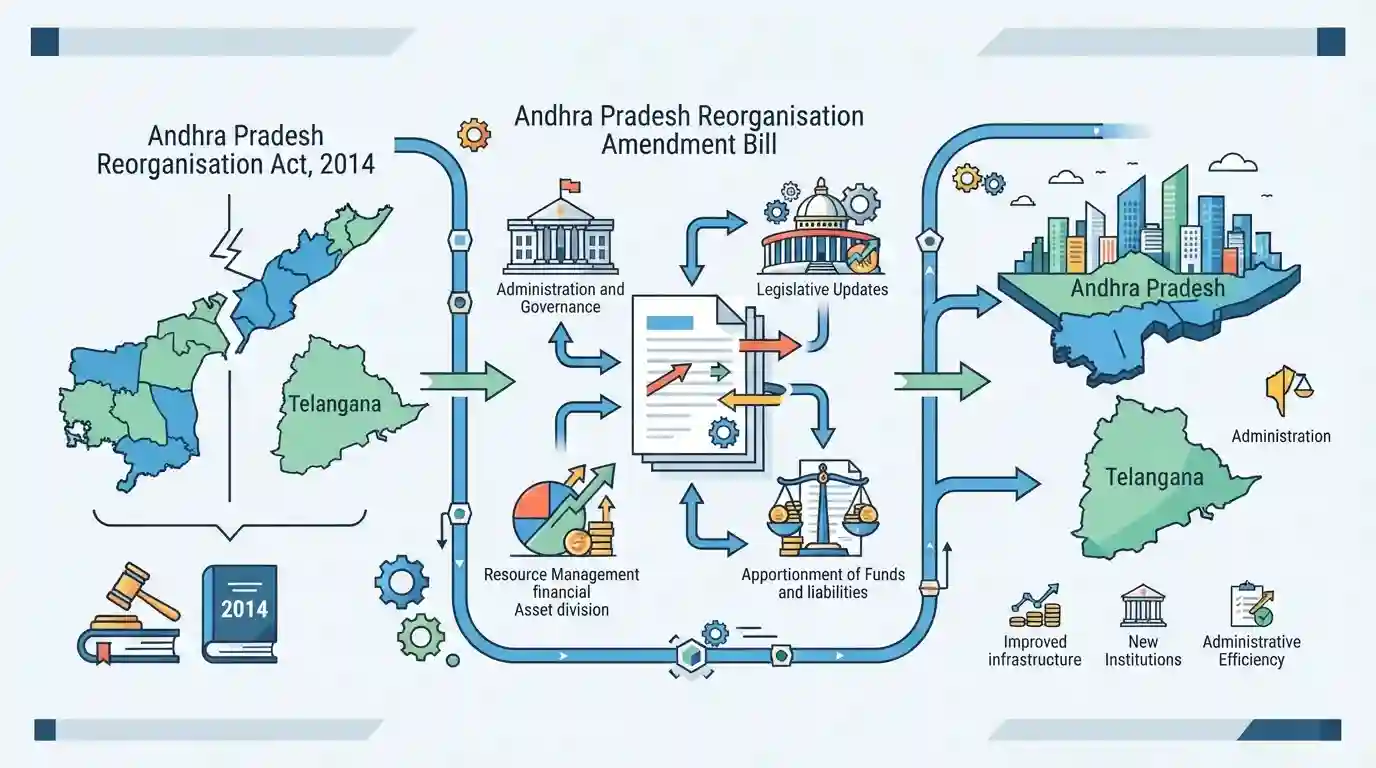
Andhra Pradesh Reorganisation Amendment Bill Legislative Framework
Source:prsindia ↗
Why It Matters
Directly impacts the legal, administrative, and financial landscape of Andhra Pradesh following the bifurcation, making updates to the 2014 Act crucial for APPSC aspirants tracking state governance and public policy.
Summary
An overview of The Andhra Pradesh Reorganisation Amendment Bill, tracking legislative updates to the Andhra Pradesh Reorganisation Act, 2014, impacting administration, governance, and resource management in Andhra Pradesh.
Key Points
- The Andhra Pradesh Reorganisation Amendment Bill seeks to amend the landmark Andhra Pradesh Reorganisation Act, 2014.
- Addresses critical legislative and structural adjustments concerning the two successor states, Andhra Pradesh and Telangana.
- Relevant for understanding contemporary state-level federal dynamics, asset division, institutional arrangements, and legislative updates pertaining to AP.
Important Terms
The Andhra Pradesh Reorganisation Amendment Bill

A legislative measure enacted to amend the Andhra Pradesh Reorganisation Act, 2014, notably designating Amaravati as the sole capital of Andhra Pradesh with retrospective effect from June 2, 2024.
UPSC context
Important for APPSC Mains (Paper-II/III) under Indian Federalism, State Reorganisation, and Andhra Pradesh Governance & Administration.
Andhra Pradesh Reorganisation Act 2014
The landmark central legislation passed in 2014 that bifurcated the erstwhile state of Andhra Pradesh into the states of Andhra Pradesh and Telangana, providing provisional joint capital and institutional provisions.
UPSC context
Core topic for APPSC syllabus on Indian Constitution, state reorganisation issues, federal challenges, and bifurcation impacts.
Parliament of India
The supreme legislative body of India comprising the President, Lok Sabha, and Rajya Sabha, empowered under Article 3 to reorganise states and amend related acts.
UPSC context
Essential for APPSC/UPSC Polity covering parliamentary functions, legislation, and federal division of powers.
PRS Legislative Research
An independent non-profit research institution in India that tracks legislative developments, analyses bills, and provides accessible policy research data for lawmakers and the public.
UPSC context
Helps civil services aspirants analyze legislative tracking, policy impacts, and governance reforms for APPSC/UPSC Mains answer writing.
Static Concepts Connected
What are the constitutional provisions and parliamentary powers governing the creation of new states in India?
- Article 3 Powers: Parliament may by law form a new State, increase or diminish area, or alter boundaries/name under Article 3.
- Prior Recommendation: Presidential recommendation is mandatory before introducing a Bill affecting state boundaries in Parliament.
- State Reference: The President must refer the Bill to the concerned State Legislature for expressing its views within a specified period.
Cross-Topic Patterns
Article 3 Reorganisation & Inter-State Fiscal Federalism
State bifurcation under Article 3 connects directly to inter-state council mechanisms under Article 263 and resource sharing protocols across newly formed states.

Expect a 2-statement question combining Article 3 powers with the 10-year joint capital transitional timeline under the 2014 Act.
Linked PYQs · 3
Linked PYQs · 3
- 2019APPSC_PRELIMSGS1
According to 2014 Reorganization Act, after the bifurcation of the State how many revenue divisions are there in Andhra Pradesh ?
- 2023APPSC_PRELIMSGS1
How many Schedules are there in the Andhra Pradesh Reorganisation Act?
- 2023APPSC_PRELIMSGS1
Part V of the Andhra Pradesh Reorganisation Act deals with
