Andhra Pradesh Reorganisation Amendment Bill Legislative Overview
Source:prsindia ↗
Why It Matters
Crucial for aspirants tracking state-specific legislation, post-bifurcation reorganisation issues, and federal dynamics in Andhra Pradesh.
Summary
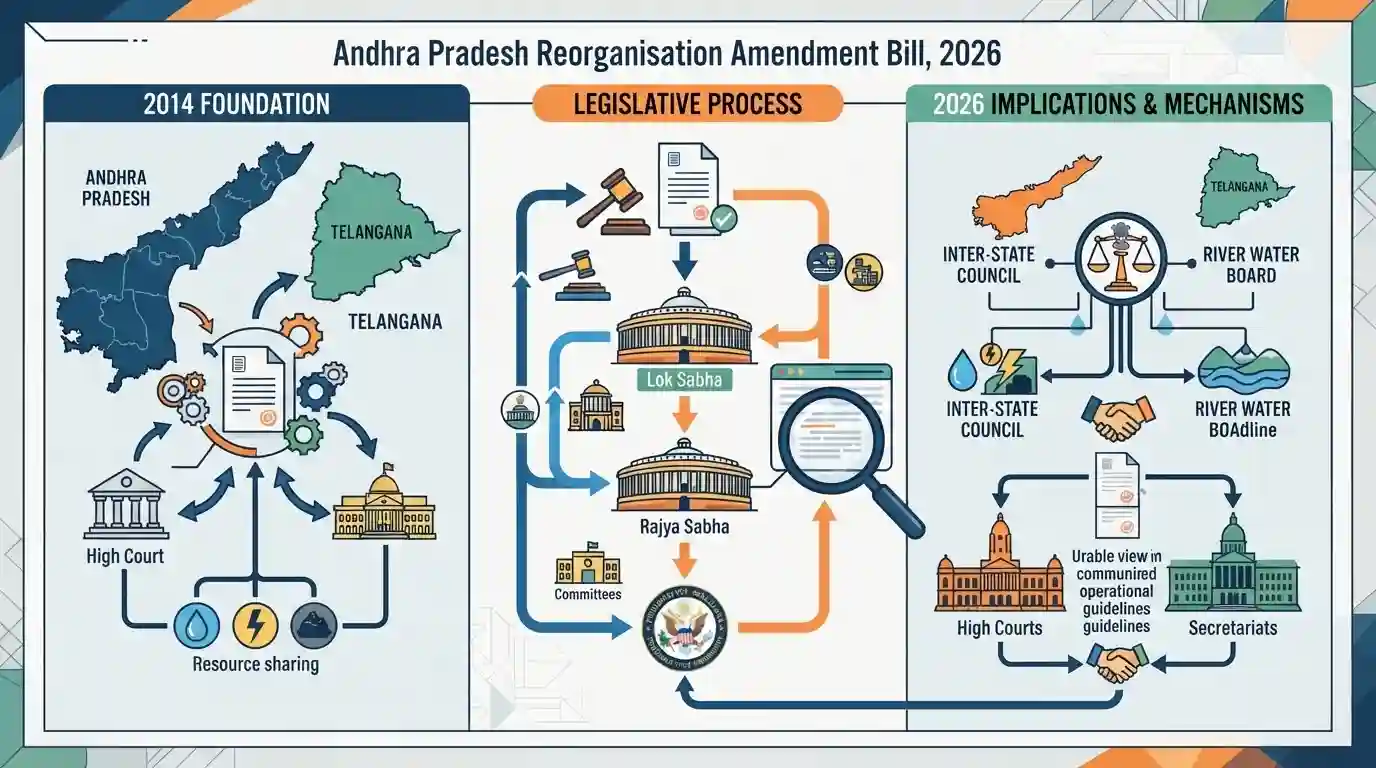
An overview of the Andhra Pradesh Reorganisation Amendment Bill, 2026 tracking legislative changes, institutional mechanisms, and federal implications concerning the successor states of Andhra Pradesh and Telangana under the broader framework of the Andhra Pradesh Reorganisation Act, 2014.
Key Points
- The Andhra Pradesh Reorganisation Amendment Bill, 2026 seeks to amend the principal 2014 Act governing the bifurcation and division of assets, liabilities, and institutional arrangements between Andhra Pradesh and Telangana.
- Such legislative amendments are critical for resolving ongoing inter-state administrative, financial, and institutional issues arising from the 2014 bifurcation.
- Provides direct relevance to state-specific polity, statutory provisions, and federal governance structures under APPSC Group 1 syllabus.
Important Terms
The Andhra Pradesh Reorganisation Amendment Bill, 2026

A 2026 legislative enactment amending the Andhra Pradesh Reorganisation Act, 2014, to officially declare Amaravati as the new permanent capital of Andhra Pradesh with retrospective effect.
UPSC context
Important for APPSC Group 1 & 2 (Indian Polity & AP History/Reorganisation), testing federal provisions, state bifurcation, and capital city legislation.
Andhra Pradesh Reorganisation Act, 2014
The landmark 2014 parliamentary enactment that bifurcated the erstwhile state of Andhra Pradesh into the successor states of Andhra Pradesh and Telangana.
UPSC context
Core APPSC syllabus topic under AP Reorganisation Act 2014, covering division of assets, liabilities, and administrative mechanisms.
Parliament
The supreme legislative body of India comprising the President, Lok Sabha, and Rajya Sabha, empowered under Article 3 to form new states and alter boundaries.
UPSC context
Crucial for Indian Polity (Parliamentary system, federal structure, and Article 3 provisions) in APPSC and UPSC exams.
PRS Legislative Research
An independent policy research institute in India that tracks legislative data, analyses bills, and provides non-partisan research on Parliament's functioning.
UPSC context
Valuable reference for civil services aspirants to study bill tracking, legislative scrutiny, and statutory reforms in Indian governance.
Static Concepts Connected
What are the constitutional provisions governing the creation of new states and reorganisation of territories in India?
- Article 3 Power: Empowers Parliament to form new states by separation, uniting territories, or altering boundaries by ordinary legislation under Article 3.
- Presidential Reference: Requires prior recommendation of the President and prior reference to the concerned State Legislature for expressing views.
- Simple Majority: Reorganisation laws are enacted by a simple majority under Article 4 and are not considered constitutional amendments under Article 368.
Cross-Topic Patterns
State Bifurcation & Federal Fiscal Architecture
Article 3 reorganisations trigger long-term fiscal adjustments, inter-state asset disputes, and institutional reallocations governed by specific statutory frameworks outside general Finance Commission allocations.

Expect a statement-based question combining Article 3 powers, Schedule VII asset divisions, and AP Reorganisation Act provisions.
Linked PYQs · 3
Linked PYQs · 3
- 2023APPSC_PRELIMSGS1
Part V of the Andhra Pradesh Reorganisation Act deals with
- 2023APPSC_PRELIMSGS1
How many Schedules are there in the Andhra Pradesh Reorganisation Act?
- 2024APPSC_PRELIMSGS1
With reference to the procedure for Amendment of the Constitution, consider the following statements : I. A private member of the House of the Parliament can introduce the Bill for amendment of the Constitution only after the prior permission of the President. II. Article 368 of the Constitution of India provides for three types of amendments - simple majority, special majority and ratification of half of the States by a simple majority. III. For amendments that require ratification of half the States by a simple majority, it is not necessary that all the State Legislatures must take action on the Bill. IV. The State Legislatures can pass a resolution requesting the Parliament to amend Article 368 in the same manner, as it could be done for the creation or abolition of Legislative Councils in the States. Which of the statement/statements given above is/are correct ?
