Andhra Pradesh Reorganisation Amendment Bill Provisions and Impact
Source:prsindia ↗
Why It Matters
Directly impacts the legal, administrative, and constitutional framework governing Andhra Pradesh post-bifurcation, making it a high-priority topic for APPSC Group 1 aspirants focusing on state-specific governance and polity.
Summary
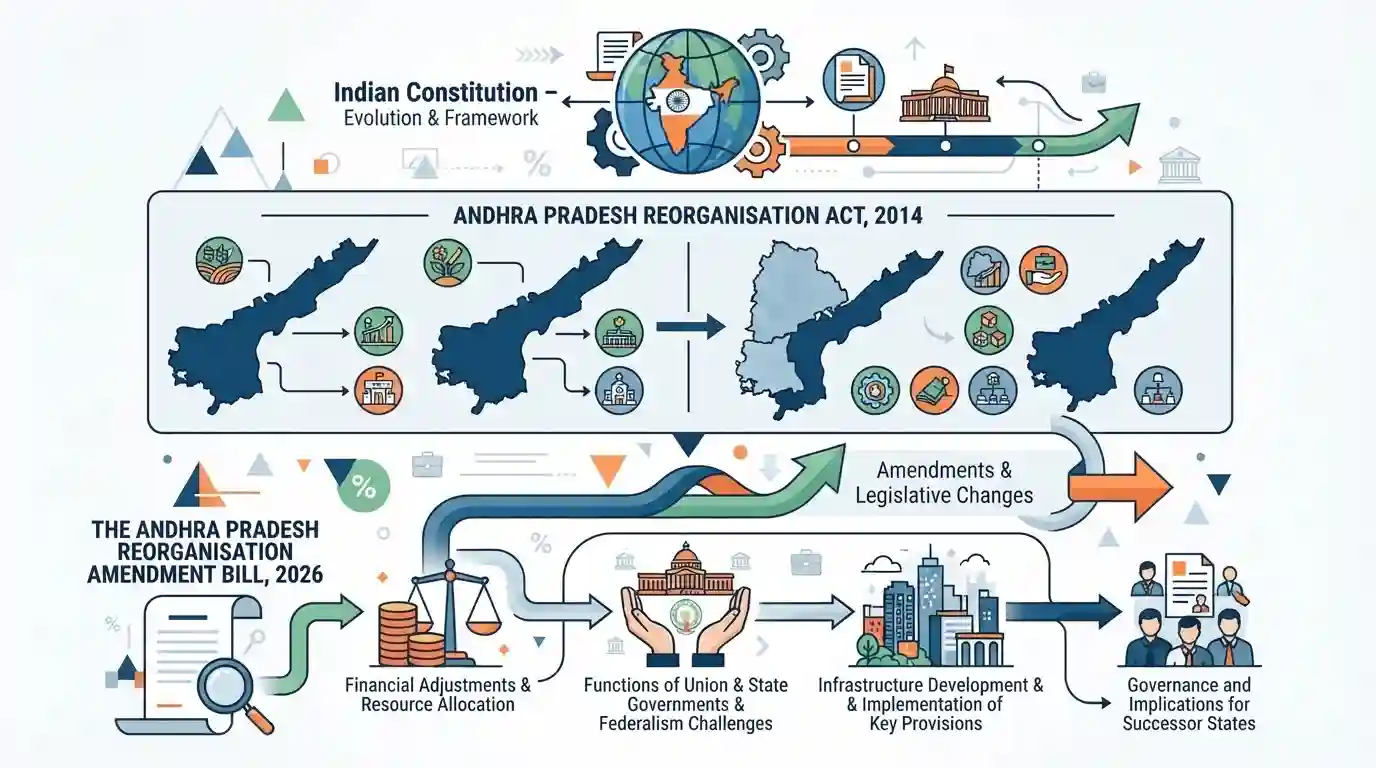
An overview of The Andhra Pradesh Reorganisation Amendment Bill, 2026 tracking legislative changes, scope, and implications for the successor states under the framework of the Andhra Pradesh Reorganisation Act, 2014.
Key Points
- The Andhra Pradesh Reorganisation Amendment Bill, 2026 seeks to amend the foundational Andhra Pradesh Reorganisation Act, 2014.
- Such legislative amendments address administrative, financial, or institutional adjustments concerning the successor states of Andhra Pradesh and Telangana.
- Crucial for APPSC aspirants tracking state bifurcation provisions, asset sharing, institutional mandates, and statutory updates under Indian federalism.
Important Terms
The Andhra Pradesh Reorganisation Amendment Bill, 2026

A 2026 parliamentary legislation that amends Section 5(2) of the 2014 Act to officially designate Amaravati as the sole permanent capital of Andhra Pradesh with retrospective effect.
UPSC context
Crucial for APPSC Group 1/2 (Andhra History, Polity & Governance), testing state reorganisation, federal dynamics, and legislative evolution post-bifurcation.
Andhra Pradesh Reorganisation Act, 2014
The central parliamentary enactment of 2014 that bifurcated the composite state of Andhra Pradesh into Telangana and the residuary state of Andhra Pradesh under Article 3 of the Constitution.
UPSC context
Essential for APPSC Indian Polity and AP Specific Governance topics, testing federal principles, asset division, and state creation under Article 3.
PRS Legislative Research
An independent non-partisan Indian research organisation that tracks parliamentary proceedings, analyses bills, and provides structured policy data for legislators and public awareness.
UPSC context
Important for General Studies on Indian Governance and Parliament functioning, testing sources of legislative analysis and public policy tracking.
Static Concepts Connected
What is the structural composition and key schedule distribution of the Andhra Pradesh Reorganisation Act, 2014?
- Statutory Structure: Total Parts and Sections: The 2014 Act is structured into 12 Parts and 108 Sections governing the bifurcation process.
- Schedules Setup: Schedules: Contains 13 Schedules addressing assets, liabilities, police deployment, public sector undertakings, and legal continuity.
- PSU Division: Schedules 9 and 10: Specifically deal with the division and apportionment of government companies, corporations, and specified institutions.
Cross-Topic Patterns
State Reorganisation & Inter-State Council Federalism
The legislative mechanics of Article 3 bifurcation paired with institutional asset sharing under Schedule 9 and 10 frequently intersects with inter-state council debates.
Rajya Sabha Seat Allocation & Asymmetrical Federalism
Changes to Rajya Sabha seat allocations under the Fourth Schedule following state bifurcation test principles of asymmetrical federalism and legislative representation.

Expect a multi-statement question on AP Reorganisation Act structures, specifically the distribution of schedules 9 and 10 or Part V financial provisions.
Linked PYQs · 3
Linked PYQs · 3
- 2023APPSC_PRELIMSGS1
Part V of the Andhra Pradesh Reorganisation Act deals with
- 2023APPSC_PRELIMSGS1
How many Schedules are there in the Andhra Pradesh Reorganisation Act?
- 2019APPSC_PRELIMSGS1
According to 2014 Reorganization Act, after the bifurcation of the State how many revenue divisions are there in Andhra Pradesh ?
