AP Reorganisation Amendment Bill impact on state administration
Source:prsindia ↗
Why It Matters
Crucial for APPSC Group 1 aspirants to track statutory amendments concerning the AP Reorganisation Act, 2014, as it directly impacts state administration, resource distribution, and governance in Andhra Pradesh.
Summary
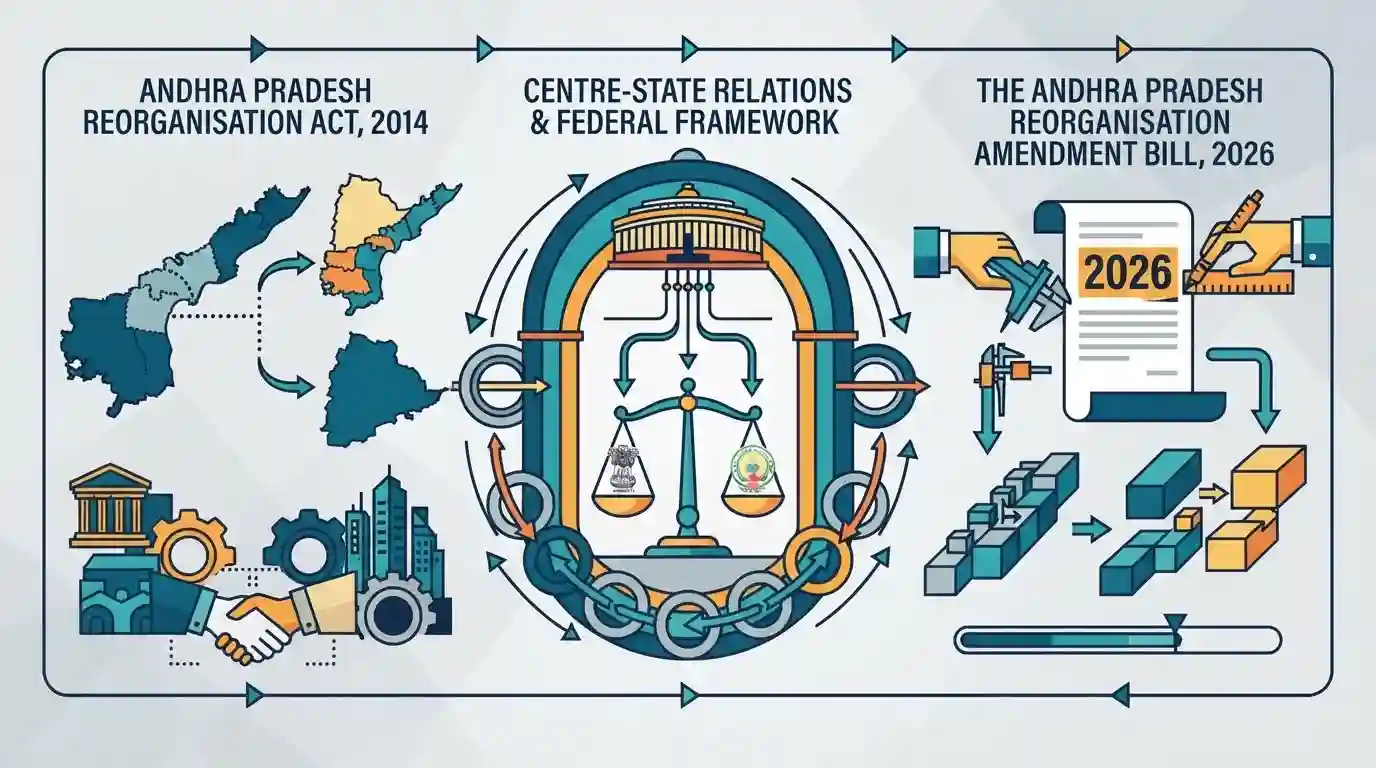
The article from PRS Legislative Research discusses 'The Andhra Pradesh Reorganisation Amendment Bill, 2026', detailing proposed modifications or updates to the framework established by the Andhra Pradesh Reorganisation Act, 2014, which governs matters between Andhra Pradesh and Telangana.
Key Points
- The Andhra Pradesh Reorganisation Amendment Bill seeks to amend the landmark Andhra Pradesh Reorganisation Act, 2014, which bifurcated the erstwhile state of Andhra Pradesh.
- It addresses critical statutory provisions, adjustments, or administrative frameworks related to the successor states of Andhra Pradesh and Telangana.
- Such legislative amendments are vital for APPSC aspirants studying state-specific governance, centre-state relations, and the statutory implications of state bifurcation.
Important Terms
The Andhra Pradesh Reorganisation Amendment Bill, 2026

A 2026 amendment to the Andhra Pradesh Reorganisation Act, 2014, giving statutory backing to Amaravati as the sole capital of Andhra Pradesh with retrospective effect from June 2, 2024.
UPSC context
Important for APPSC Group 1 & 2 (Andhra Pradesh History, Polity, and Reorganisation Act updates) and federal governance topics.
Andhra Pradesh Reorganisation Act, 2014
The landmark 2014 legislation enacted by Parliament that bifurcated the erstwhile state of Andhra Pradesh into Andhra Pradesh and Telangana, establishing the legal framework for division.
UPSC context
Essential core topic for APPSC Polity and AP History syllabus, testing understanding of state formation and federal reorganization.
Static Concepts Connected
What are the key constitutional and statutory provisions governing state formation and bifurcation in India?
- Parliamentary Power: Article 3 empowers Parliament to form new states, alter areas, boundaries, or names by ordinary legislative majority.
- State Viewpoint: Presidential Reference to State Legislature under Article 3 proviso is mandatory for expressing views, though Parliament is not bound by them.
- Statutory Schedules: The Andhra Pradesh Reorganisation Act, 2014 contained 13 schedules dealing with assets, public debt, corporations, and infrastructure.
Cross-Topic Patterns
Bifurcation law and Centre-State federalism
State bifurcation under Article 3 connects directly to cooperative federalism debates, Fifth/Sixth Schedule extensions, and inter-state river water disputes tribunals under Article 262.
Financial devolution and successor states
Asset and financial liabilities division under Reorganisation Acts parallels Fourteenth Finance Commission devolution formulas and revenue deficit grants for successor states.

AP Schedule/Article matching questions from the 2014 Act or amendment scopes are a high-probability target for APPSC Group-1.
Linked PYQs · 3
Linked PYQs · 3
- 2023APPSC_PRELIMSGS1
How many Schedules are there in the Andhra Pradesh Reorganisation Act?
- 2023APPSC_PRELIMSGS1
Part V of the Andhra Pradesh Reorganisation Act deals with
- 2019APPSC_PRELIMSGS1
According to 2014 Reorganization Act, after the bifurcation of the State how many revenue divisions are there in Andhra Pradesh ?
