Andhra Pradesh Reorganisation Amendment Bill Introduced
Source:prsindia ↗
Why It Matters
Crucial for aspirants tracking state-specific legislative developments, center-state relations, and amendments to the AP Reorganisation Act, which directly shape governance and administrative structures in Andhra Pradesh.
Summary
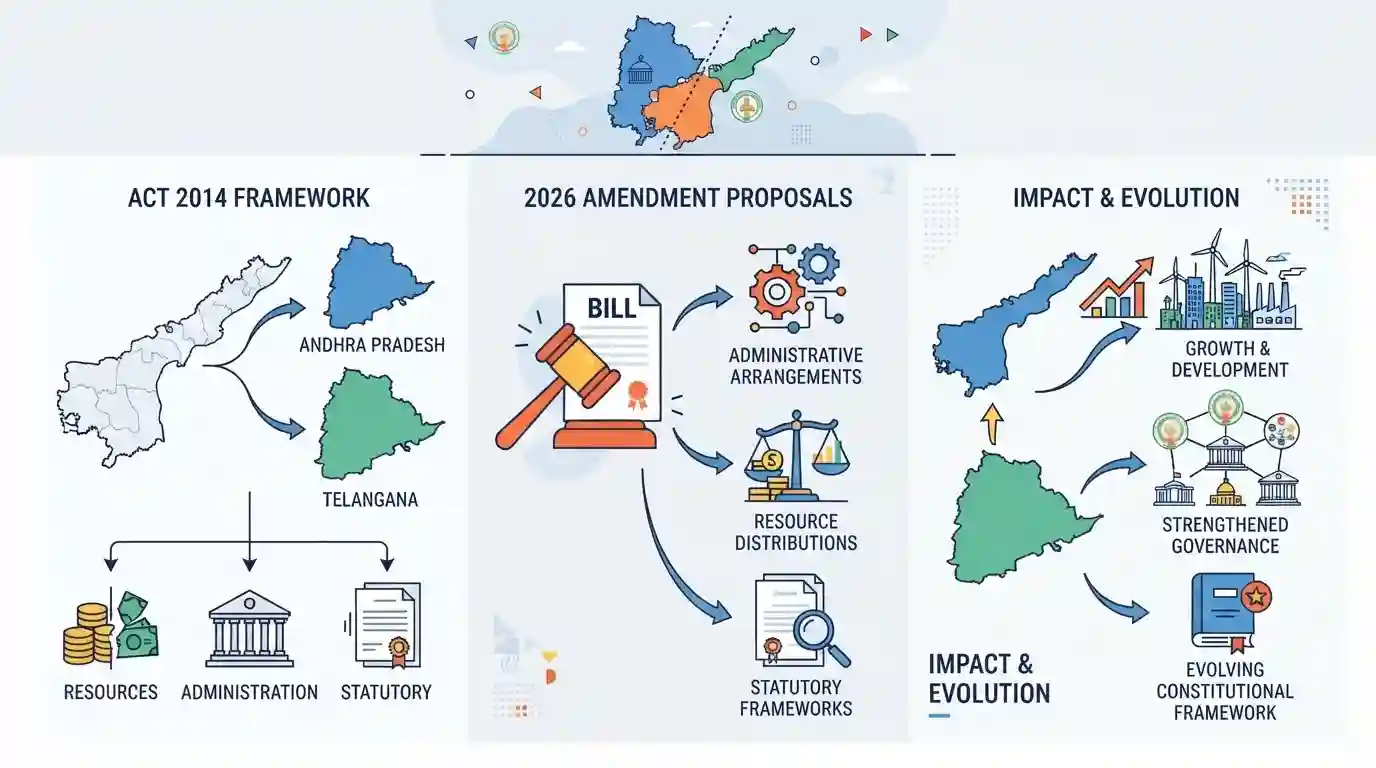
The Andhra Pradesh Reorganisation Amendment Bill, 2026 proposes key amendments to the Andhra Pradesh Reorganisation Act, 2014, impacting administrative arrangements, resource distributions, and statutory frameworks for Andhra Pradesh and Telangana.
Key Points
- The Andhra Pradesh Reorganisation Amendment Bill, 2026 seeks to amend the primary 2014 Act governing the bifurcation of the erstwhile state of Andhra Pradesh.
- Focuses on legislative modifications, institutional adjustments, or administrative asset/liability distributions between the successor states of Andhra Pradesh and Telangana.
- Holds immense significance for state polity, administrative control, and legal frameworks governing Andhra Pradesh.
Important Terms
The Andhra Pradesh Reorganisation Amendment Bill, 2026

A legislative proposal amending the Andhra Pradesh Reorganisation Act, 2014, to grant statutory status to Amaravati as the sole capital of Andhra Pradesh with retrospective effect from June 2, 2024.
UPSC context
Crucial for APPSC Group 1/2 (Polity and Governance - State Reorganisation, Centre-State Relations). Tests knowledge of post-bifurcation legislative developments.
Andhra Pradesh Reorganisation Act, 2014
The central legislation enacted in 2014 under Articles 3 and 4 of the Constitution that bifurcated the united state of Andhra Pradesh into Andhra Pradesh and Telangana.
UPSC context
Essential for APPSC syllabus on Indian Constitution, state bifurcation, and regional administrative arrangements.
Parliament of India
The supreme legislative body of India comprising the President, Lok Sabha, and Rajya Sabha, empowered under Article 3 to alter state boundaries and create new states.
UPSC context
Core topic in Indian Polity (Parliamentary system, law-making powers, and federal structure).
Static Concepts Connected
What are the constitutional provisions and procedural requirements for the creation of new states under Article 3 of the Indian Constitution?
- Presidential Recommendation: A bill for altering state boundaries or forming new states can be introduced in either House of Parliament only on the recommendation of the President.
- State Legislature Reference: Before recommending the Bill, the President must refer it to the state legislature concerned for expressing its views within a specified period.
- Non-Binding Views: The views of the state legislature are not binding on the President or Parliament; Parliament is supreme in altering boundaries.
- Simple Majority: Laws enacted under Article 3 to alter state boundaries are not deemed constitutional amendments under Article 368 and require only a simple majority.
Cross-Topic Patterns
Article 3 Reorganisation vs. Federal Principles
State bifurcation acts under Article 3 are insulated from rigid federal procedures, reflecting unilateral Union dominance in Indian federalism.

Expect statement-based questions on constitutional requirements of Article 3 bills, specifically President's prior recommendation and state assembly views.
Linked PYQs · 2
Linked PYQs · 2
- 2023APPSC_PRELIMSGS1
Part V of the Andhra Pradesh Reorganisation Act deals with
- 2023APPSC_PRELIMSGS1
How many Schedules are there in the Andhra Pradesh Reorganisation Act?
