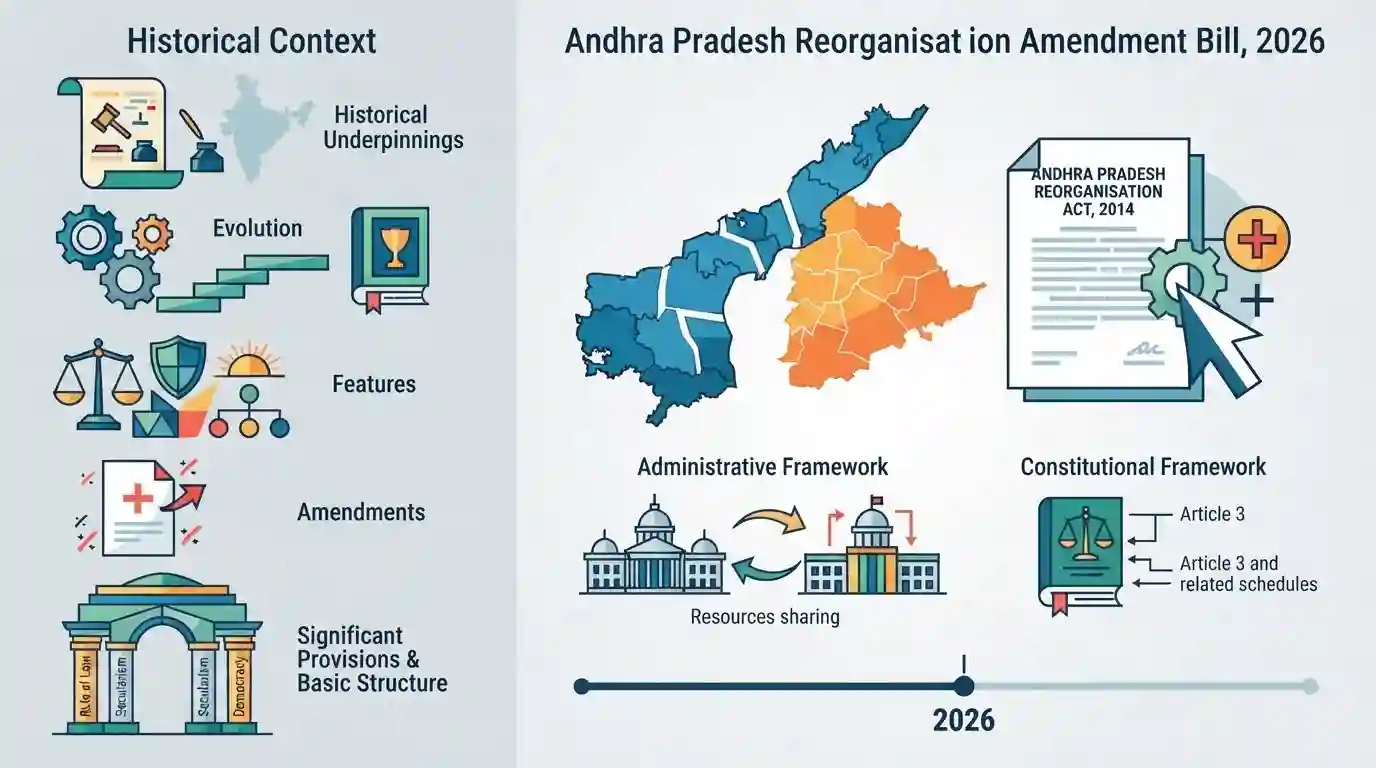
AP Reorganisation Amendment Bill 2026 key statutory provisions
Source:prsindia ↗
Why It Matters
As a legislative development directly modifying the Andhra Pradesh Reorganisation Act, 2014, this bill is of paramount importance for APPSC Group 1 aspirants focusing on state bifurcation history, statutory provisions, schedules, and center-state administration.
Summary
The Andhra Pradesh Reorganisation Amendment Bill, 2026 proposes key legislative amendments to the Andhra Pradesh Reorganisation Act, 2014, impacting administrative and constitutional frameworks concerning the bifurcation states of Andhra Pradesh and Telangana.
Key Points
- The Andhra Pradesh Reorganisation Amendment Bill, 2026 seeks to amend the principal Andhra Pradesh Reorganisation Act, 2014.
- Addresses legal, financial, or administrative adjustments pertaining to the successor states of Andhra Pradesh and Telangana.
- Critical for understanding legislative updates, resource distribution, and statutory mechanisms impacting Andhra Pradesh's governance framework.
Important Terms
Andhra Pradesh Reorganisation Act, 2014

A landmark 2014 parliamentary enactment that bifurcated the unified state of Andhra Pradesh into the states of Andhra Pradesh and Telangana, establishing institutional and financial frameworks for both.
UPSC context
Crucial for APPSC Paper II (Indian Polity and Governance - State Reorganisation, Centre-State Relations, and bifurcated state issues).
PRS Legislative Research
An independent non-profit research institution in India that tracks legislative business, provides non-partisan analysis, and publishes comprehensive legislative briefs on bills.
UPSC context
Important for APPSC current affairs and understanding policy analysis tools used in tracking lawmaking and parliamentary amendments.
Parliament
The supreme legislative body of India comprising the President, Lok Sabha, and Rajya Sabha, empowered under Article 3 to reorganise states and alter boundaries.
UPSC context
Fundamental for APPSC Paper II under Indian Constitution, Union Legislature, and powers related to state formation and legislative amendments.
Static Concepts Connected
What are the constitutional provisions and parliamentary procedures governing the creation and reorganisation of states in India?
- Constitutional Route: Article 3 empowers Parliament to form new states, alter boundaries, or change names by a simple majority, without needing a constitutional amendment under Article 368.
- Presidential Reference: Bills under Article 3 require prior recommendation of the President, who must refer the bill to the concerned state legislature for expressing its views within a specified period.
- Article 4 Exemption: Article 4 states that laws made under Articles 2 and 3 providing for the formation of new states are not deemed amendments of the Constitution for the purposes of Article 368.
Cross-Topic Patterns
Article 3 Reorganisation & Federal Finance Split
State reorganisation bills under Article 3 require Presidential recommendation before introduction in Parliament, linking legislative procedure with federal finance distribution in Part XII.

Expect a multi-statement question on Article 3 powers, constitutional role of President, and 2014 Act structure (Parts/Schedules).
Linked PYQs · 2
Linked PYQs · 2
- 2023APPSC_PRELIMSGS1
Part V of the Andhra Pradesh Reorganisation Act deals with
- 2023APPSC_PRELIMSGS1
How many Schedules are there in the Andhra Pradesh Reorganisation Act?
