Transition to Hyper Personalized Artificial Intelligence
Source:The Hindu ↗
Why It Matters
The pivot to personalized AI touches directly upon the GS3 syllabus covering developments in Science and Technology, as well as Cybersecurity challenges. It also raises critical GS4 ethical issues regarding data manipulation, privacy rights, and the concentration of sensitive information by technology monopolies.
Summary
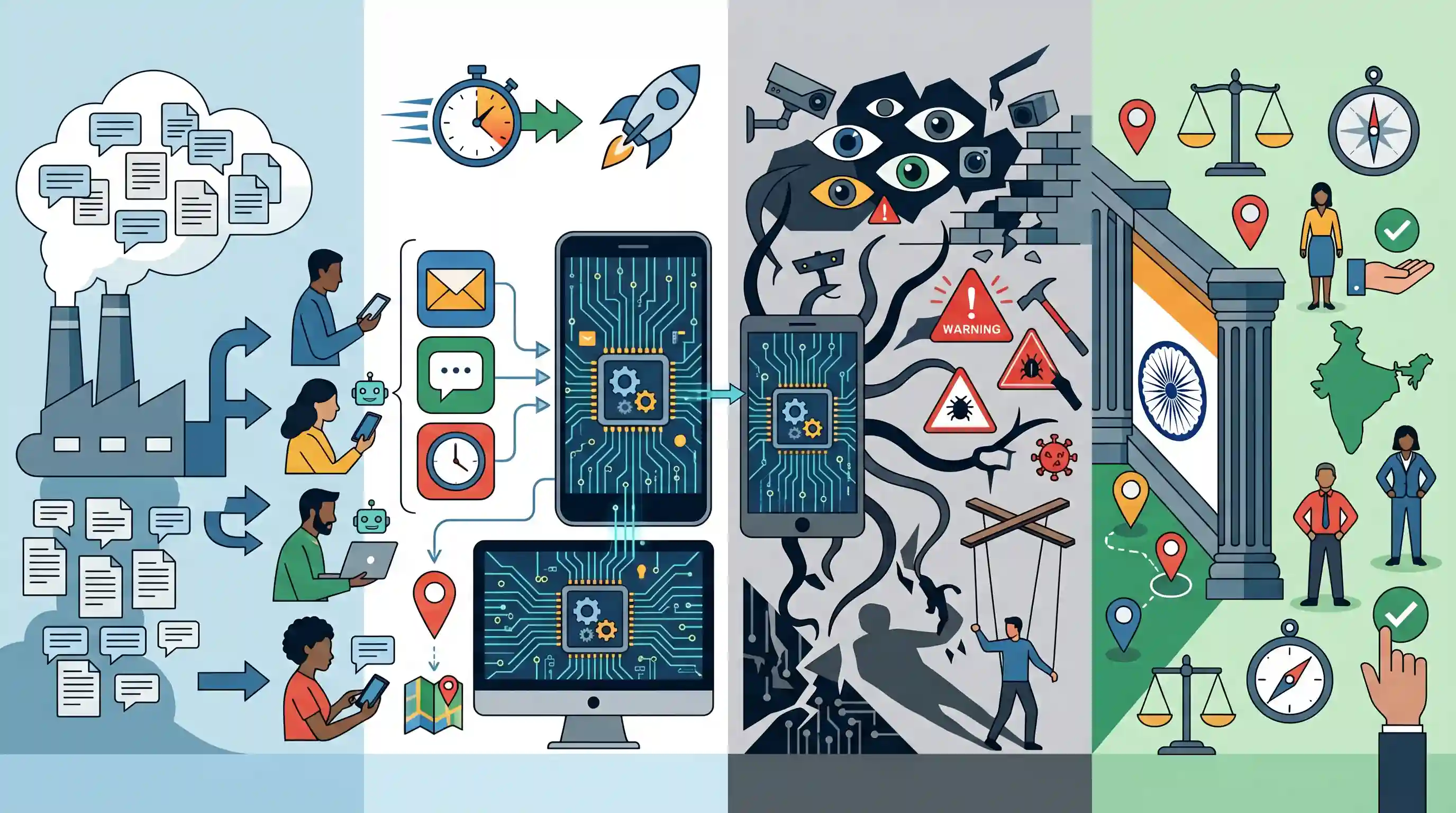
The article explores the latest phase in the artificial intelligence industry, wherein the focus has shifted from generalized large language models to hyper-personalized AI assistants. Tech giants are increasingly integrating AI directly into consumer devices and communication platforms to offer highly tailored experiences based on individual user data. While 'on-device AI' offers potential latency and security benefits by processing data locally, the deep integration of AI into personal emails, messages, and daily routines amplifies concerns over data privacy, cybersecurity risks, and algorithmic manipulation. This evolution necessitates robust regulatory frameworks, such as India's Digital Personal Data Protection Act, to safeguard individuals against the unethical exploitation of their digital footprints.
Key Points
- The AI industry is transitioning from building massive, generalized large language models to developing highly personalized AI agents tailored to individual users.
- Companies are increasingly deploying 'on-device AI' capabilities to process user data locally, attempting to balance hyper-personalization with data privacy and security.
- Personal AI systems require deep integration with a user's intimate digital footprint (emails, messages, photos, schedules), significantly raising the stakes for cybersecurity and data breaches.
- The shift poses complex ethical and regulatory challenges, particularly concerning the manipulation of consumer behavior, algorithmically driven echo chambers, and the monopolization of user data by big tech firms.
Important Terms
Digital Personal Data Protection (DPDP) Act, 2023

India's first comprehensive law regulating digital personal data processing, balancing individual privacy rights with lawful data needs. It established the Data Protection Board of India for adjudicating grievances.
UPSC context
GS II (Governance/Polity) and GS III (Cybersecurity); tests knowledge of digital rights and regulatory frameworks.
Data Fiduciary
Any person, company, or government entity that determines the purpose and means of processing personal data under India's DPDP Act, 2023. They are legally accountable for data security.
UPSC context
GS II and III; essential for understanding legal responsibilities in India's digital economy and data governance.
On-device AI
AI technology that processes data locally on a user’s hardware (e.g., smartphone) rather than cloud servers, enhancing privacy, reducing latency, and enabling offline functionality.
UPSC context
GS III (Science & Technology); focuses on emerging tech trends, data sovereignty, and privacy-enhancing innovations.
Large Language Models (LLMs)
AI systems trained on massive datasets to understand, interpret, and generate human-like text. They are built on transformer-based neural networks and power generative tools like chatbots.
UPSC context
GS III (Science & Technology); tests awareness of foundational AI technologies and their applications/limitations.
Algorithmic Bias
Systematic, unfair outcomes produced by AI systems when they reflect or amplify human prejudices present in their training data or underlying design choices.
UPSC context
GS IV (Ethics) and GS III; relevant for discussing the ethical implications and societal impacts of automation.
Generative AI
A subset of AI capable of creating new, original content—such as text, images, or code—by learning and predicting patterns from existing datasets.
UPSC context
GS III (Science & Technology); core topic for digital transformation and technological advancements in the 21st century.
Prelims Trap
On-device AI relies continuously on centralized cloud servers to process real-time personalized data.
On-device (Edge) AI processes data locally on the user's hardware (smartphone/PC), specifically aiming to reduce latency and cloud dependency, unlike traditional centralized LLMs.
Static Concepts Connected
What is Edge Computing and how does it differ from Cloud Computing?
- Data Processing: Edge computing processes data locally at or near the source (the device itself), whereas cloud relies on distant, centralized data centers.
- Latency & Bandwidth: Edge architecture drastically reduces latency and bandwidth usage since raw data doesn't need to travel continuously to the cloud.
- Security & Privacy: Edge computing enhances data privacy by keeping sensitive personal information on-device, minimizing the risk of interception during network transmission.
What are the core data protection principles underlying India's DPDP Act, 2023?
- Verifiable Consent: Data Fiduciaries must obtain clear, affirmative, and verifiable consent from Data Principals before processing their personal data.
- Data Minimization: Entities are legally bound to collect only the personal data that is strictly necessary to fulfill the specified purpose.
- Purpose Limitation: Personal data collected for one specific, declared purpose cannot be subsequently used for an unrelated or secondary purpose.
Cross-Topic Patterns
AI Personalization & Cognitive Manipulation
Hyper-personalized AI links S&T to GS4 (Ethics). Algorithms that exploit personal vulnerabilities to shape consumer behavior challenge the ethical principles of human autonomy and informed consent.
Spear-phishing, Cybercrime, and DPDP Act
Deep integration of AI into personal profiles expands the attack surface for targeted cybercrimes like spear-phishing, directly testing the grievance redressal mechanisms under India's new Data Protection Board.

A 2026 Prelims question will likely mix statements on 'Edge Computing' mechanisms with the 'Purpose Limitation' clause of the DPDP Act.
Linked PYQs · 5
Linked PYQs · 5
- 2023MainsGS3
Introduce the concept of Artificial Intelligence (AI). How does Al help clinical diagnosis? Do you perceive any threat to privacy of the individual in the use of Al in healthcare?
- 2024MainsGS3
Describe the context and salient features of the Digital Personal Data Protection Act, 2023.
- 2024MainsGS4
The application of Artificial Intelligence as a dependable source of input for administrative rational decision-making is a debatable issue. Critically examine the statement from the ethical point of view.
- 2025MainsGS4
In the present digital age, social media has revolutionised our way of communication and interaction. However, it has raised several ethical issues and challenges. Describe the key ethical dilemmas in this regard.
- 2020PrelimsGS1
With the present state of development, Artificial Intelligence can effectively do which of the following? 1. Bring down electricity consumption in industrial units 2. Create meaningful short stories and songs 3. Disease diagnosis 4. Text-to-Speech Conversion 5. Wireless transmission of electrical energy Select the correct answer using the code given below:
