Islamic Law and the Age of Marriage in India
Source:The Hindu ↗
Why It Matters
This topic is central to the ongoing discourse on gender justice, uniform civil code, and the harmonization of personal laws with constitutional rights, which frequently appear in GS Paper II.
Summary
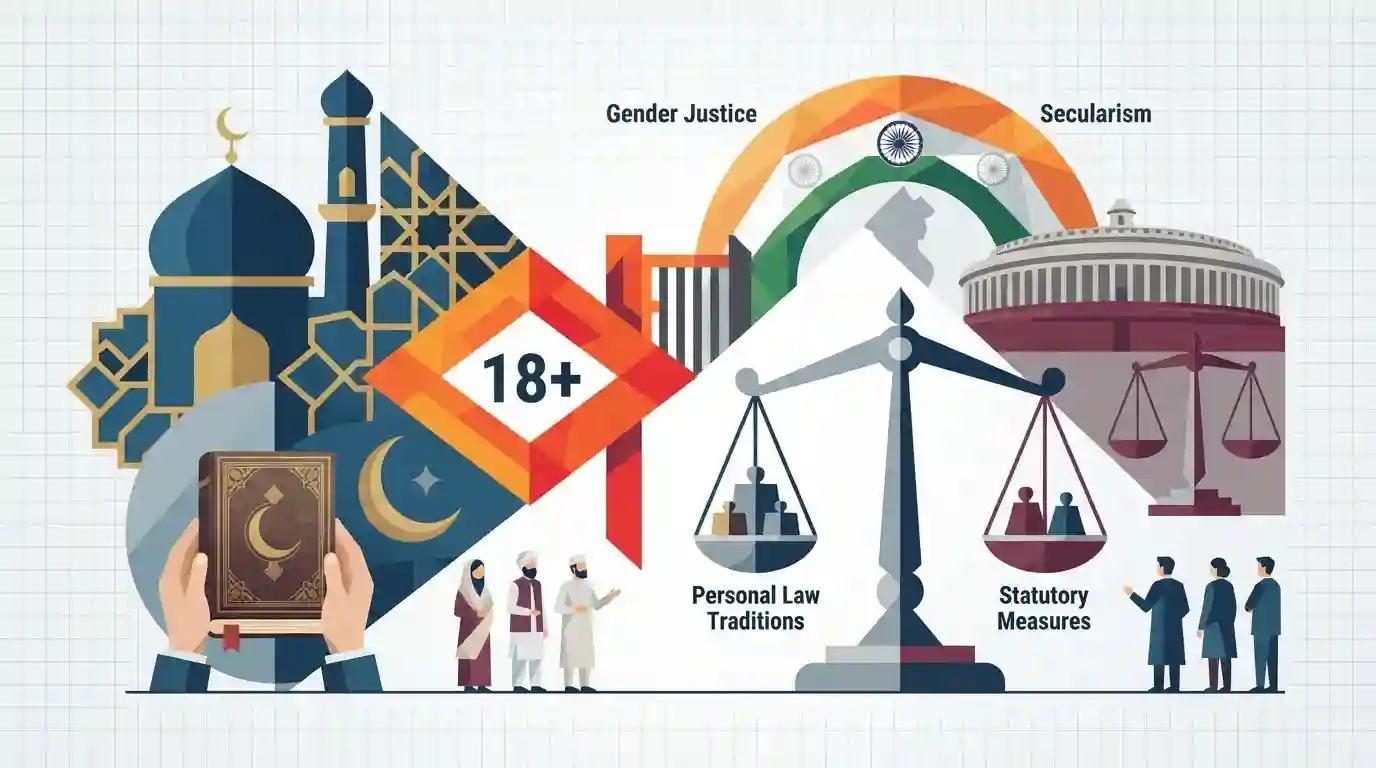
The article explores the legal complexities and jurisprudential nuances surrounding the age of marriage under Islamic law in India, balancing personal law traditions with statutory measures against child marriage and the broader constitutional imperatives of gender justice and secularism.
Key Points
- Examining the legal framework surrounding the age of marriage under Islamic jurisprudence and Indian secular statutory laws.
- Discussing the tensions between personal laws, fundamental rights, and gender justice in India.
- Analyzing the implications of statutory age limits on minority personal laws and child marriage prohibitions.
Important Terms
Prohibition of Child Marriage Act

A comprehensive central legislation enacted to prohibit the solemnization of child marriages across India, applying uniformly to all citizens irrespective of their religion and overriding conflicting personal laws.
UPSC context
UPSC GS Paper II: Social Justice & Vulnerable Sections. Tests policies, interventions, and statutory measures against child marriage.
Muslim Personal Law Shariat Application Act
A 1937 colonial-era legislation that codified the application of Islamic personal law (Shariat) to Muslims in India regarding matters like marriage, succession, and charities.
UPSC context
UPSC GS Paper I & II: Indian Society, History, and Polity (Personal Laws vs. Secular Statutory Frameworks).
Supreme Court of India
The highest constitutional court of India, tasked with judicial review, protecting fundamental rights, and arbitrating tensions between secular statutory rights and personal laws.
UPSC context
UPSC GS Paper II: Judiciary, Basic Structure, and Constitutional Governance.
Law Commission of India
An executive body established by the Government of India to recommend legal reforms, modernize statutes, and examine complex interactions between personal laws and gender justice.
UPSC context
UPSC GS Paper II: Statutory Bodies, Public Policy, and Legal Reforms.
Prelims Trap
Secular statutes like the PCMA automatically and uniformly override all personal law provisions regarding marriage age without requiring constitutional adjudication.
Aspirants often assume secular criminal statutes automatically repeal personal law provisions without a direct legislative declaration or specific judicial harmonization by the apex court.
Static Concepts Connected
What is the constitutional scope and limitation of Freedom of Conscience and Religion under Article 25?
- Constitutional Limits:: Subject to public order, morality, health, and other Fundamental Rights provisions (Part III).
- State Regulation:: State can regulate or restrict economic, financial, political, or secular activity associated with religious practice.
- Social Reform:: Provides for social welfare and reform, allowing the state to throw open Hindu religious institutions of a public character to all classes.
Cross-Topic Patterns
Article 25 vs Secular Criminal Legislation
The interface between religious freedom under Article 25 and secular criminal statutes is increasingly tested across personal laws, conversion laws, and marriage acts.
UCC and Personal Law Harmonization
Debates over Uniform Civil Code (Article 44) frequently intersect with minority personal law protections and the doctrine of harmonious construction.

Expect a statement-based prelims question on whether secular statutes like PCMA implicitly repeal or override personal law provisions on puberty.
Linked PYQs · 3
Linked PYQs · 3
- 2015MainsGS2
Discuss the possible factors that inhibit India from enacting for its citizens a uniform civil code as provided for in the Directive Principles of State Policy.
- 2023MainsGS2
Explain the constitutional perspectives of Gender Justice with the help of relevant Constitutional Provisions and case laws.
- 2019PrelimsGS1
Which Article of the Constitution of India safeguards one's right to marry the person of one's choice?
