Nobel Winning Insights on Economic Stabilisation Policies
Source:The Hindu ↗
આ શા માટે મહત્વનું છે
Crucial for understanding macroeconomic management, inflation targeting, and the institutional dynamics of monetary and fiscal policy coordination in developing economies like India.
સારાંશ
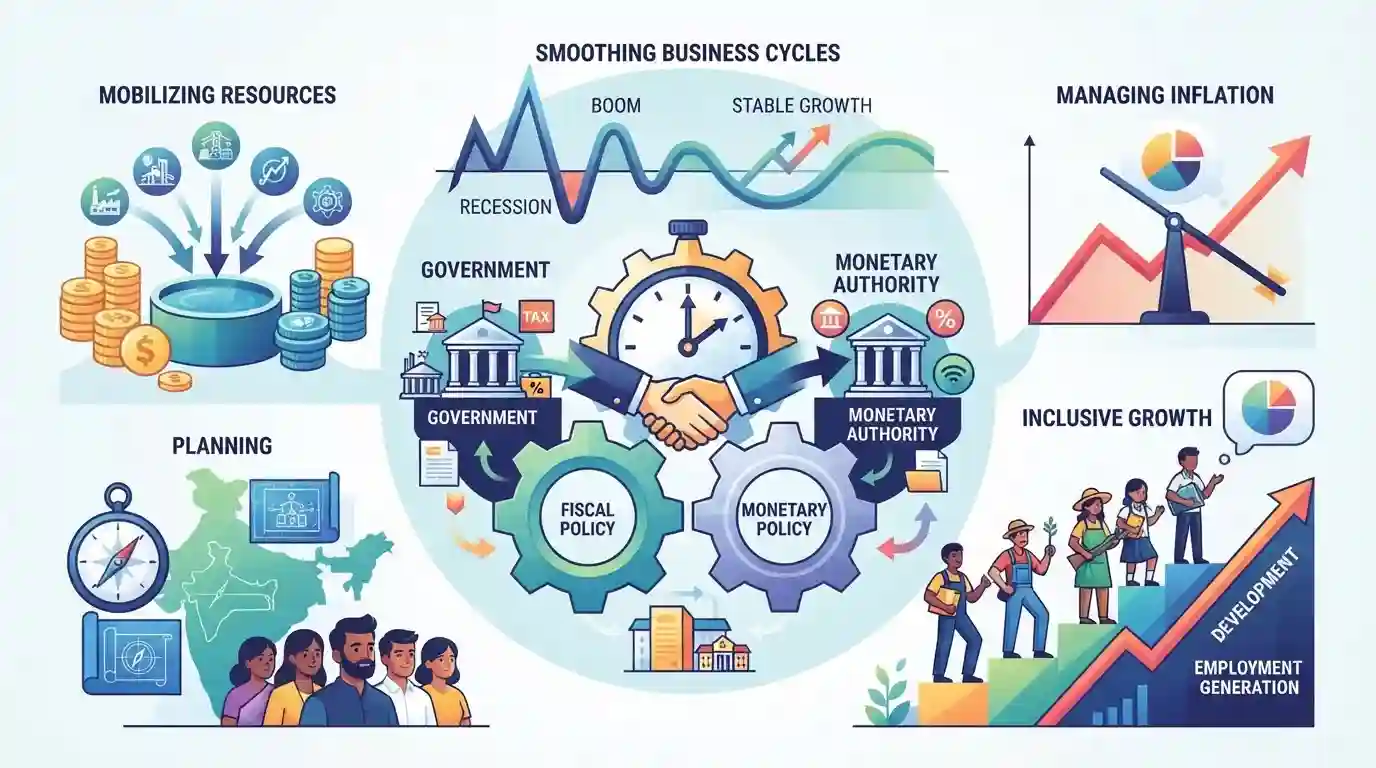
An analysis of the 2026 Nobel-winning economic insights detailing how governments and monetary authorities can effectively stabilise economies, manage inflation, and smooth out business cycles through coordinated fiscal and monetary interventions.
મુખ્ય મુદ્દા
- The 2026 Nobel-winning insights focus on how governments and central banks should design economic policies to stabilise economies during business cycles.
- The research highlights the interplay between fiscal policy and monetary policy in mitigating economic shocks and managing inflation.
- Emphasises structural factors, institutional credibility, and coordination in macroeconomic management.
મહત્વપૂર્ણ શબ્દો
Stabilization Policy

Measures implemented by governments and monetary authorities—using fiscal and monetary policy tools—to smooth out business cycles, manage inflation, and maintain economic stability during shocks.
UPSC context
UPSC CSE General Studies Paper III (Indian Economy): Core concept tested under economic planning, growth, development, inflation, and counter-cyclical fiscal/monetary management.
Microeconomic Foundations
Economic models constructed from the bottom up on the rational, optimal behavior of individual households and firms, rather than relying solely on aggregate macro statistical trends.
UPSC context
UPSC CSE General Studies Paper III (Economy): Evaluates modern macroeconomic analysis, policy formulation frameworks, and the theoretical basis of central banking.
New Keynesian Models
An advanced framework of Keynesian macroeconomics incorporating microeconomic foundations and rational expectations, widely used by central banks to design interest rate and stabilization policies.
UPSC context
UPSC CSE General Studies Paper III (Economy): Important for understanding modern inflation-targeting frameworks, monetary policy transmission mechanisms, and economic shocks.
સંલગ્ન સ્થિર ખ્યાલો
What is the distinction between monetary policy and fiscal policy in macroeconomic stabilization?
- Monetary Policy:: Controlled by central banks (RBI in India) via interest rates, liquidity management, and reserve requirements to control inflation.
- Fiscal Policy:: Managed by the central government through taxation, public expenditure, and borrowings to influence aggregate demand directly.
- Policy Coordination:: Effective stabilization requires close policy coordination, especially during supply shocks and high debt-to-GDP cycles.
આંતર-વિષય પેટર્ન
Monetary Policy + Institutional Credibility & Governance
Forward guidance and central bank communication rely heavily on institutional credibility, connecting macroeconomic stabilization to governance and administrative reforms.
Fiscal-Monetary Coordination + FRBM Framework
The interplay between fiscal and monetary interventions dictates debt sustainability and fiscal deficit management during economic downturns, linking macro theory to the Fiscal Responsibility and Budget Management (FRBM) framework.

Expect a statement-based Prelims question distinguishing central bank forward guidance from traditional repo-rate adjustments in macro stabilization.
સંલગ્ન PYQ · 1
સંલગ્ન PYQ · 1
- 2024MainsGS3
What are the causes of persistent high food inflation in India? Comment on the effectiveness of the monetary policy of the RBI to control this type of inflation.
