Historical Significance of the 1946 Royal Indian Navy Mutiny
Source:The Hindu ↗
Why It Matters
The RIN Mutiny is a foundational topic in the GS1 Modern History syllabus. It illustrates the critical contribution of the armed forces and the masses to the freedom struggle, contrasting sharply with the conservative approach of mainstream political leadership. Understanding this event helps aspirants analyze questions on communal harmony, the transfer of power, and whether the mutiny was the 'last nail in the coffin' of British rule.
Summary
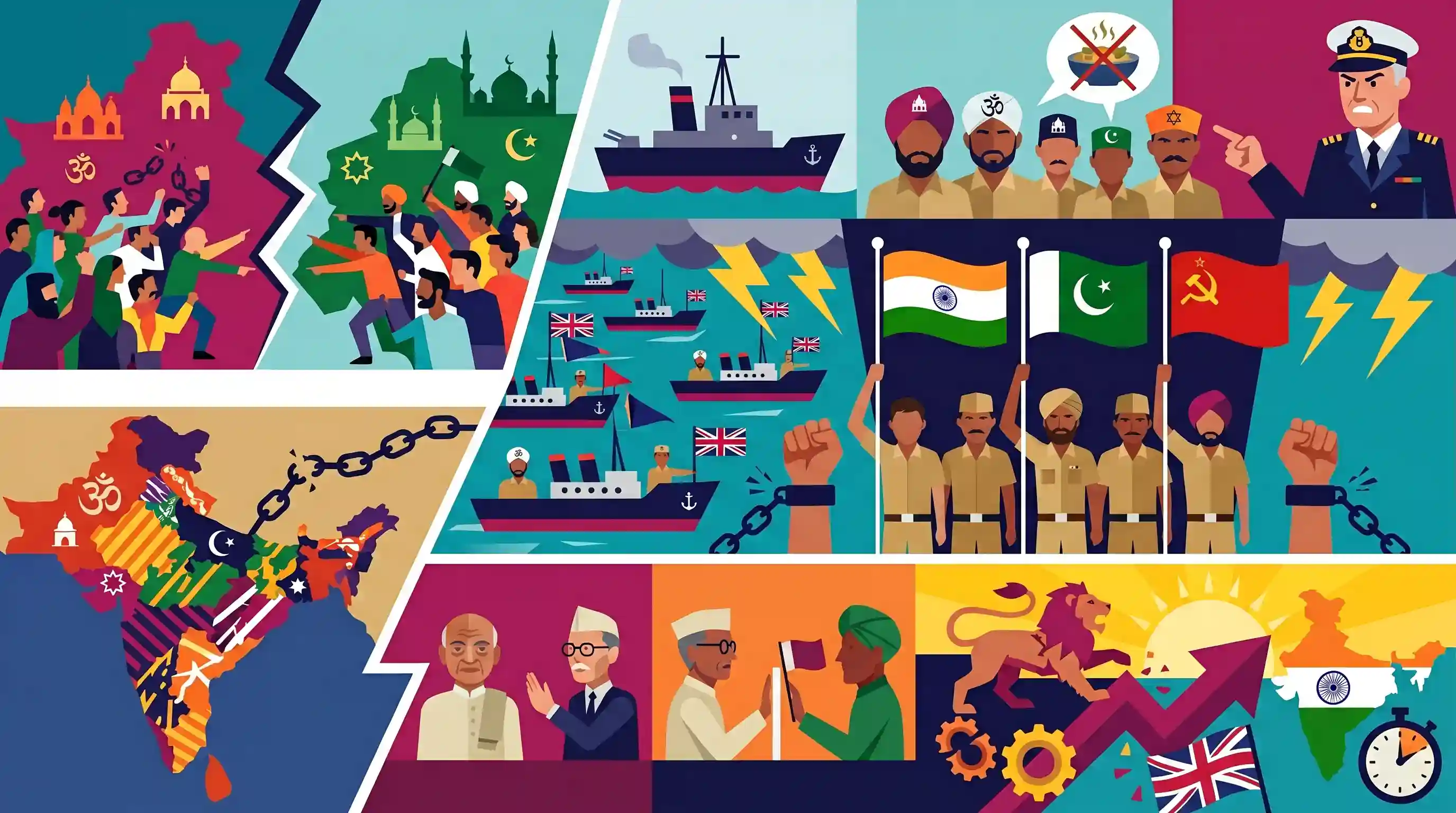
The article reflects on the 1946 Royal Indian Navy (RIN) mutiny, highlighting it as a remarkable episode of unity during the deeply fractured final phase of India's independence struggle. Erupting initially over poor food and racial abuse aboard HMIS Talwar in Bombay, the protest swiftly escalated into a massive anti-British uprising across naval ships and shore bases. The most defining feature of the revolt was the extraordinary solidarity exhibited by the ratings, who transcended religious divides to fly the flags of the Congress, Muslim League, and Communist Party side-by-side, even as the broader political climate was sharpening into intense communal polarisation. Although the established leadership—notably Sardar Patel and M.A. Jinnah—withheld support and brokered the mutineers' surrender, the uprising shattered the myth of the loyal Indian soldier. It delivered a critical blow to British colonial aspirations, accelerating the ultimate transfer of power.
Key Points
- The Royal Indian Navy (RIN) mutiny began on February 18, 1946, when naval ratings aboard HMIS Talwar in Bombay protested against substandard food and racial discrimination by British officers.
- The uprising rapidly expanded to over 70 ships and multiple shore establishments, garnering widespread civilian support, including general strikes (hartals) and violent clashes with British authorities in Bombay.
- In an extraordinary display of communal and political solidarity, the mutineers jointly hoisted the flags of the Congress, the Muslim League, and the Communist Party of India on the masts of naval ships.
- This cross-communal unity among the ratings and the working class stood in stark contrast to the rapidly sharpening political polarisation and communal tensions dividing India's leadership at the time.
- Despite the massive grassroots momentum, national leaders such as Sardar Patel and M.A. Jinnah disapproved of the undisciplined armed revolt and ultimately persuaded the mutineers to surrender to prevent further destruction.
- The mutiny served as a definitive turning point (the 'last nail in the coffin'), proving to the British government that it could no longer rely on the Indian armed forces to maintain its colonial grip on the subcontinent.
Important Terms
Royal Indian Navy (RIN) Mutiny

A massive 1946 uprising by naval ratings in Bombay against racial discrimination and poor food. It spread to 78 ships, symbolizing the end of British control over the Indian armed forces.
UPSC context
GS Paper I: Modern History. Tests understanding of the final phase of the freedom struggle and the erosion of British military authority.
HMIS Talwar
A naval signal school in Bombay where the 1946 mutiny originated on February 18. It became the epicenter of the revolt after ratings went on strike against racial abuse and substandard rations.
UPSC context
GS Paper I: Modern History (Prelims). Tests factual knowledge of the origins and triggers of the 1946 naval uprising.
Naval Central Strike Committee (NCSC)
A body elected by mutineers, led by M.S. Khan, to coordinate demands across naval establishments. It highlights the organized nature of the 1946 revolt despite lack of support from mainstream parties.
UPSC context
GS Paper I: Modern History. Examines the leadership structures and organized resistance within post-WWII revolutionary upsurges.
Communist Party of India (CPI)
A political organization that provided total support to the 1946 naval ratings, organizing strikes in Bombay and Calcutta. It stood apart from Congress and the Muslim League in endorsing the rebellion.
UPSC context
GS Paper I: Modern History. Tests knowledge of various ideological strands and their differing strategies during the independence movement.
Sardar Vallabhbhai Patel
A senior Congress leader who, alongside M.A. Jinnah, persuaded the RIN ratings to surrender on February 23, 1946. He prioritized a disciplined military for a stable, independent India.
UPSC context
GS Paper I: Modern History. Tests the role of key leaders in managing the transition to independence and maintaining institutional discipline.
Transfer of Power
The formal transition of political authority from British colonial rule to independent India. The 1946 naval revolt accelerated this process by proving the British could no longer rely on Indian soldiers.
UPSC context
GS Paper I: Modern History. Analyzes the factors, like the RIN revolt, that compelled the British withdrawal from India.
All India Muslim League
A major political party that, despite its flag being hoisted by mutineers, joined Congress in urging surrender. It feared the impact of military indiscipline on the future state of Pakistan.
UPSC context
GS Paper I: Modern History. Tests political dynamics and communal-nationalist tensions during the final years of the British Raj.
Prelims Trap
"The 1946 RIN Mutiny was actively supported by mainstream national leaders like Sardar Patel and M.A. Jinnah."
Aspirants assume all anti-British revolts had mainstream backing. However, Sardar Patel and M.A. Jinnah strongly condemned the mutiny's indiscipline and jointly persuaded the ratings to surrender.
Static Concepts Connected
What were the broader contextual causes of the 1946 RIN Mutiny?
- INA Trials: The Red Fort trials of INA soldiers created an explosive nationalist fervor, eroding military loyalty to the British Crown.
- Post-War Economy: High inflation, severe food rationing, and the massive demobilization of troops post-WWII created deep economic insecurity and resentment.
- Racial Discrimination: The initial spark was specifically poor-quality food and persistent racial abuse by British commanders aboard HMIS Talwar.
How did civilian and political groups respond to the RIN mutiny?
- Communist Mobilization: The Communist Party of India (CPI) actively mobilized massive sympathy strikes (hartals) by mill workers in Bombay and Karachi.
- Civilian Uprisings: Ordinary citizens engaged in pitched, violent battles with the police and British military, facing heavy casualties to support the ratings.
- Mainstream Reluctance: Unlike the CPI, mainstream INC and Muslim League leadership withheld support, fearing the armed revolt would derail power-transfer negotiations.
Cross-Topic Patterns
Subaltern vs Elite Nationalism
The mutiny exemplifies the growing divide between subaltern, working-class radicalism and the elite political leadership's preference for a negotiated, constitutional transfer of power in the 1940s.
Cabinet Mission's Immediate Catalyst
The British realization that they could no longer rely on the Indian armed forces to suppress revolts directly accelerated the arrival of the Cabinet Mission in March 1946.
Ephemeral Unity Before Partition
The simultaneous hoisting of Congress, League, and CPI flags represents a brief, class-based unity that starkly contrasts with the severe communal violence of Direct Action Day just months later.

Expect a multi-statement question linking the 1945-46 chronology (INA, RIN, Cabinet Mission) with the INC and Muslim League's opposition.
Linked PYQs · 4
Linked PYQs · 4
- 2011MainsGS1
Trace the salient sequence of events in the popular revolt that took place in February 1946 in the then 'Royal Indian Navy' and bring out its significance in the freedom struggle. Do you agree with the view that the sailors who took part in this revolt were some of the unsung heroes of the freedom struggle ?
- 2014MainsGS1
In what ways did the naval mutiny prove to be the last nail in the coffin of British colonial aspirations in India?
- 2017PrelimsGS1
With reference to Indian freedom struggle, consider the following events: 1. Mutiny in Royal Indian Navy 2. Quit India Movement launched 3. Second Round Table Conference What is the correct chronological sequence of the above events?
- 2019MainsGS1
Assess the role of British imperial power in complicating the process of transfer of power during the 1940s.
