Bipartisan Foreign Policy Consensus and Political Dynamics in India
Source:The Hindu ↗
Why It Matters
It illustrates the critical role of bipartisanship and political consensus in shaping India\'s foreign policy and managing national security crises. A united political front enhances India\'s diplomatic leverage and soft power on the global stage.
Summary
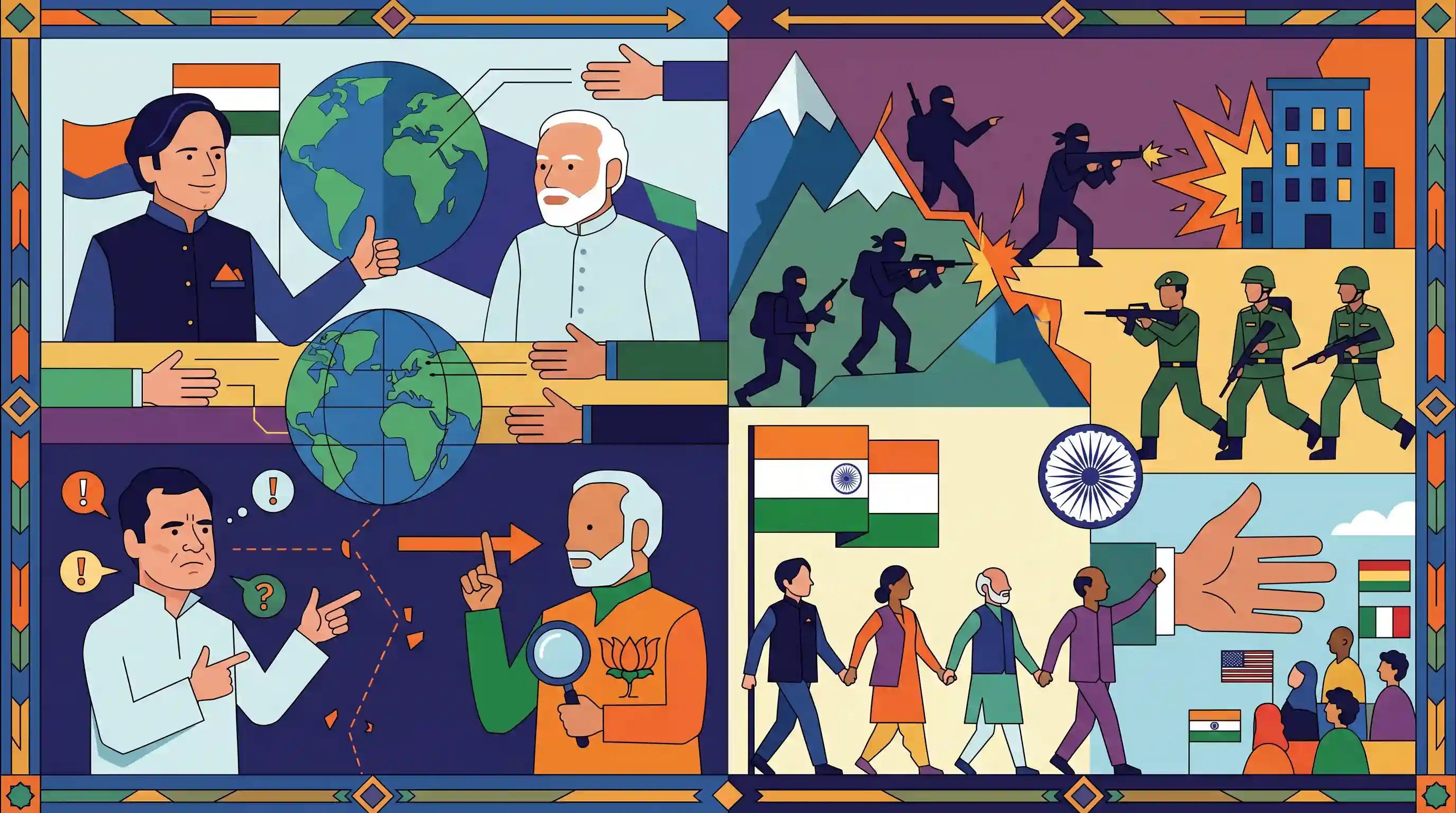
The BJP highlighted an opinion piece by Congress MP Shashi Tharoor that praised PM Narendra Modi\'s global diplomacy and the military\'s \'Operation Sindoor\' (following the Pahalgam terror attack), arguing that Tharoor\'s stance exposes Rahul Gandhi\'s constant criticism of the government\'s foreign policy. Tharoor\'s participation in a multi-party delegation to convey India\'s national resolve demonstrates a bipartisan approach to national security and international outreach, a contrast the ruling party is using to critique the main opposition leader.
Key Points
- Congress MP Shashi Tharoor authored an opinion piece praising PM Narendra Modi\'s energy and diplomatic outreach on the global stage.
- Tharoor commended the government\'s proactive communication and the multi-party delegation sent to articulate India\'s stance following the Pahalgam terror attack and the subsequent military response, \'Operation Sindoor\'.
- The BJP capitalized on Tharoor\'s praise to target Leader of the Opposition Rahul Gandhi, highlighting a contrast between Tharoor\'s bipartisan support and Gandhi\'s frequent criticism of the government\'s foreign policy.
- The incident underscores the significance of maintaining a bipartisan consensus on foreign policy and national security, presenting a united front internationally despite domestic political divides.
Important Terms
Operation Sindoor

A 2025 Indian military operation involving precision strikes on terror launchpads in Pakistan and PoJK. It was launched in response to the Pahalgam terror attack to dismantle terror infrastructure.
UPSC context
GS Paper III: Internal Security; GS Paper II: India and its Neighborhood. Tests understanding of India's retaliatory strategies and proactive defense posture.
Bipartisanship
A collaborative approach where opposing political parties align on key national interests, particularly foreign policy, to present a unified front on the global stage (e.g., 'political differences stop at the water's edge').
UPSC context
GS Paper II: Parliament and State Legislatures; International Relations. Relevant for the role of Opposition and parliamentary diplomacy.
Multi-party Delegation
A diplomatic mission consisting of representatives from various political parties. It is used to demonstrate domestic consensus and strengthen India's narrative in international forums during crises.
UPSC context
GS Paper II: Parliamentary Diplomacy. Tests knowledge of tools used by the executive to build international support through legislative engagement.
Cross-Border Terrorism
Terrorism originating in one country (Pakistan) and targeting another (India), often involving state-sponsored or non-state actors using neighboring territory as a base for attacks.
UPSC context
GS Paper III: Security Challenges and their Management in Border Areas. A core theme in Indo-Pak relations and internal security.
The Resistance Front (TRF)
A terror group active in Jammu and Kashmir, identified as an offshoot of Lashkar-e-Taiba. It claimed responsibility for the 2025 Pahalgam attack targeting civilians.
UPSC context
GS Paper III: Internal Security. Important for understanding evolving terror outfits and hybrid warfare in the J&K region.
National Resolve
The collective determination and unity shown by a nation's leadership and citizens in pursuing strategic goals or responding to security threats, ensuring a clear and firm international posture.
UPSC context
GS Paper IV: Ethics (National Interest); GS Paper II: IR. Relates to strategic culture and domestic unity in foreign policy.
Prelims Trap
"Operation Sindoor was an internal counter-insurgency operation led by CAPFs within Jammu & Kashmir."
Operation Sindoor was an external, non-contact precision military strike (using drones/missiles) targeting terror infrastructure across the border, not an internal CAPF counter-insurgency sweep.
Static Concepts Connected
How is bipartisan consensus on foreign policy structurally enabled in India?
- Parliamentary Committees: The Standing Committee on External Affairs involves MPs from across party lines to continuously scrutinize policies and build consensus.
- Multi-party Delegations: The Executive traditionally includes opposition leaders in UN or diplomatic delegations (e.g., A.B. Vajpayee at UNHRC in 1994) to project unified national resolve globally.
- All-Party Meetings: Conventionally convened by the Executive during security crises or military standoffs to confidentially brief opposition leaders and ensure a unified national stance.
What is 'Deterrence by Punishment' in India's counter-terrorism doctrine?
- Proactive Strikes: A doctrinal shift from 'strategic restraint' to imposing immediate, disproportionate costs on state sponsors of terrorism via surgical or precision strikes.
- Non-Contact Warfare: Utilizing assets like drones and standoff missiles to destroy terror infrastructure without exposing Indian troops to direct conventional combat or capture.
- Preemptive Dominance: Targeting the deep-state handlers and launchpads rather than merely fighting terrorists who have already infiltrated domestic territory.
Cross-Topic Patterns
Military strikes & Narrative Diplomacy
Kinetic actions like Operation Sindoor are now immediately followed by bipartisan global outreach to UNSC members to preempt diplomatic backlash and decisively isolate state sponsors of terror.
Political Ethics in Parliamentary Democracy
The tension between the Opposition's duty to scrutinize the Executive and the ethical imperative to present a united front during national security crises is a classic GS-4 applied ethics theme.

Expect a GS-3 Mains question linking non-contact warfare (Op Sindoor) with the GS-2 imperative of bipartisan narrative diplomacy.
Linked PYQs · 1
Linked PYQs · 1
- 2020MainsGS3
Analyze internal security threats and transborder crimes along Myanmar, Bangladesh and Pakistan borders including Line of Control (LoC). Also discuss the role played by various security forces in this regard.
